Flower or power? Campaigners fear lithium mine could kill rare plant / Photo: © AFP

 EU vows AI rules will protect Europeans. Will they?

 Myanmar leader to visit Malaysia after migrant returns begin
 Germany's AfD poised to preside over state assembly for first time
 Australia's opposition vows 'largest cut to immigration' in country's history

 Ready, set, snooze: Sleep-deprived Japanese compete for best-rested

 Falcons thump Saints 45-24 as New Orleans marks Katrina anniversary

 Tuvalu govt adviser says Australia overstepped in pre-COP visit

 Asian stocks mixed despite tech-led Wall St record
 Tens of thousands expected in Paris for high school protests

 AI borrowing binge rattles US markets

 Young Canadians sue government over alleged climate failures

 White Sox down Guardians to take 2-0 series lead

 NHL record-breaker Ovechkin says current season will be his last

 France roar back in Nations League as Italy beat Turkey

 Messi readies for final farewell in Argentina send-off

 Esposito seals Italy win over Turkey in Nations League

 Russia downplays plague reports as Trump offers US help

 Trump says US moved bombers from UK base after 'threats'

 Brazilian stocks surge to record after Bolsonaro election lead

 Leaders to visit Pacific atoll at frontline of climate change

 ICC gives more details about arrest warrants for Taliban ministers
 Nigeria's Tinubu confirms 32 dead after military plane crash

 'Reckless' AI firms can't control models, says whistleblower

 Switching on brain cells: the Nobel-winning science of optogenetics

 Quebec votes as separatist surge poses test for Canada PM

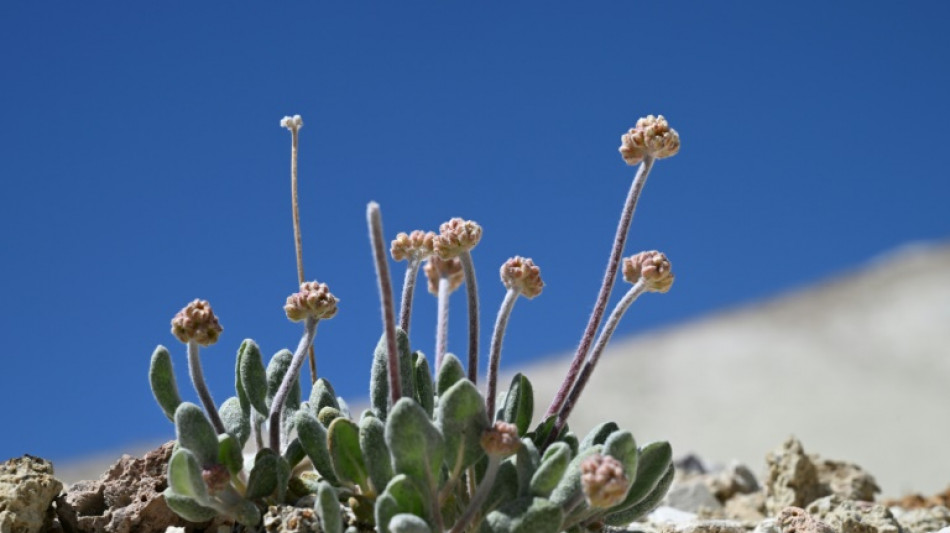
Delicate pink buds sway in the desert breeze, pregnant with yellow pompoms whose explosion will carpet the dusty corner of Nevada that is the only place on Earth where they exist.
Under their roots lie vast reserves of lithium, vital for the rechargeable electric car batteries that will reduce planet-heating pollution.
But campaigners fear the extraction of the precious metal could destroy the flower's tiny habitat.
"This mine is going to cause extinction," says Patrick Donnelly, an environmentalist who works at the Center for Biological Diversity, a non-governmental organization.
"They somehow claim that they're not harming the (plant). But can you imagine if someone built an open-pit mine 200 feet from your house? Wouldn't that affect your life profoundly?"
The plant in question is Tiehm's buckwheat.
There are only around 20,000 known specimens, growing in a few very specific places on a total surface area equivalent to around five soccer fields.
In 2022, the wildflower was classified as endangered by US federal authorities, with mining cited as a major threat to its survival.
The plant and the lithium reserve on which it grows embody one of the key challenges and contradictions of the global climate struggle: how much damage can we inflict on the natural world as we seek to halt or reverse the problems we have already created?
- 'Coexist' -
Bernard Rowe, boss of Australian miner Ioneer, which holds the mineral rights to the area, says the lithium produced at Rhyolite Ridge "will be sufficient to provide batteries for about 370,000 vehicles" a year.
"We'll do that year-on-year for 26 years," he said.
Those nearly 10 million vehicles will go a long way towards meeting the goal President Joe Biden has set of cutting down the nation's fleet of gas-guzzlers as a way to slash US production of planet-warming pollutants.
So-called zero-emission cars make up around 7.5 percent of new vehicle sales in the United States today -- more than double the percentage just a few years earlier.
In California, the figure is more than 20 percent.
And while expansion in the sector has slowed, the category remains the fastest-growing, according to Kelley Blue Book.
And it's not only in the United States: Global demand for lithium will increase five to seven times by 2030, according to the International Energy Agency.
The difficulty for US manufacturers is that much of the world's lithium supply is dominated by strategic rival China, as well as Australia and Chile.
"The United States has very, very little domestic production," said Rowe.
"So it's important to develop a domestic supply chain to allow for that energy transition, and Rhyolite Ridge will be an integral part of that."
Ioneer's plans show that over the years the mine is in operation -- it is projected to start producing lithium in late 2027 -- around a fifth of the plant's habitat will be directly affected.
But the company, which has spent $2.5 million researching the plant, says mining will not affect its survival; it is already growing well in greenhouses and biologists think it can be replanted.
"We're very confident that the mine and Tiehm's buckwheat can coexist," Rowe said.
- 'Greenwashing' -
Donnelly counters that Ioneer is "basically greenwashing extinction."
"They're saying. 'We're going to save this plant,' when actually they are going to send it to its doom," he said.
Under the company's plans, the strip mine will use hundreds of trucks, which Donnelly says will raise clouds of dust that will affect photosynthesis and harm the insects that pollinate the plants.
Ioneer says it has already planned mitigation methods, like dust curtains, and keeping the roads wet.
Still, Donnelly says, why not just move the mine? But Rowe counters that it's not as simple as just digging somewhere else.
Ioneer has invested $170 million since 2016 to demonstrate the feasibility of this site, which it believes is one of the best around.
"Many of these other deposits haven't had that amount of work, so they're not viable alternatives to a project like this," he said.
The US Department of Energy has offered Ioneer a $700 million loan for the project, if the Bureau of Land Management signs off on an operating permit.
Donnelly insists the issue is not just the future of one obscure wildflower, but rather just one example of large-scale biodiversity loss that is threatening millions of plants and animals.
"If we solve the climate crisis, but we drive everything extinct while we do it, we're still going to lose our world," he said.
L.Maurer--VB