Govts, tech firms vow to cooperate against AI risks at Seoul summit / Photo: © AFP

 EU vows AI rules will protect Europeans. Will they?

 Myanmar leader to visit Malaysia after migrant returns begin

 Germany's AfD poised to preside over state assembly for first time
 Australia's opposition vows 'largest cut to immigration' in country's history

 Ready, set, snooze: Sleep-deprived Japanese compete for best-rested

 Falcons thump Saints 45-24 as New Orleans marks Katrina anniversary

 Tuvalu govt adviser says Australia overstepped in pre-COP visit
 Asian stocks mixed despite tech-led Wall St record
 Tens of thousands expected in Paris for high school protests

 AI borrowing binge rattles US markets

 Young Canadians sue government over alleged climate failures

 White Sox down Guardians to take 2-0 series lead

 NHL record-breaker Ovechkin says current season will be his last

 France roar back in Nations League as Italy beat Turkey
 Messi readies for final farewell in Argentina send-off
 Esposito seals Italy win over Turkey in Nations League

 Russia downplays plague reports as Trump offers US help

 Trump says US moved bombers from UK base after 'threats'

 Brazilian stocks surge to record after Bolsonaro election lead

 Leaders to visit Pacific atoll at frontline of climate change

 ICC gives more details about arrest warrants for Taliban ministers

 Nigeria's Tinubu confirms 32 dead after military plane crash

 'Reckless' AI firms can't control models, says whistleblower

 Switching on brain cells: the Nobel-winning science of optogenetics
 Quebec votes as separatist surge poses test for Canada PM

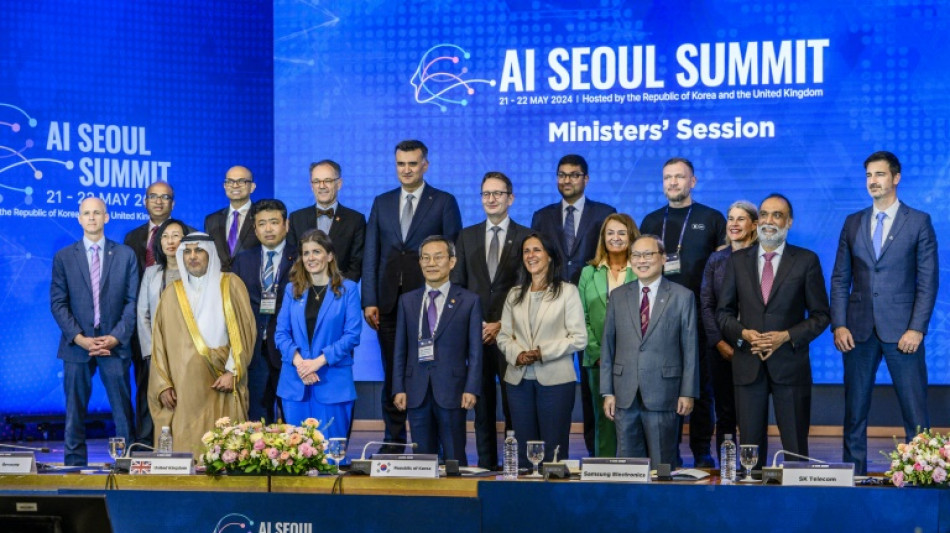
More than a dozen countries and some of the world's biggest tech firms pledged on Wednesday to cooperate against the potential dangers of artificial intelligence, including its ability to dodge human control, as they wrapped up a global summit in Seoul.
AI safety was front and centre of the agenda at the two-day gathering. In the latest declaration, more than two dozen countries including the United States and France agreed to work together against threats from cutting-edge AI, including "severe risks".
Such risks could include an AI system helping "non-state actors in advancing the development, production, acquisition or use of chemical or biological weapons", said a joint statement from the nations.
These dangers also include an AI model that could potentially "evade human oversight, including through safeguard circumvention, manipulation and deception, or autonomous replication and adaptation", they added.
The ministers' statement followed a commitment on Tuesday by some of the biggest AI companies, including ChatGPT maker OpenAI and Google DeepMind, to share how they assess the risks of their tech, including what is considered "intolerable".
The 16 tech firms also committed to not deploying a system where they cannot keep risks under those limits.
The Seoul summit, co-hosted by South Korea and Britain, was organised to build on the consensus reached at the inaugural AI safety summit last year.
"As the pace of AI development accelerates, we must match that speed... if we are to grip the risks," UK technology secretary Michelle Donelan said.
"Simultaneously, we must turn our attention to risk mitigation outside these models, ensuring that society as a whole becomes resilient to the risks posed by AI."
The summit also saw a separate commitment -- the so-called Seoul AI Business Pledge -- from a group of tech companies including South Korea's Samsung Electronics and US titan IBM, to develop AI responsibly.
AI is "a tool in the hands of humans. And now is our moment to decide how we're going to use it as a society, as companies, as governments," Christina Montgomery, IBM's Chief Privacy and Trust Officer, told AFP on the sidelines of the summit.
"Anything can be misused, including AI technology," she added. "We need to put guardrails in place, we need to put protections in place, we need to think about how we're going to use it in the future."
- Seeking consensus -
AI's proponents have heralded it as a breakthrough that will improve lives and businesses around the world, especially after the stratospheric success of ChatGPT.
However, critics, rights activists and governments have warned that the technology can be misused in a wide variety of ways, including election manipulation through AI-generated disinformation such as "deepfake" pictures and videos of politicians.
Many have called for international standards to govern the development and use of AI. But experts at the Seoul summit warned that AI poses a huge challenge to regulators because it is rapidly developing.
"Dealing with AI, I expect to be one of the biggest challenges that governments all across the world will have over the next couple of decades," said Markus Anderljung, head of policy at the UK-based non-profit Centre for the Governance of AI.
Jack Clark, co-founder of the AI startup Anthropic, said consensus on AI safety cannot be left to tech firms alone, and that government and academic experts are needed in the conversation.
"At this summit, I've actually been asking every single person I met with: What's safety to you? And I've had a different answer from each person," Clark told reporters. "And I think that illustrates the problem."
"You aren't going to arrive at consensus by the companies alone, and if you did, I doubt it would be the correct one."
Also on the agenda in Seoul was ensuring that AI is inclusive and open to all.
It is not just the "runaway AI" of science fiction nightmares that is a huge concern, but also inequality, said Rumman Chowdhury, an AI ethics expert who leads the non-profit AI auditor Humane Intelligence.
"All AI is just built, developed and the profits reaped (by) very, very few people and organisations," she told AFP.
People in developing countries such as India "are often the staff that does the clean-up. They're the data annotators, they're the content moderators. They're scrubbing the ground so that everybody else can walk on pristine territory".
S.Spengler--VB