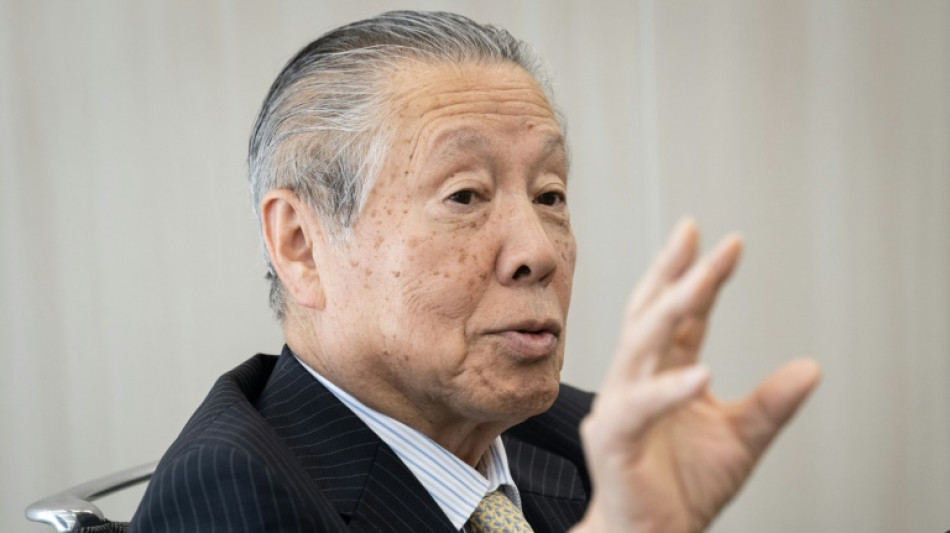
Rapidus 'last opportunity' to put Japan back on global chip map / Photo: © AFP

 Ready, set, snooze: Sleep-deprived Japanese compete for best-rested

 Falcons thump Saints 45-24 as New Orleans marks Katrina anniversary

 Tuvalu govt adviser says Australia overstepped in pre-COP visit

 Asian stocks mixed despite tech-led Wall St record

 Tens of thousands expected in Paris for high school protests

 AI borrowing binge rattles US markets

 Young Canadians sue government over alleged climate failures

 White Sox down Guardians to take 2-0 series lead

 NHL record-breaker Ovechkin says current season will be his last

 France roar back in Nations League as Italy beat Turkey

 Messi readies for final farewell in Argentina send-off

 Esposito seals Italy win over Turkey in Nations League

 Russia downplays plague reports as Trump offers US help

 Trump says US moved bombers from UK base after 'threats'

 Brazilian stocks surge to record after Bolsonaro election lead

 Leaders to visit Pacific atoll at frontline of climate change

 ICC gives more details about arrest warrants for Taliban ministers

 Nigeria's Tinubu confirms 32 dead after military plane crash

 'Reckless' AI firms can't control models, says whistleblower

 Switching on brain cells: the Nobel-winning science of optogenetics

 Quebec votes as separatist surge poses test for Canada PM

 Euro slides as concerns about French debt mount

 Former Trump press secretary Leavitt joins Fox News

 Djokovic advances to China Open final as Medvedev out for hitting fan with ball

 Disgraced former US House speaker dies at 84

Japan's Rapidus project that brings together some of the world's biggest companies is the "last opportunity" to put the country's once-dominant semiconductor sector back on the global map, its chairman warned.
And, while the company has the financial firepower of the government behind it, Tetsuro Higashi told AFP in an interview that he was under illusions about the challenges ahead.
"The entire world is becoming digitised. It is becoming crucially important for Japan to build a very strong digital technology industry," said Higashi, an industry veteran and ex-president of Tokyo Electron, a major producer of tools to make chips.
"Japan is more than a decade behind others. It will require enormous money just to catch up."
Tokyo has promised up to four trillion yen ($25.7 billion) in subsidies to help triple sales of domestically produced chips to more than 15 trillion yen by 2030.
Taiwan Semiconductor Manufacturing Company (TSMC), which makes half the world's chips, has already benefitted, with the giant opening a new fabrication plant in Japan in February and planning a second.
The government has committed 920 billion yen to Rapidus, a joint venture involving Sony, Toyota, IBM and others, which is now building its fab in the Hokkaido region.
The aim is to mass-produce logic chips in Japan from 2027 using two-nanometre technology, the next frontier in chips containing an even more dizzying number of miniscule transistors.
TSMC and others are already racing to reach full production for their 2nm chips, which will be vital in powering the mooted revolution in artificial intelligence (AI).
But Higashi is confident that Rapidus can do it -- and makes no bones about what's at stake.
"This could be the last opportunity for Japan" to relaunch a competitive semiconductor-making industry, he said.
- Exploding demand -
By around 2027, global demand for advanced, energy-efficient semiconductors is expected to explode as AI and digital technologies further enter people's daily lives, Higashi said.
US tech firms like Google and OpenAI are also investing heavily in Japan in the hope that the country, once a world-beating technology pioneer, can regain its edge with AI.
The CEO of Nvidia, whose chips currently dominate in AI, said the firm would "do our very, very best" to supply Japan.
But it is clear that it must rely less on foreign supply, Higashi said, adding: "We are becoming a digital society. All kinds of industries in Japan will rely immensely on semiconductors."
Japan was a big player in the semiconductor industry in the 1980s through early 1990s, commanding a half of the global market with the likes of NEC and Toshiba leading the way.
Now it accounts for about 10 percent of the market, although it remains a leader in chip-making equipment and materials, with firms such as Higashi's former employer Tokyo Electron.
But Japan's aims also have a geopolitical angle as it, along with the United States and others seek to reduce their reliance on TSMC's fabs in Taiwan because of fears of a Chinese invasion.
At the same time, Washington is seeking to restrict the supply of next-generation chips to China to hold up Beijing's AI drive.
While avoiding directly discussing geopolitics, Higashi said he expected firms in friendly nations, like Japan and the United States, to share tasks to maintain international supply chains.
"In Japan, like the United States, there are many major production equipment firms and materials companies. They are dealing with customers that require very advanced products," he said.
"Those production-equipment makers and materials firms are providing their support to us."
And its success should inspire young engineers to further growth Japan's chip sector, he added.
"We must create new semiconductors and inspire people that we can create a new world," he said.
L.Meier--VB