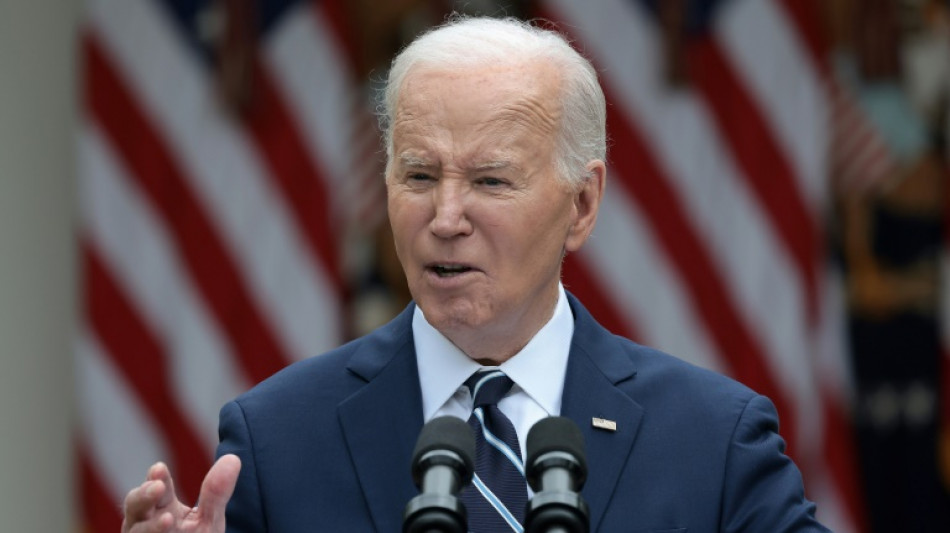
What will be the repercussions of Biden's new China tariffs? / Photo: © GETTY IMAGES NORTH AMERICA/AFP/File

 Ready, set, snooze: Sleep-deprived Japanese compete for best-rested

 Falcons thump Saints 45-24 as New Orleans marks Katrina anniversary

 Tuvalu govt adviser says Australia overstepped in pre-COP visit

 Asian stocks mixed despite tech-led Wall St record
 Tens of thousands expected in Paris for high school protests

 AI borrowing binge rattles US markets

 Young Canadians sue government over alleged climate failures

 White Sox down Guardians to take 2-0 series lead

 NHL record-breaker Ovechkin says current season will be his last

 France roar back in Nations League as Italy beat Turkey
 Messi readies for final farewell in Argentina send-off
 Esposito seals Italy win over Turkey in Nations League

 Russia downplays plague reports as Trump offers US help

 Trump says US moved bombers from UK base after 'threats'

 Brazilian stocks surge to record after Bolsonaro election lead

 Leaders to visit Pacific atoll at frontline of climate change

 ICC gives more details about arrest warrants for Taliban ministers

 Nigeria's Tinubu confirms 32 dead after military plane crash

 'Reckless' AI firms can't control models, says whistleblower
 Switching on brain cells: the Nobel-winning science of optogenetics
 Quebec votes as separatist surge poses test for Canada PM

 Euro slides as concerns about French debt mount

 Former Trump press secretary Leavitt joins Fox News

 Djokovic advances to China Open final as Medvedev out for hitting fan with ball
 Disgraced former US House speaker dies at 84

US President Joe Biden unveiled steep tariff hikes on Chinese green tech this week, hitting imports like electric vehicles, chips and solar cells -- and adding stress to US-China ties.
But despite targeting $18 billion in imports across new and already targeted sectors, analysts do not expect a major economic impact, assuming Beijing does not retaliate significantly.
So what will be the repercussions of his moves?
- Will this hit the US economy? -
Biden's EV, semiconductor and battery tariffs "will not have a noticeable impact on US inflation or GDP," said economist Ryan Sweet at Oxford Economics.
There were already levies on Chinese EVs, causing automakers to avoid the US market -- though the new increase takes the tariff level from 25 percent to 100 percent.
"Last year, China exported around $400 million in battery EVs to the US while the European Union exported nearly $7.5 billion to the US," Sweet said.
Oxford's model assumes China does not retaliate significantly, given the current weaknesses seen in the world's second largest economy, he said.
Tianlei Huang, research fellow at the Peterson Institute for International Economics, believes tariffs could hurt some Chinese companies' sales and profitability.
But "the direct impact of those tariff hikes is actually quite limited," he told a virtual event. "It's more of a signal."
- What about green tech prices? -
More restrictive trade policies can cause low-carbon technologies to be less competitive against rivals like combustion engine vehicles, according to research from the Center for Strategic and International Studies (CSIS).
But research scenarios found that "rising trade frictions didn't overcome the still-falling costs of clean energy," said Joseph Majkut, director of the energy security and climate change program at the think tank.
US policies like the Inflation Reduction Act, which puts funding towards supporting the green transition, will still support the creation of domestic content too, he added.
- Will China strike back? -
Beijing has warned it would "take resolute measures" to defend its interests.
Policymakers could target industries in US swing states to impact Biden's election chances, or opt for a symbolic retaliation, the Trivium China policy analysis group said in a newsletter.
China's response, or lack thereof, will be telling in terms of how officials plan to address acts they deem as "economic suppression" moving forward, Trivium added.
"The challenge for the Chinese is, how do they do it in a way that doesn't freak out foreign businesses?" said Bill Bishop, who publishes the Sinocism newsletter.
With Beijing previously announcing export controls on two rare metals essential for the manufacture of semiconductors, action on critical minerals remains possible, he said.
Beijing-based economist Mei Xinyu expects the response to be targeted, and analysts generally do not expect tit-for-tat actions.
China does not import American EVs while "Beijing and Shanghai have been very supportive of the one major US EV player, Tesla, in the China market," said Paul Triolo, partner for China at Albright Stonebridge Group.
- Could this sway US allies? -
Biden's move "may accelerate pressure on the EU to adopt a similarly strong posture in its own China tariff review, which is forthcoming," said CSIS senior fellow Emily Benson.
The European Union launched an inquiry into Chinese electric car subsidies last year, fearing a threat to Europe's auto industry. This could culminate in a tariff hike from the current 10 percent.
For now, the leaders of Germany and Sweden have expressed reservations about new European tariffs on Chinese EVs.
But if multiple major developed economies are on board with a tariff approach, China will likely be concerned from both an economic and propaganda standpoint, Bishop told AFP.
US tariffs may also "force Brussels' hand" as it could divert trade to Europe, said Atlantic Council senior fellow Joseph Webster in an analysis.
"Brussels will have to act quickly, either to put its own tariffs in place or to accept a flood of Chinese-made products," Webster added.
- Does this worsen US-China ties? -
Analysts said the latest tariffs probably didn't come as a surprise to China, given the signals from US officials ahead of the announcement.
But Bishop noted that the underlying problems between Washington and Beijing run deep -- and that while both sides are talking again, their behaviors do not appear to have changed.
"These new actions just chip away at that very, very thin facade of stability," he said.
N.Schaad--VB