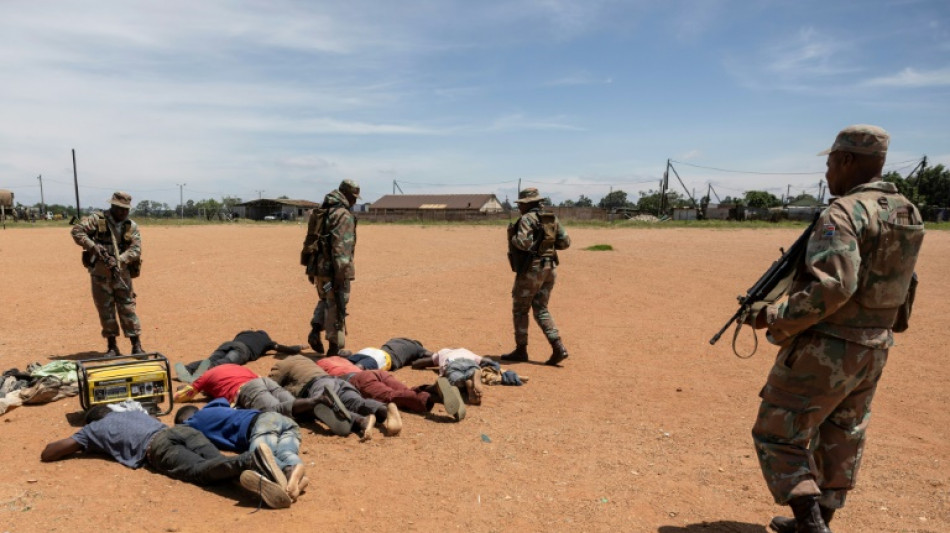
S. African communities terrorised by gold mining gangs / Photo: © AFP/File

 American Nobel laureate in medicine hopes to illuminate the brain
 Trump approves firing squad for convicted US military base shooter
 Grappling with 'homework scams,' US universities shun AI detectors
 Separatists win Quebec election in test for Canada PM

 Leaders visit Pacific atoll at frontline of climate change

 Yemen's Houthis claim striking Riyadh airport, other Saudi sites

 Best-selling British author Jeffrey Archer dies aged 86

 Military plane crash kills 32 in Nigeria

 Olise powers France to win over Belgium in Nations League

 High-flying Blazy turns to birdlife at Chanel

 Riyadh's allies pledge troops as Yemen, Saudi Arabia attack Houthis

 Clashes erupt outside Kosovo parliament over war crimes court

 Milan's Saelemaekers suffers ankle setback, faces lengthy spell out
 Rubio arrives in Iceland to push for greater US presence in Arctic
 Putin allows Italy's UniCredit to sell part of Russian business
 Djokovic into China Open final as Medvedev out for hitting fan with ball

 ICC unseals arrest warrants for Taliban education ministers
 Modric hopes fans back Croatia against Spain after England shame

 Bolsonaro rides right-wing surge into Brazil's election runoff

 Turkey blocks X account of British reporter

 Ukraine says using AI robot guns to shoot down new Russian drones
 At Oct 7 memorial, Netanyahu says will be no Hamas rule in Gaza
 Ukraine blames Russia for deadly sinking of Turkish ship in Black Sea

 UN rights council slams Taliban's 'oppression' of women
 Norway eyes partial ban of smart glasses
Walking between the corrugated iron shacks of the informal settlement west of Johannesburg she calls home, Lutho Makheyi points out trenches filled by dirty rainwater holing the unpaved streets.
These are the scars left by illegal gold mining, a business she blames for the high levels of violent crime that haunt South Africa ahead of the tightest general election in decades.
"You never know when a gunshot can go off or if you're going to be raped," Makheyi, 21, said, adding that she hoped the vote would bring about change.
"You never know if you'll be alive tomorrow."
The Johannesburg region is dotted with slag heaps, shafts and deep trenches left by generations of miners, whose arrival in a gold rush in the 1880s led to the city's birth.
Thousands of illegal miners commonly known as "zama zamas" -- "those who try" in the Zulu language -- operate in the area, scavenging, recycling and reworking leftover gold ore.
Access to the old mines is often controlled by gangs that sometimes battle for control.
Makheyi's informal settlement, Zamimpilo, sits atop one such deposit.
- 'Duck for cover' -
Here, ordinary families on years-long government housing waiting lists live side by side with miners -- both groups constantly fearing for their lives.
Nobukho Novokoza said her 17-month-old daughter "knows when to duck for cover if gunshots go off".
"'Mom get down'," she says when loud bangs ring, according to her mother.
Novokoza, 38, is among the many South Africans who have lost faith in politics.
On May 29, she will not vote, she said.
The ruling African National Congress (ANC) is credited with winning freedom for all South Africans after decades of apartheid and lifting millions from abject poverty.
But, 30 years after the country's first democratic elections, many voters are fed up with high unemployment, inequality and rampant crime.
The ANC is widely expected to lose its outright parliamentary majority for the first time.
In Zamimpilo, large pigs feed on waste at a central dumping site as children play nearby.
Residents look on as a miner with a head torch walks past covered in sand.
Illegal mines are seen as a hotbed for crime in a country where more than 80 people are murdered every day.
In 2022, the brutal gang rape of eight women who were filming a music video near a mining site shocked the nation.
The government has vowed to wage war on illegal miners, who authorities say are often foreign nationals.
Thousands have been arrested since a crackdown last year.
As AFP visited Zamimpilo, a raid was ongoing but residents claimed most zama zamas had been tipped off.
Police officers casually strolled through the settlement.
The swoop followed a visit late last year by the police minister after several people were killed in a suspected gang shooting.
"They deployed police here for three months but still the illegal mining continued... under their nose," said Nokuzola Qwayede, 42, a Zamimpilo community leader. "Nothing has been done."
Authorities say there are more than 6,000 derelict and ownerless mines in South Africa.
The government has committed to rehabilitating them and closing abandoned shafts.
But experts say corruption makes that harder.
"Our... intelligence says that some politicians are running the show," said Dale McKinley, a senior researcher at the Development Studies department at the University of Johannesburg.
Next to Zamimpilo is Riverlea, a working-class suburb.
There, religious leader Anthony Sherman would like to see Zamimpilo gone completely.
Men in big-brimmed hats and fancy cars parked near shafts as they appear to collect goods or money are a common sight, he said.
"The full solution is going to be the removal of Zamimpilo," he said. "We're going to eliminate immediately the running battles" and "secure the people".
- Mental scars -
Yet some illegal miners say they also live in fear, with gangs adding to the dangers of an infamously perilous work.
"So many people die there in front of me... I'm scared," said a miner who preferred not to give his real name and whom AFP agreed to call Thobani Mdunge.
Sporting a dirty torn blue jacket and sweatpants, a body full of scars and an open wound on his lower leg, he had just resurfaced after a week to restock on food.
Mining "disturbs my mental health", he said.
Gangs sometimes hold miners hostage underground and rob them.
Mdunge has to pay protection money to criminals who kill those who do not cough up.
Yet, with little prospect of legal employment, he has no intention of quitting.
He and his colleagues recently unearthed gold worth R40,000 (about $2,100) -- a hefty sum for some.
In South Africa, more than three million people are classified as "multidimensionally poor", lacking access to healthcare, education, water and adequate sanitation.
"For now, I won't stop this job," Mdunge shrugged.
T.Zimmermann--VB