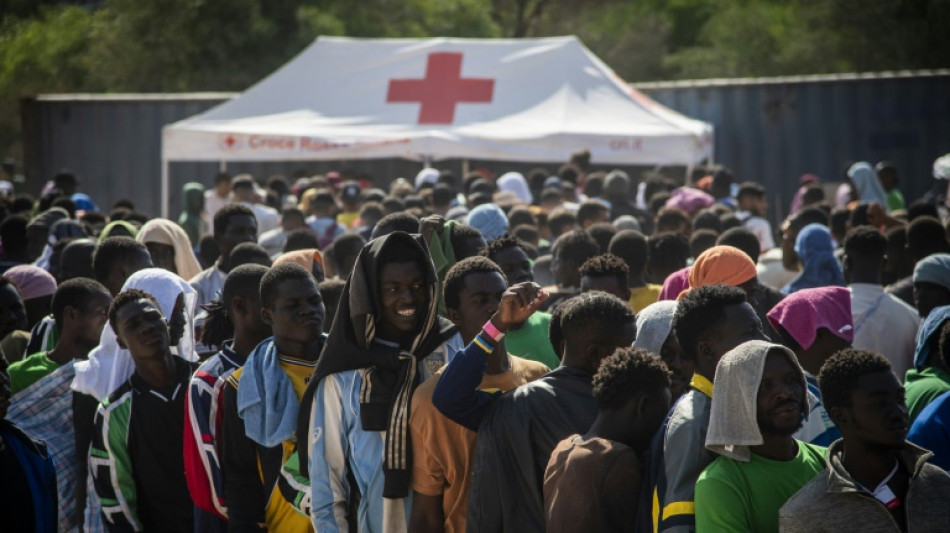
EU signs off on asylum overhaul / Photo: © AFP/File

 American Nobel laureate in medicine hopes to illuminate the brain

 Trump approves firing squad for convicted US military base shooter

 Grappling with 'homework scams,' US universities shun AI detectors

 Separatists win Quebec election in test for Canada PM

 Leaders visit Pacific atoll at frontline of climate change

 Yemen's Houthis claim striking Riyadh airport, other Saudi sites

 Best-selling British author Jeffrey Archer dies aged 86

 Military plane crash kills 32 in Nigeria

 Olise powers France to win over Belgium in Nations League

 High-flying Blazy turns to birdlife at Chanel

 Riyadh's allies pledge troops as Yemen, Saudi Arabia attack Houthis

 Clashes erupt outside Kosovo parliament over war crimes court

 Milan's Saelemaekers suffers ankle setback, faces lengthy spell out

 Rubio arrives in Iceland to push for greater US presence in Arctic

 Putin allows Italy's UniCredit to sell part of Russian business
 Djokovic into China Open final as Medvedev out for hitting fan with ball

 ICC unseals arrest warrants for Taliban education ministers

 Modric hopes fans back Croatia against Spain after England shame

 Bolsonaro rides right-wing surge into Brazil's election runoff

 Turkey blocks X account of British reporter

 Ukraine says using AI robot guns to shoot down new Russian drones

 At Oct 7 memorial, Netanyahu says will be no Hamas rule in Gaza

 Ukraine blames Russia for deadly sinking of Turkish ship in Black Sea

 UN rights council slams Taliban's 'oppression' of women

 Norway eyes partial ban of smart glasses

The EU on Tuesday gave the final green light to a landmark overhaul of its migration and asylum policies that will see hardened borders and responsibility shared among member states.
A majority of European Union countries backed the reform's 10 pieces of legislation, ensuring its passage despite opposition from Hungary and Poland.
The overhaul comes into effect from 2026.
"These new rules will make the European asylum system more effective and increase solidarity between member states," said Belgium's asylum and migration minister Nicole de Moor, whose country currently holds the EU presidency.
German Interior Minister Nancy Faeser said the reform still helps people fleeing persecution, while making "clear that those who do not need this protection cannot come to Germany or must leave Germany much more quickly".
The adoption comes a month ahead of EU elections expected to see a surge by far-right parties campaigning on the need to crack down on irregular migration.
The overhaul of the European Union's asylum rules took nearly a decade of wrangling.
Poland and Hungary remain fiercely against the changes, mainly because of a new bloc-wide "solidarity mechanism" under which they must either take in thousands of asylum seekers or pay the nations that do.
But an overwhelming number of EU countries backed all 10 acts, resulting in its adoption.
The overhaul, spurred by a massive inflow of irregular migrants in 2015, many from war-torn Syria and Afghanistan, has drawn criticism from migrant rights charities as hardening the buttresses of "Fortress Europe".
It establishes new border centres that will hold irregular migrants while their asylum requests are vetted. Deportations of those deemed inadmissible will be accelerated.
Proponents of the pact had pushed hard to force it over the finish line ahead of the EU-wide elections in June that could have seen it buried if a more right-wing parliament is chosen.
The European Commission is soon to set out its implementation for it to be operational in less than two years' time.
- Push to go further? -
In parallel with the sweeping reforms, the EU is stepping up its deals with countries of transit and origin aimed at curbing the number of arrivals.
In recent months, that has seen agreements inked with Tunisia, Mauritania and Egypt.
Italy has also struck its own accord with Albania to send migrants rescued in Italian waters to the country while their asylum requests are treated.
Furthermore, a group of countries spearheaded by Denmark and the Czech Republic are preparing to send a letter pushing for the transfer of migrants picked up at sea to countries outside the EU.
These new migration and asylum pact proposals will fall to the next EU executive which will take office after the European elections.
But Camille Le Coz, an expert from the Migration Policy Institute Europe, said that there were "many questions" about how any such initiatives could work.
Under EU law, immigrants can only be sent to a country outside the bloc where they could have applied for asylum, provided they have a sufficient link with that country.
That rules out -- for now -- any programmes such as the United Kingdom's deal with Rwanda to send arrivals to the African country.
Le Coz said that it still needs "to be clarified" how proposals for any EU outsourcing deals would work as well as "who the European authorities are working with and which third countries are likely to accept".
P.Vogel--VB