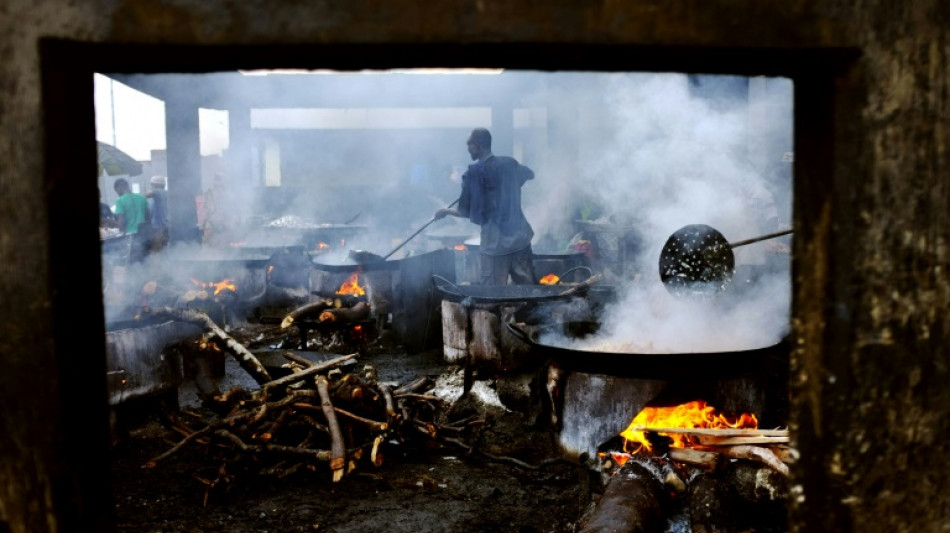
Bid to end deadly cooking methods which stoke global warming / Photo: © AFP/File

 American Nobel laureate in medicine hopes to illuminate the brain
 Trump approves firing squad for convicted US military base shooter

 Grappling with 'homework scams,' US universities shun AI detectors
 Separatists win Quebec election in test for Canada PM

 Leaders visit Pacific atoll at frontline of climate change

 Yemen's Houthis claim striking Riyadh airport, other Saudi sites

 Best-selling British author Jeffrey Archer dies aged 86

 Military plane crash kills 32 in Nigeria

 Olise powers France to win over Belgium in Nations League

 High-flying Blazy turns to birdlife at Chanel

 Riyadh's allies pledge troops as Yemen, Saudi Arabia attack Houthis

 Clashes erupt outside Kosovo parliament over war crimes court
 Milan's Saelemaekers suffers ankle setback, faces lengthy spell out

 Rubio arrives in Iceland to push for greater US presence in Arctic

 Putin allows Italy's UniCredit to sell part of Russian business
 Djokovic into China Open final as Medvedev out for hitting fan with ball
 ICC unseals arrest warrants for Taliban education ministers
 Modric hopes fans back Croatia against Spain after England shame

 Bolsonaro rides right-wing surge into Brazil's election runoff

 Turkey blocks X account of British reporter

 Ukraine says using AI robot guns to shoot down new Russian drones
 At Oct 7 memorial, Netanyahu says will be no Hamas rule in Gaza

 Ukraine blames Russia for deadly sinking of Turkish ship in Black Sea

 UN rights council slams Taliban's 'oppression' of women
 Norway eyes partial ban of smart glasses

Fifty countries are meeting in France on Tuesday to discuss the lack of access to clean cooking methods worldwide which causes millions of deaths every year and fuels global warming.
Some 2.3 billion people across 128 countries breathe in harmful smoke when they cook on basic stoves or over open fires, according to an International Energy Agency (IEA)-African Development Bank (ADB) report that sounded the alarm last year.
It said 3.7 million people a year die prematurely from harmful cooking practices, with children and women most at risk.
The IEA said the "unprecedented" Paris gathering aims to be "a moment of changing the direction", its sustainability and technology director Laura Cozzi told journalists.
The problem "touches on gender, it touches on forestry, it touches on climate change, it touches on energy, it touches on health," added Cozzi.
A third of the world cooks with fuels which produce harmful fumes when burned, including wood, charcoal, coal, animal dung and agricultural waste.
They pollute indoor and outdoor air with fine particles that penetrate the lungs and cause multiple respiratory and cardiovascular problems, including cancer and strokes.
These cooking practices are the third highest cause of premature deaths in the world and the second highest in Africa. In young children, they are a major cause of pneumonia, experts say.
They also prevent women and children from accessing education or earning a wage, as they spend hours looking for fuel.
The meeting at UNESCO's headquarters will primarily focus on Africa and aims to garner financial backing for a major push on the problem.
- Huge 'bang for its buck' -
Greenhouse gas emissions from using basic stoves and deforestation from collecting wood also contribute hugely to global warming.
Switching to clean cooking methods, such as LPG or electric cooking, would save 1.5 billion tonnes of CO2 a year by 2030 -- roughly the amount emitted by ships and planes last year, according to the IEA.
Subsidised LPG and free stoves in China, India and Indonesia led to a decline in people without access to clean cooking between 2010 to 2022. But the same was not true for Africa.
Four out of five households in sub-Saharan Africa still rely on highly polluting cooking fuels and the situation is getting worse.
"We're seeing a lot of concerted efforts that are yielding benefits in Kenya, Ghana, Tanzania," said IEA expert Dan Wetzel.
"But really what we see is that population growth is outstripping the progress there."
The funds needed are a fraction of global investment in energy, the IEA pointed out. The estimated $8 billion needed annually worldwide is less than one percent of government spending on energy measures in 2022.
Of this sub-Saharan Africa would need $4 billion. Current worldwide investment in clean cooking is about $2.5 billion.
"Dollar for dollar, it's hard to imagine a single intervention that could have more bang for its buck in terms of health emissions and development than this," Wetzel said.
Such financial support is essential as many African households cannot afford a suitable cooker or fuel.
But the IEA also recommends strong national leadership as well as grassroots efforts to change social norms.
T.Germann--VB