Cambodia's famed Kampot pepper withers in scorching heatwave / Photo: © AFP

 American Nobel laureate in medicine hopes to illuminate the brain

 Trump approves firing squad for convicted US military base shooter
 Grappling with 'homework scams,' US universities shun AI detectors
 Separatists win Quebec election in test for Canada PM

 Leaders visit Pacific atoll at frontline of climate change

 Yemen's Houthis claim striking Riyadh airport, other Saudi sites

 Best-selling British author Jeffrey Archer dies aged 86

 Military plane crash kills 32 in Nigeria

 Olise powers France to win over Belgium in Nations League

 High-flying Blazy turns to birdlife at Chanel

 Riyadh's allies pledge troops as Yemen, Saudi Arabia attack Houthis

 Clashes erupt outside Kosovo parliament over war crimes court

 Milan's Saelemaekers suffers ankle setback, faces lengthy spell out

 Rubio arrives in Iceland to push for greater US presence in Arctic

 Putin allows Italy's UniCredit to sell part of Russian business

 Djokovic into China Open final as Medvedev out for hitting fan with ball
 ICC unseals arrest warrants for Taliban education ministers

 Modric hopes fans back Croatia against Spain after England shame

 Bolsonaro rides right-wing surge into Brazil's election runoff

 Turkey blocks X account of British reporter

 Ukraine says using AI robot guns to shoot down new Russian drones

 At Oct 7 memorial, Netanyahu says will be no Hamas rule in Gaza

 Ukraine blames Russia for deadly sinking of Turkish ship in Black Sea

 UN rights council slams Taliban's 'oppression' of women
 Norway eyes partial ban of smart glasses

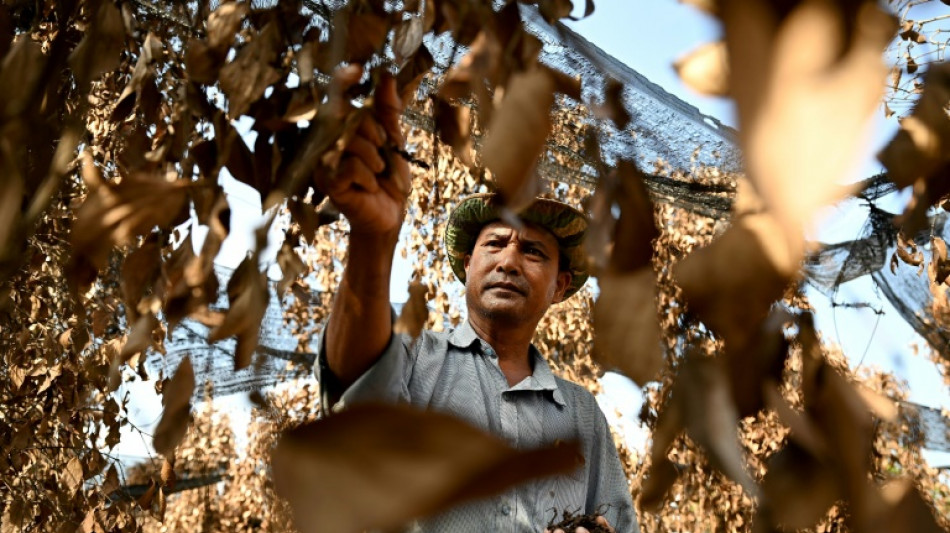
Farmer Chhim Laem shakes his head as he walks between long rows of dead bushes, their brown leaves scorched by heat and drought that have devastated Cambodia's famed Kampot pepper crop.
Known for its intense floral flavour, Kampot pepper is prized by top chefs around the world and sells for up to $200 per kilo.
Nurtured for generations in two provinces in southwest Cambodia, the pepper industry survived the genocidal Khmer Rouge and decades of instability, but now faces the threat of extreme weather driven by climate change.
"It is so hot this year, no rains, and we have no water to water the pepper plants," Laem told AFP. "So they all died."
South and Southeast Asia have sweltered in recent weeks under record temperatures, with governments closing schools, people dying of heatstroke and farmers praying for rain.
Scientists warn that human-induced climate change will produce more frequent, longer and more intense heatwaves.
In parts of Cambodia, the mercury nearly hit 43 degrees Celsius (109 Fahrenheit) in late April -- after a six-month drought that pushed farmers to a breaking point.
All 264 of Laem's pepper bushes perished, the 55-year-old explained, thanks to water shortages and hot weather.
Production has grown in recent years, boosted by the European Union granting the spice a "protected geographical indication" in 2016 -- meaning that only pepper grown in a designated area can be called Kampot.
The Kampot region produced about 120 tonnes of peppercorns last year, but farmers say that excessive heat and rain have made 2024 the worst on record.
Laem earned about $1,000 from his farm last year, but said he expects a fraction of that now.
"I am so sad, but I don't know what to do," he said.
- 'The worst year' -
Nguon Lay is a fourth-generation pepper farmer, harvesting nine tonnes from his nearby five-hectare farm last year.
But the 71-year-old farmer expected to harvest nothing this year.
"This year we meet the biggest obstacle," he said, while examining a dying pepper bush.
Torrential rain destroyed the plants' flowers earlier in the season, with more dying in the prolonged drought that followed.
"So it is the worst year. We don't know what to do. We see problems, but we can't resolve them," Lay said.
Like other farmers, Lay said he knew the problems came from the weather and the environment.
Several ponds used to water his plants have dried up, and his workers only water the crop once every five days.
"We have been prepared. We know about climate change, we have stored water, we built roofs to protect our peppers from the hot weather, but it was not enough."
"So many pepper plants are dying," he said, adding that he no longer goes to his farms because it is too painful.
"This year we think we will get nothing," he said, adding that what little can be harvested is of lower quality because of the weather.
- 'Fight against nature' -
Kampot pepper gained global acclaim during the French colonial occupation of Cambodia when it was exported widely, but the industry was nearly wiped out during the Khmer Rouge era.
In more recent years it has bounced back, gracing hip restaurant menus across the globe.
The pepper comes in green, black, red and white varieties -- the colour changes as the corn ripens, with green the youngest and white the most mature.
Lay said consumers had no idea of the difficulties facing Kampot farmers, but they will soon see the effects.
"For 2024 and 2025, we won't have abundant pepper for them to eat," he said.
"It is zero!"
Kann Sinouch, president of the Kampot Pepper Promotion Association, said he expects this year's pepper yield to be halved -- and warned of an export shortage in 2025.
He told AFP the changing weather meant farmers were unable to expand their farms, and instead were stuck struggling to keep their existing plants alive.
But Chan Deng, who has been growing pepper since the 1960s, said he would not surrender to the unpredictable weather.
"This year, it is strangely hot," Deng, 67, said.
His pepper yield plummeted from 300 kilos last year to around 10 kilos in 2024, with 20 percent of his plants dying due to the hot weather.
But Deng said he will dig more ponds to store water, hoping that in three years a good yield will return.
In the meantime, he said, "we will fight against nature".
E.Burkhard--VB