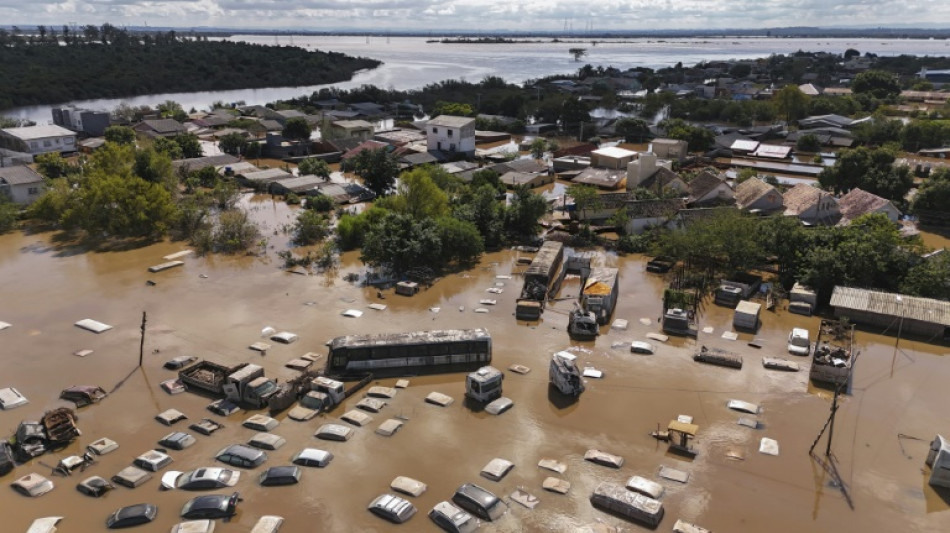
Brazil floods strike blow to powerful agriculture sector / Photo: © AFP

 American Nobel laureate in medicine hopes to illuminate the brain

 Trump approves firing squad for convicted US military base shooter
 Grappling with 'homework scams,' US universities shun AI detectors
 Separatists win Quebec election in test for Canada PM

 Leaders visit Pacific atoll at frontline of climate change

 Yemen's Houthis claim striking Riyadh airport, other Saudi sites

 Best-selling British author Jeffrey Archer dies aged 86

 Military plane crash kills 32 in Nigeria

 Olise powers France to win over Belgium in Nations League

 High-flying Blazy turns to birdlife at Chanel

 Riyadh's allies pledge troops as Yemen, Saudi Arabia attack Houthis

 Clashes erupt outside Kosovo parliament over war crimes court

 Milan's Saelemaekers suffers ankle setback, faces lengthy spell out

 Rubio arrives in Iceland to push for greater US presence in Arctic

 Putin allows Italy's UniCredit to sell part of Russian business

 Djokovic into China Open final as Medvedev out for hitting fan with ball

 ICC unseals arrest warrants for Taliban education ministers

 Modric hopes fans back Croatia against Spain after England shame

 Bolsonaro rides right-wing surge into Brazil's election runoff

 Turkey blocks X account of British reporter

 Ukraine says using AI robot guns to shoot down new Russian drones

 At Oct 7 memorial, Netanyahu says will be no Hamas rule in Gaza

 Ukraine blames Russia for deadly sinking of Turkish ship in Black Sea

 UN rights council slams Taliban's 'oppression' of women
 Norway eyes partial ban of smart glasses

Floodwaters in Brazil have swallowed up soybean fields and farming equipment, cutting off roads, livestock farms and warehouses in the latest extreme weather event to hit the agricultural giant.
The inundated state of Rio Grande do Sul is one of the biggest soy-producing regions in Brazil, as well as its main rice-growing area, and both crops are expected to suffer from the historic flooding.
"In a year, we have suffered a drought and three floods, including this one, which reached levels never seen before," said Nilvo Bosa, president of a local cooperative of small farmers.
"We have no way of accessing our fields, which are under four or five meters (13 to 16 feet) of water," he said from his house atop a hill, reflecting on the extensive damage from floods that have turned streets into rivers and left more than 100 dead.
The region had been counting on a record harvest of more than 22 million tons of soybeans this year, but extreme weather could affect up to five million tons of the harvest, said Luiz Fernando Gutierrez, an analyst at the Safras & Mercado agricultural consulting firm.
Before the rains, "a quarter of the soybean fields remained to be harvested," he said.
"Part of the crops will rot and be lost, others will have lower yields than expected. Storage areas were also likely affected."
While Brazil will retain its spot as the world's largest producer of soybeans, which are used in livestock feed, the flooding is expected to hit its results this season.
A decline had already been forecast before the floods, due to previous torrential rains and a drought in the center-west of the huge country.
- Rice, chicken and pork -
Rio Grande do Sul is also Brazil's largest grower of rice, a staple in the country, with 6.9 million tons produced last year.
Around 15 percent of rice crops had yet to be harvested before the floods hit, according to the regional Institute of Technical Assistance and Rural Extension (Emater).
To address any potential deficit and combat price speculation, President Luiz Inacio Lula da Silva's government has announced plans to import rice.
Rio Grande do Sul has experienced major disruptions to its network of meat processing plants, with two of its 10 plants still paralyzed, according to the Brazilian Animal Protein Association.
The region is responsible for 11 percent of Brazil's chicken meat production, of which it is the world's largest exporter, and almost 20 percent of pork, of which it is the world's fourth-largest exporter.
"To restore the (agricultural) sector we need a guarantee fund supported by the government," said Gedeao Pereira, president of the Regional Federation of Agriculture.
Experts link the historic floods and other recent extreme weather in Brazil to global warming, exacerbated by the El Nino climate phenomenon.
Agronomist Eduardo Assad, who studies the effects of climate change on agriculture, said Brazil "will begin to suffer severe crop losses" if the sector does not take the necessary measures to protect the soil and biodiversity.
According to a report published last year by MapBiomas, a consortium of Brazilian NGOs and universities, agricultural activities contributed to 95.7 percent of deforestation in Brazil.
While Lula's government boasted lowered deforestation rates in the vital Amazon rainforest last year, experts say the country needs to develop a more sustainable agricultural model that can adapt to global warming.
R.Buehler--VB