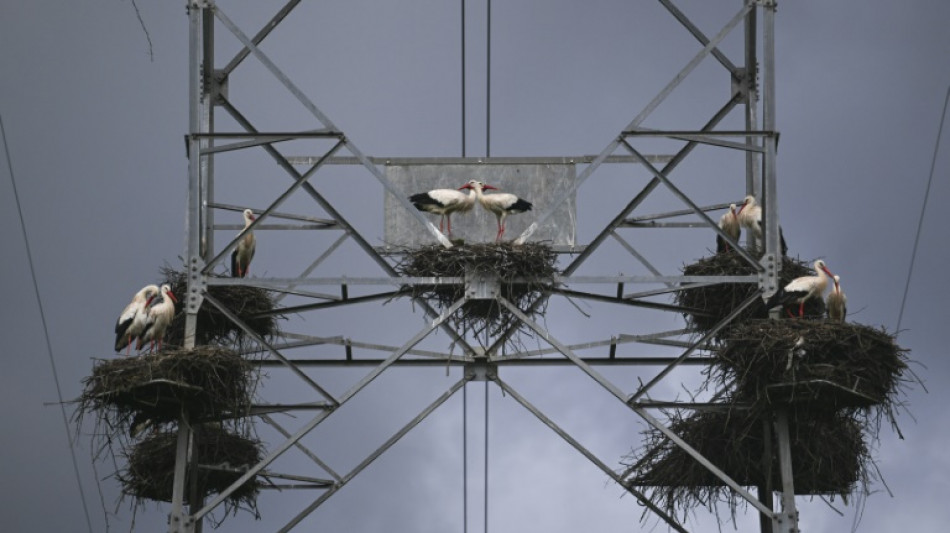
Rubbish, climate change help boost Portugal's white stork numbers / Photo: © AFP

 Leaders visit Pacific atoll at frontline of climate change

 Yemen's Houthis claim striking Riyadh airport, other Saudi sites

 Best-selling British author Jeffrey Archer dies aged 86

 Military plane crash kills 32 in Nigeria

 Olise powers France to win over Belgium in Nations League

 High-flying Blazy turns to birdlife at Chanel

 Riyadh's allies pledge troops as Yemen, Saudi Arabia attack Houthis

 Clashes erupt outside Kosovo parliament over war crimes court

 Milan's Saelemaekers suffers ankle setback, faces lengthy spell out

 Rubio arrives in Iceland to push for greater US presence in Arctic

 Putin allows Italy's UniCredit to sell part of Russian business

 Djokovic into China Open final as Medvedev out for hitting fan with ball

 ICC unseals arrest warrants for Taliban education ministers

 Modric hopes fans back Croatia against Spain after England shame

 Bolsonaro rides right-wing surge into Brazil's election runoff

 Turkey blocks X account of British reporter

 Ukraine says using AI robot guns to shoot down new Russian drones

 At Oct 7 memorial, Netanyahu says will be no Hamas rule in Gaza

 Ukraine blames Russia for deadly sinking of Turkish ship in Black Sea

 UN rights council slams Taliban's 'oppression' of women

 Norway eyes partial ban of smart glasses

 Two dead after ship catches fire, sinks in Black Sea

 Spain's PM calls snap election after housing bill defeat

 STARCARES Equips Seven Foster Homes for Children and Young People in Tanzania

 Alleged Indian leader of neo-Nazi child abuse ring goes on trial in Paris
Above a flowering meadow in southern Portugal, three white stork nestlings click their beaks, adding to the chorus of a thriving stork population that has settled year-round in the country.
The long-legged birds have traditionally migrated from Europe in the autumn, heading south to spend winter in sub-Saharan Africa before returning in springtime to breed.
But abundant food from landfill sites, coupled with warmer weather due to climate change, has led the vast majority of breeding-age storks in Portugal to skip this arduous journey and stay put all year.
In spring and summer they often nest on chimneys or electricity pylons, which humans have helped make safer for them.
White storks were considered an endangered species in Portugal as recently at the turn of the century.
Happily, the number of breeding pairs has almost doubled in the last decade, rising from around 12,000 pairs 10 years ago to around 20,000 pairs today, according to scientific estimates.
"They look good! Let's hope there's enough food for all three chicks," said Ines Catry, a biologist with the University of Porto's Research Centre in Biodiversity and Genetic Resources (CIBIO).
After checking, weighing and measuring them, she carefully placed the chicks in a cloth bag and used a ladder to hoist them back into their nest on top of an old tree trunk near the town of Aljustrel.
For the past six years, CIBIO scientists have been tracking the behaviour of a group of White Storks, thanks to tiny satellite tags attached to their backs.
- 'Dependent on waste' -
One of the birds, named Alvalade, has built a nest on top of a pole by a side road in this region of Alentejo, an unending landscape of flatness dotted with cork oaks and olive trees.
Alvalade travels some 2,500 kilometres (1,500 miles) each year to reach Senegal in Western Africa, returning to Portugal to breed in spring and summer.
But this stork's behaviour is now the exception.
Around 80 percent of Portugal's white storks stay permanently in the country, avoiding the dangers associated with migration, said Catry.
Juvenile storks still follow the instinct to fly to Africa for winter but "as time goes by they stop migrating", she said. Older, breeding birds tend to stay put.
The change in migratory habits is linked in part to climate change and the year-round availability of food in Portugal.
They have an abundant year-round supply of food from Portuguese rubbish tips, Catry said.
"They are very dependent on waste from rubbish tips", she explained, adding that white storks were "highly adaptable and have been able to benefit from coexistence with humans".
In addition, milder weather conditions in southern Portugal in winter are now similar to those which the birds find in Africa, Catry said.
- 'Stork maternities' -
After dropping considerably -- mainly due to drought in Africa's Sahel region, which decimated their food supplies -- the number of storks began creeping back up in Portugal in the 1980s.
The birds found conditions more favourable in Portugal than in Africa. Electricity pylons dotted along roads have become a favourite. A single pylon can sometimes host around 30 nests.
Over the past two decades, Portugal's electricity grid operator REN has taken steps to reduce the risk of storks being electrocuted, especially when building nests, and to prevent power cuts.
These include installing platforms on metal pylons for the birds to use for nest building.
Almost a quarter of white stork nests can now be found on these platforms, sometimes dubbed "stork nurseries".
Before the breeding season, specialised teams clean the platforms, move nests if necessary and repair metal grids set up to keep storks away from high-voltage power cables.
"We have been working here for more than 20 years on making our equipment compatible with the presence of storks. We're used to it," said Francisco Parada, head of environmental safety at REN.
The storks seem to flourish as a result, he said, with the number of birds nesting on these platforms "quadrupling" in the past two decades.
A.Ammann--VB