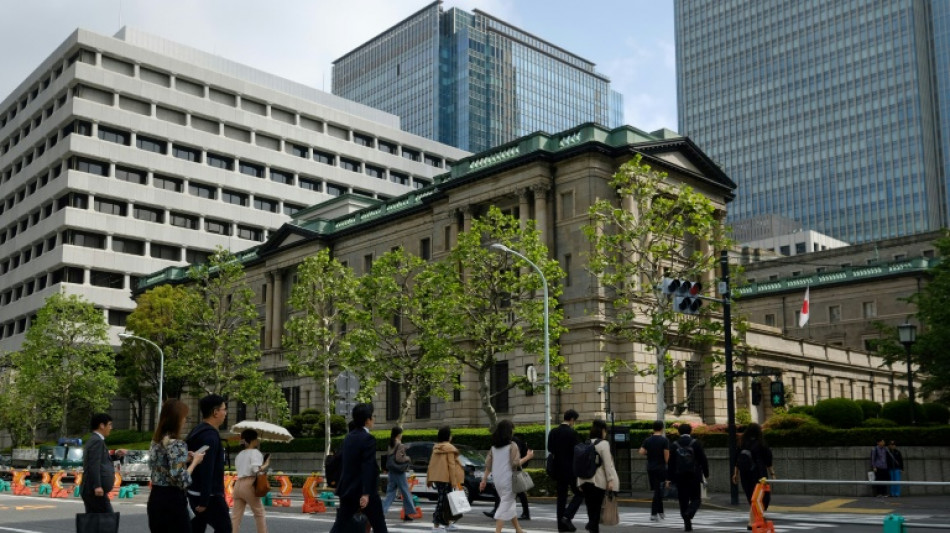
Yen falls further as Bank of Japan stands pat on rates / Photo: © AFP

 Trump says US moved bombers from UK base after 'threats'

 Brazilian stocks surge to record after Bolsonaro election lead

 Leaders to visit Pacific atoll at frontline of climate change

 ICC gives more details about arrest warrants for Taliban ministers

 Nigeria's Tinubu confirms 32 dead after military plane crash

 'Reckless' AI firms can't control models, says whistleblower

 Switching on brain cells: the Nobel-winning science of optogenetics

 Quebec votes as separatist surge poses test for Canada PM

 Euro slides as concerns about French debt mount

 Former Trump press secretary Leavitt joins Fox News

 Djokovic advances to China Open final as Medvedev out for hitting fan with ball

 Disgraced former US House speaker dies at 84

 Euro slides as worries about French debt grow

 US withdraws all bomber aircraft from UK airbase

 Drone hits Ethiopia IDP camp as fears grow of regional war

 US-German trio wins medicine Nobel for illuminating the brain

 England captain Kane driven by desire for records says Tuchel

 N.Irish court hears challenge to disputed Orangemen parade

 Talking points from the Bahrain Grand Prix in Malaysia

 Yemen, Saudi Arabia target Houthis in new campaign as war escalates

 US-German trio wins medicine Nobel for work on optogenetics

 Swiatek, Zheng survive three-set tests in China Open third round

 Hasan says Test cricket momentum turning for Bangladesh

 Intense heat puts births in jeopardy, UN tells Fiji talks

 US arrests woman accused of spying for China on Taiwan leader's family

The Bank of Japan kept its ultra-low interest rates unchanged Friday and stopped short of signalling another hike, pushing the yen to a fresh 34-year low against the dollar.
Officials last month announced the first increase in borrowing costs for 17 years as inflation continued to stick above their two percent target but warned they would take a steady approach to normalising monetary policy.
While widely expected, Friday's decision had been keenly awaited to see if decision-makers would respond to a drop in the yen that has pushed it to levels not seen since 1990.
The BoJ has been a global outlier in sticking to an ultra-loose policy while other central banks pushed rates up as they fought against surging inflation -- causing a wide differential that saw investors push into other currencies.
The standout among them has been the dollar, which has gained even more ground in recent weeks as a string of above-forecast US inflation readings fuels fears the Federal Reserve will keep rates at two-decade highs for longer than hoped.
A weaker yen is good for Japanese exporters but it pushes up the price of imports and the BoJ hiked its inflation forecast for the current fiscal year to 2.8 percent, from 2.4 percent previously.
In March, inflation excluding fresh food prices stood at 2.6 percent.
With the currency sitting around three-decade lows against the dollar, speculation has grown that authorities could intervene in forex markets to provide support for the first time since 2022.
On Friday at around 1.30 pm (0430 GMT) the dollar bought 156.18 yen.
Last week BoJ Governor Kazuo Ueda had signalled that it would change monetary policy if the fall in the yen becomes "too big to be ignored".
Finance Minister Shunichi Suzuki warned Friday the government was "concerned" about the negative aspects of the weak yen, repeating that authorities will take "all possible measures" if necessary, Japanese media said.
Ueda was due to make further comments later on Friday.
He might want to take a long-term view, but "he may not be able to avoid the forex factor", said Hideo Kumano, chief economist of Dai-ichi Life Research Institute.
"Amidst the ongoing yen depreciation against the US dollar, the pressure intensifies on Japanese policymakers to translate their verbal assurances into concrete measures," said Luca Santos, currency analyst ACY Securities.
The BoJ has spent vast amounts on bonds and other assets to pump liquidity into the Japanese economy, targeting inflation of two percent that policymakers hoped would fuel growth.
Jiji Press cited sources Friday as saying BoJ policymakers would discuss ways to reduce the bank's purchases of Japanese government bonds.
The institution currently holds 592 trillion yen ($3.8 trillion) in JGBs, an amount equivalent to the size of the country's gross domestic product in 2023.
N.Schaad--VB