The Myanmar 'water brothers' salvaging shipwrecks on the tide / Photo: © AFP

 Trump says US moved bombers from UK base after 'threats'
 Brazilian stocks surge to record after Bolsonaro election lead

 Leaders to visit Pacific atoll at frontline of climate change

 ICC gives more details about arrest warrants for Taliban ministers
 Nigeria's Tinubu confirms 32 dead after military plane crash

 'Reckless' AI firms can't control models, says whistleblower

 Switching on brain cells: the Nobel-winning science of optogenetics

 Quebec votes as separatist surge poses test for Canada PM

 Euro slides as concerns about French debt mount

 Former Trump press secretary Leavitt joins Fox News

 Djokovic advances to China Open final as Medvedev out for hitting fan with ball
 Disgraced former US House speaker dies at 84

 Euro slides as worries about French debt grow

 US withdraws all bomber aircraft from UK airbase

 Drone hits Ethiopia IDP camp as fears grow of regional war

 US-German trio wins medicine Nobel for illuminating the brain

 England captain Kane driven by desire for records says Tuchel

 N.Irish court hears challenge to disputed Orangemen parade

 Talking points from the Bahrain Grand Prix in Malaysia

 Yemen, Saudi Arabia target Houthis in new campaign as war escalates

 US-German trio wins medicine Nobel for work on optogenetics

 Swiatek, Zheng survive three-set tests in China Open third round

 Hasan says Test cricket momentum turning for Bangladesh

 Intense heat puts births in jeopardy, UN tells Fiji talks

 US arrests woman accused of spying for China on Taiwan leader's family

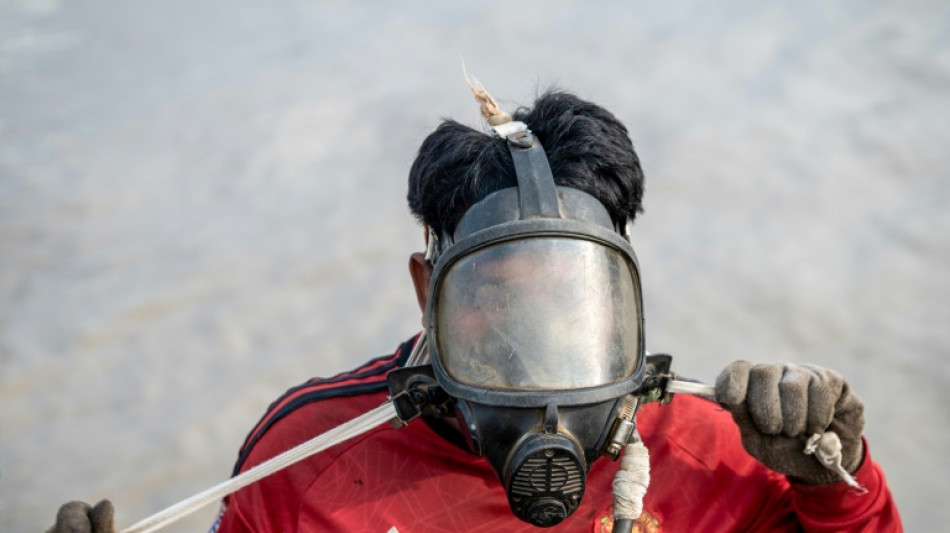
Diving into the darkness of the Yangon River, Than Nyunt starts another murky sortie in his months-long mission to salvage a sunken ship using the power of the moon.
His target is a 53-metre (174-foot) long cargo vessel resting on the silty riverbed in Myanmar's commercial hub, whose steel carcass will fetch a tidy sum as scrap -- if he can get it to shore.
A hose running from his mask up to an oxygen pump on the boat is his lifeline and only means of communication -- one tug on it from a colleague means "come up quickly".
He stays in the dark depths for up to three hours at a time, attaching cables to the wreck.
The cables run up to the team's boat on the surface, and then to shore. When it rises on the next tide, it will drag the shipwreck a few metres along the bed.
The work is slow and dangerous but addictive, said Than Nyunt, 58.
He says he has salvaged around 40 ships, from cargo boats to passenger ferries, since he started diving over four decades ago.
"After I excavate one ship I always want to do it again and again," he told AFP from the river, wearing a Manchester United jersey and a pair of gardening gloves.
"Besides making money, I want to know the condition of the wreck... I also talk with ship owners about the ship's history, and we both are delighted when we can salvage them."
The team's current shipwreck -- the Mya Nadi (Emerald River) -- is an old friend for Than Nyunt.
He salvaged the vessel in 1981 for its owner, who fitted it with a new engine and set it back to work.
Around eight years ago it sank again.
- 'Water brothers' -
There are between 20 and 30 wrecks on the bed of the Yangon, according to Than Nyunt.
During the British colonial era, the water thronged with ships taking away teak wood and rice from the hinterlands and bringing in workers from abroad.
In World War II, fierce fighting between Japan and Allied forces sent many vessels to the riverbed.
Cyclone Nargis, which devastated Myanmar's Irrawaddy Delta in 2008, killing at least 138,000 people, sent more to the bottom.
It left the riverbed a rich, if risky, hunting ground for salvagers.
Wrapping a metal chain around his body to weigh himself down, Thet Oo, 38, prepares for a shift unclogging silt from the 'Emerald River'.
Working in the darkness, as much as 25 metres (80 feet) down and buffeted by strong currents is risky, he says.
"My life is in the hands of the man holding the oxygen pipe... If something happens to the oxygen machine, I can only know if he gives a signal to me."
That signal is a tug on the oxygen tube, warning the diver to come up.
"However much we argue on the boat, we have to act like brothers when we are under the water," said Than Nyunt.
- Tidal cranes -
Pulling the wrecks using the tidal surges of the river is organic but plodding and requires much patience.
"We don't have a heavy-duty crane to pull the ships," says Than Nyunt.
"When the tide rises by up to 12 feet, we can expect the ship to move up to 10 feet and we can pull it to land."
After more than four months work, the skeleton of the Emerald River is visible in the shallows.
In the last stage of the salvage, the team fix tyres and sandbags to the wreck to anchor it in place.
Another team then moves in to dismember the wreck, working with blowtorches in knee-deep water.
A scrap dealer will buy the metal and melt it down to be used again.
Divers in Than Nyunt's team can earn 25,000 to 30,000 kyat each day ($12 - 14).
He has salvaged boats all over Myanmar, and doesn't want to stop.
"I don't smoke, drink or use drugs in my life... and I have the ambition to work for as many years as possible," he said.
"I'm 58 years old right now and I can work for the next 10 years, because I'm like a sportsperson who is always active."
W.Huber--VB