As 'news deserts' spread, US journalism fights on / Photo: © AFP Photo

 Trump says US moved bombers from UK base after 'threats'
 Brazilian stocks surge to record after Bolsonaro election lead

 Leaders to visit Pacific atoll at frontline of climate change

 ICC gives more details about arrest warrants for Taliban ministers
 Nigeria's Tinubu confirms 32 dead after military plane crash

 'Reckless' AI firms can't control models, says whistleblower

 Switching on brain cells: the Nobel-winning science of optogenetics

 Quebec votes as separatist surge poses test for Canada PM

 Euro slides as concerns about French debt mount
 Former Trump press secretary Leavitt joins Fox News

 Djokovic advances to China Open final as Medvedev out for hitting fan with ball

 Disgraced former US House speaker dies at 84

 Euro slides as worries about French debt grow
 US withdraws all bomber aircraft from UK airbase
 Drone hits Ethiopia IDP camp as fears grow of regional war

 US-German trio wins medicine Nobel for illuminating the brain
 England captain Kane driven by desire for records says Tuchel
 N.Irish court hears challenge to disputed Orangemen parade

 Talking points from the Bahrain Grand Prix in Malaysia

 Yemen, Saudi Arabia target Houthis in new campaign as war escalates

 US-German trio wins medicine Nobel for work on optogenetics

 Swiatek, Zheng survive three-set tests in China Open third round
 Hasan says Test cricket momentum turning for Bangladesh

 Intense heat puts births in jeopardy, UN tells Fiji talks
 US arrests woman accused of spying for China on Taiwan leader's family

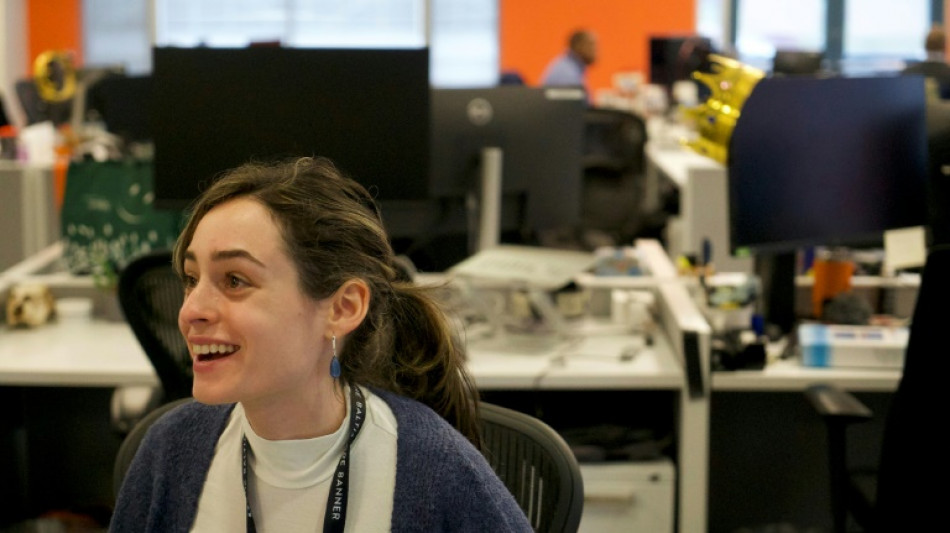
Baltimore Banner reporter Matti Gellman is first to leap in with questions during a recent press appearance by Maryland's state governor and celebrity chef Jose Andres at an urban farm.
With her notebook wedged under her arm and a Banner-branded baseball cap on her head, Gellman is launching her career as the long decimation of the news industry in the United States reaches what some have called an "extinction-level event."
She and her colleagues are at the vanguard of a fightback, seeking new and innovative ways to sustain local journalism in the world's most powerful democracy.
"We're a start-up, essentially," says the 26-year-old.
"I felt really inspired by the fact that the Banner was built by people who were sort of disillusioned by the industry and were looking to create something maybe different."
It's an optimism rarely found in America's bleak media landscape, more often characterized by abrupt mass layoffs, a grinding lack of resources -- and, finally, an information vacuum.
A study by Northwestern University last year identified 204 counties out of some 3,000 in the US as "news deserts," having "no newspapers, local digital sites, public radio newsrooms or ethnic publications."
But Gellman's zeal permeates the upstart Banner, an online non-profit which launched in 2022 to challenge the city's only remaining newspaper, the Baltimore Sun.
"People need to be informed," managing editor Andrea McDaniels tells AFP, speaking over the buzz of the newsroom, overlooking Baltimore's harbor.
If not, "they can't make good decisions in their lives, the schools fall apart, political corruption happens. So we need good journalism."
- 'Perilous' -
For more than two decades, since the internet upended the advertising and print model on which newspapers had been based, the industry has been in crisis.
Even behemoths of American journalism have been affected.
National outlets including The Washington Post and Los Angeles Times have laid off hundreds since 2023 alone, while digital organizations including BuzzFeed News and Vice.com shuttered altogether.
But it is at the local level that news has been most shockingly hollowed out, with newspapers vanishing at a rate of more than two a week, according to Northwestern's 2023 State of Local News report.
The state of the industry is "perilous," says professor and former journalist Penny Abernathy, who headed the report.
"We lost more than a third of our newspapers over the last 18 years, almost two thirds of our newspaper journalists" since 2005, she adds.
Nearly half of US counties have just one news source, the report said, often a weekly newspaper. And 228 are on a so-called "watch list" at high risk of losing even that.
The impact, experts say, has been significant.
"We all live our lives locally," says Ellen Clegg, who co-founded another non-profit local news outlet, BrooklineNews in Massachusetts.
"This is where we vote. It's where we raise our kids, educate our kids," she continues.
When local issues are not reported on, "you have a nationalization of news that rushes in to fill the vacuum."
- Energy, innovation -
That means more Fox News, more CNN, more Trump, more Biden. In areas without strong broadband access, it also means people are reliant on their phones -- that is, on social media as their primary source of information.
The effect is local and national polarization, Clegg says.
Take school board meetings: instead of asking why a proposed new high school is over budget, or why math test scores are low, parents are "yelling about critical race theory or... transgender issues."
Repercussions can also be seen at the ballot box, Abernathy says.
When all news is national, all politics become national, too. "It feeds into this political divide," she explains.
But non-profits like the Banner are not the only green shoots.
This month New York state passed tax credits for local news organizations -- a first in a country where public funding of journalism has historically been viewed with suspicion.
Meanwhile studies have shown that rural readers are still willing to pay for products like events, memberships or newsletters -- even in an era of free news.
As for the Banner, the importance of its mission was underscored recently when a container ship crashed into a major Baltimore bridge, collapsing it within seconds.
The Banner newsroom leapt into action, and has been lauded for its coverage of the disaster.
Whether it can keep it up all depends on funding -- currently a combination of subscriptions and donations.
CEO Bob Cohn is hopeful.
"It does seem like there's a degree of energy and innovation in this space that's acknowledging the depth of the problem," he says.
T.Germann--VB