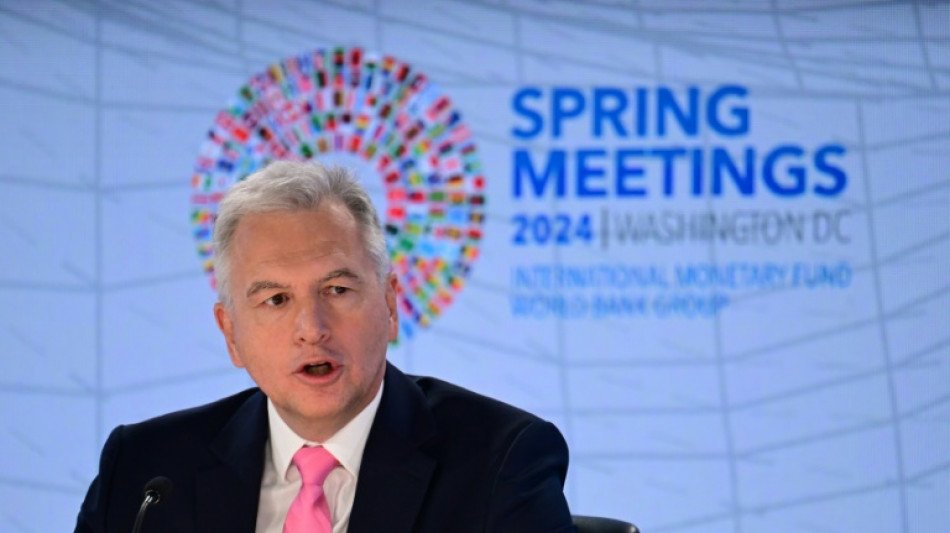
IMF calls on EU to deepen single market integration to boost growth / Photo: © AFP

 Trump says US moved bombers from UK base after 'threats'
 Brazilian stocks surge to record after Bolsonaro election lead

 Leaders to visit Pacific atoll at frontline of climate change

 ICC gives more details about arrest warrants for Taliban ministers

 Nigeria's Tinubu confirms 32 dead after military plane crash
 'Reckless' AI firms can't control models, says whistleblower

 Switching on brain cells: the Nobel-winning science of optogenetics

 Quebec votes as separatist surge poses test for Canada PM

 Euro slides as concerns about French debt mount

 Former Trump press secretary Leavitt joins Fox News

 Djokovic advances to China Open final as Medvedev out for hitting fan with ball
 Disgraced former US House speaker dies at 84

 Euro slides as worries about French debt grow
 US withdraws all bomber aircraft from UK airbase

 Drone hits Ethiopia IDP camp as fears grow of regional war

 US-German trio wins medicine Nobel for illuminating the brain
 England captain Kane driven by desire for records says Tuchel
 N.Irish court hears challenge to disputed Orangemen parade

 Talking points from the Bahrain Grand Prix in Malaysia

 Yemen, Saudi Arabia target Houthis in new campaign as war escalates

 US-German trio wins medicine Nobel for work on optogenetics
 Swiatek, Zheng survive three-set tests in China Open third round

 Hasan says Test cricket momentum turning for Bangladesh

 Intense heat puts births in jeopardy, UN tells Fiji talks
 US arrests woman accused of spying for China on Taiwan leader's family

Deeper integration of the European Union's internal market could prove crucial for boosting lackluster economic growth and productivity levels in the 27-member trading bloc, a senior IMF official told AFP Friday.
"We estimated, actually, what you could do just by reform of that single market and integration -- and the numbers are startling high," International Monetary Fund European director Alfred Kammer said in an interview in Washington.
The IMF expects European growth to pick up slightly this year to 1.6 percent, increasing to 2.0 percent next year, according to a regional economic outlook published Friday.
But with European average per capita income levels -- in purchasing-power-parity terms -- still roughly one third lower than in the United States, Europe must do more to boost flagging productivity and growth levels, Kammer said.
The IMF estimates that cutting internal barriers within the EU's single market by 10 percent would lead to a seven percent rise in growth inside the EU.
"It requires leadership, and it requires to explain to the populations what the benefits are of that single market and of the European Union," Kammer said.
"Brussels is the scapegoat and is being blamed for many things," he added. "That narrative needs to change."
Beyond deepening regional integration, the IMF report suggested other ways to boost flagging productivity levels, including by increasing digitalization and enacting structural reforms.
"You can do a lot in Europe in order to catch up in this productivity gap," Kammer said.
"What is not good enough is when you're looking at current productivity growth rates in Europe," he added. "That will not help you converge."
- Inflation on track -
The IMF report said European countries were on track for a so-called "soft landing," when countries successfully bring down inflation without causing a surge in unemployment or killing off economic growth.
Although inflation in some European countries remains elevated, among advanced economies it is expected to continue falling from recent highs to 2.4 percent this year and 2.1 percent in 2025, according to the IMF.
"We are seeing a recovery, while we have had substantial disinflation," Kammer said. "That's not the usual landing you have after monetary policy tightening."
"So this recession has been avoided," he continued. "And that is a big, big achievement."
However, the work is far from done, Kammer said, and there are a number of "crosswinds" which could cause a reacceleration in inflation.
"If oil prices are higher, again that would increase inflation in Europe," Kammer said.
"Everything has been relatively small in terms of impact what happened on the oil markets recently," he continued, adding: "it's not having much of an impact."
"The bottom line is that we need to stay data dependent meeting by meeting, and that policy loosening may have to be adjusted from what we have right now in the baseline," he said.
- Rising spending pressures -
The IMF report recommends that Europe's advanced economies with high debt levels should "frontload fiscal consolidation" -- including by raising some taxes -- to rebuild fiscal buffers depleted by government spending during the pandemic.
"This is part of the fiscal consolidation to create buffers to be ready for the next shock," Kammer said.
"But we also are very clear that the spending pressures are going to rise in the medium term," he added.
Kammer said the IMF estimates Europe's advanced economies will face a rise in spending pressures of 5.5 percent of GDP, on average, by 2050.
"That's climate, that's defense, that's pension payments, that's interest payments," Kammer said.
"So if you want to deal with those, you need to create room in the budget," he added.
C.Koch--VB