
Mideast in 'shadow of uncertainty' due to regional conflicts: IMF / Photo: © AFP

 Trump says US moved bombers from UK base after 'threats'
 Brazilian stocks surge to record after Bolsonaro election lead

 Leaders to visit Pacific atoll at frontline of climate change

 ICC gives more details about arrest warrants for Taliban ministers
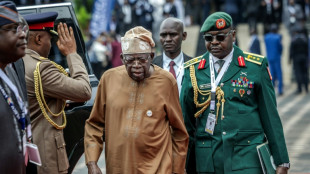 Nigeria's Tinubu confirms 32 dead after military plane crash

 'Reckless' AI firms can't control models, says whistleblower

 Switching on brain cells: the Nobel-winning science of optogenetics
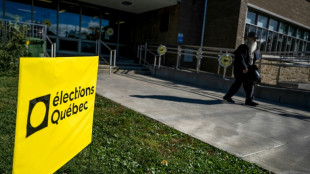 Quebec votes as separatist surge poses test for Canada PM

 Euro slides as concerns about French debt mount

 Former Trump press secretary Leavitt joins Fox News
 Djokovic advances to China Open final as Medvedev out for hitting fan with ball
 Disgraced former US House speaker dies at 84
 Euro slides as worries about French debt grow
 US withdraws all bomber aircraft from UK airbase
 Drone hits Ethiopia IDP camp as fears grow of regional war

 US-German trio wins medicine Nobel for illuminating the brain
 England captain Kane driven by desire for records says Tuchel
 N.Irish court hears challenge to disputed Orangemen parade

 Talking points from the Bahrain Grand Prix in Malaysia

 Yemen, Saudi Arabia target Houthis in new campaign as war escalates

 US-German trio wins medicine Nobel for work on optogenetics

 Swiatek, Zheng survive three-set tests in China Open third round

 Hasan says Test cricket momentum turning for Bangladesh

 Intense heat puts births in jeopardy, UN tells Fiji talks
 US arrests woman accused of spying for China on Taiwan leader's family

Economies in the Middle East and North Africa face a "shadow of uncertainty" from ongoing tensions in the region, a senior IMF official told AFP on Thursday.
"We are in a context where the overall outlook is cast into shadows," the International Monetary Fund's director for the Middle East and Central Asia department, Jihad Azour, said in an interview in Washington.
"The shadow of uncertainty on the geopolitical side is an important one," added Azour, a recent candidate to be the next Lebanese president.
In the face of the ongoing conflicts in Gaza and Sudan, and a recent cut to oil supplies by Gulf countries, the IMF has pared back its growth outlook for the Middle East and North Africa (MENA) region once again.
The Fund now expects growth in MENA of 2.7 percent this year -- 0.2 percentage points below its January forecast -- before picking up again next year, the IMF said in its regional economic outlook report published Thursday.
- Conflict risk -
The risks to growth in the MENA region remain heightened, the IMF said, pointing to the danger of greater regional spillovers from the ongoing Israel-Gaza war.
The conflict started after Hamas launched an unprecedented attack on October 7 that resulted in the deaths of 1,170 people in southern Israel, mostly civilians, according to an AFP tally of Israeli official figures.
The militants also took about 250 hostages.
Israel's retaliatory offensive has killed at least 33,970 people in Gaza, mostly women and children, according to the Hamas-run territory's health ministry, and caused severe economic damage in both Gaza and the West Bank.
"We have concerns about the immediate and lasting impact of conflict," Azour said.
The IMF report said economic activity in Gaza has "come to a standstill" and estimates economic output in the West Bank and Gaza contracted by six percent last year.
The report excludes economic projections for the West Bank and Gaza for the next five years, "on account of the unusually high degree of uncertainty," the IMF said.
The Fund cannot lend to the West Bank and Gaza because it is not an IMF member country. However, it has provided the Palestinian Authority and the central bank with technical assistance during the current conflict, Azour said.
"When we move into the phase of reconstruction, we will be part of the international community support to the region," he added.
Azour also discussed the situation in Sudan, where thousands have been killed in a civil war that has also devastated the economy, causing it to contract by almost 20 percent last year, according to the IMF.
"The country is barely functioning, institutions have been dismantled," he said.
"And for an economy, for a country like Sudan, with all this potential, it's important to very quickly the stop the bleeding and move to a phase of reconstruction," he added.
- Egyptian economy -
The Egyptian economy has been particularly badly hit by the recent Huthi attacks on Red Sea shipping, which caused trade through the Egypt-run Suez Canal to more than halve -- depriving the country of a key source of foreign exchange.
Egypt reached agreement last month to increase an existing IMF loan package from $3 billion to $8 billion, after its central bank hiked interest rates and allowed the pound to plunge by nearly 40 percent.
A key pillar of the current IMF program is the privatization of Egypt's state-owned enterprises, many of which are owned by or linked to the military.
"This is a priority for Egypt," Azour told AFP. "Because Egypt needs to have a growing private sector, and to give space for the private sector to create more jobs."
"We have an opportunity to re-engineer the role of the state, to give the state more responsibility as an enabler, and less as a competitor," he said.
F.Fehr--VB