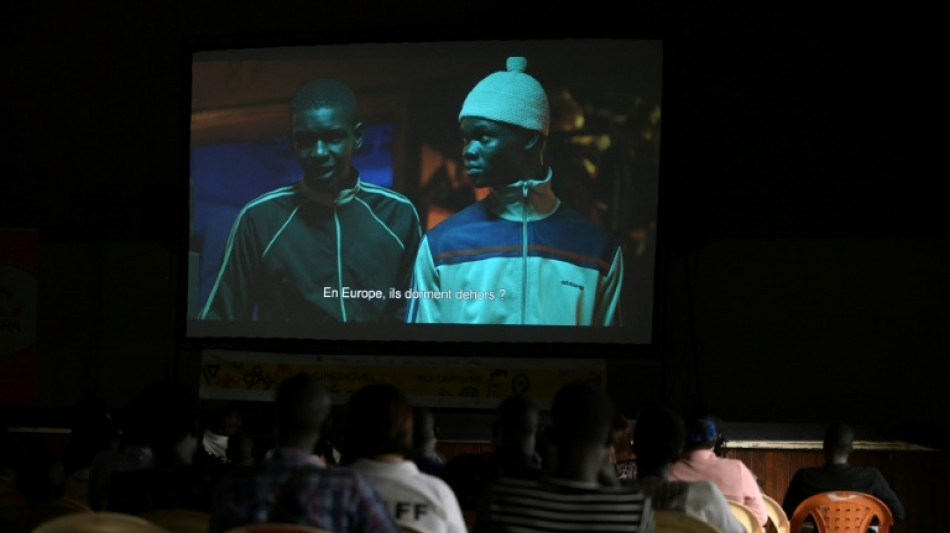
Team behind Italian film 'Io Capitano' returns to Senegal / Photo: © AFP

 Trump says US moved bombers from UK base after 'threats'
 Brazilian stocks surge to record after Bolsonaro election lead
 Leaders to visit Pacific atoll at frontline of climate change

 ICC gives more details about arrest warrants for Taliban ministers
 Nigeria's Tinubu confirms 32 dead after military plane crash

 'Reckless' AI firms can't control models, says whistleblower

 Switching on brain cells: the Nobel-winning science of optogenetics

 Quebec votes as separatist surge poses test for Canada PM

 Euro slides as concerns about French debt mount
 Former Trump press secretary Leavitt joins Fox News

 Djokovic advances to China Open final as Medvedev out for hitting fan with ball
 Disgraced former US House speaker dies at 84

 Euro slides as worries about French debt grow
 US withdraws all bomber aircraft from UK airbase
 Drone hits Ethiopia IDP camp as fears grow of regional war

 US-German trio wins medicine Nobel for illuminating the brain
 England captain Kane driven by desire for records says Tuchel
 N.Irish court hears challenge to disputed Orangemen parade

 Talking points from the Bahrain Grand Prix in Malaysia

 Yemen, Saudi Arabia target Houthis in new campaign as war escalates

 US-German trio wins medicine Nobel for work on optogenetics

 Swiatek, Zheng survive three-set tests in China Open third round
 Hasan says Test cricket momentum turning for Bangladesh

 Intense heat puts births in jeopardy, UN tells Fiji talks

 US arrests woman accused of spying for China on Taiwan leader's family

Members of a 200-strong audience struggle to hold back tears as the credits roll on the film "Io Capitano" in a small auditorium in the outskirts of Senegal's capital Dakar.
The crowd has spent two hours following a pair of Senegalese teenagers as they risk their lives to reach Europe, facing a gruelling journey across the Sahara, torture in Libyan jails and Europe's indifference to their plight.
After winning awards at the Venice Film Festival and receiving nominations at the Oscars and the Golden Globes, the film has now returned to where the story began.
The director, actors and wider team are embarking on a twelve-date tour of screenings across the West African nation with the Cinemovel foundation, scheduled to run until the end of April.
"This film teaches us that there are enormous risks involved in illegal immigration. The question I want to ask the audience is whether it's worth risking your life to try to reach another continent," asked an audience member after the film had finished, garnering a round of applause.
Mamadou Kouassi, whose own story inspired the script, responded from the stage.
"Everyone will have a different point of view. But my opinion is that there should be no hiding. Everyone should be free to move from one continent to another," he said.
- 'Bodies thrown into the sea' –
Illegal immigration is a daily reality for thousands in Senegal, where barely a day goes by without a report of an arrival in Spain's Canary Islands, an interception or a shipwreck.
While some take the treacherous Atlantic route, others travel through the Sahel and then cross the Mediterranean -– the route taken by the film's protagonists.
"This film is very powerful and has left a deep impression on me because I lived the story myself," said El Hadji Issa Diouf, a 42-year-old fisherman.
"I've been on a pirogue three times trying to get to Europe. I saw with my own eyes a woman give birth in a pirogue, I saw people vomit to the point of losing their lives, I saw bodies thrown into the sea during my illegal journeys. This film makes me relive a reality of the African continent," he added.
"I'm asking the director to show this film in all the coastal towns of Senegal... Maybe this tour will raise awareness, because all these towns have lost a lot of young people trying to reach Europe by sea," the fisherman said.
Marieme Fall, an audience member in her twenties, said the film "shows us that it's better to try to succeed in Africa than to go through this journey".
"I went through all kinds of emotions watching it, I even cried because I told myself that I know people who went through the same journey and died during it. It's very hard," she added.
- 'An experience' –
"This is not a film that gives an answer, but one that gives the audience an experience," the film's Italian director, Matteo Garrone, told AFP.
"I'm no one to tell someone not to leave," he added.
Seydou Sarr, the 19-year-old lead who won an award at the Venice Film Festival, expressed pride at showing the film in his own country.
He said he now knew the "reality" of the dangers awaiting would-be immigrants, having known nothing before taking part in the project.
Mamadou Kouassi, who now works as an intercultural mediator, recounted how he set off for Europe in 2005 at the age of 19, experiencing an "atrocious journey" and spending three years in Libya fearing death daily.
"Once a person has decided to leave, no one can stop them," he said, adding that young people should be able to believe in their dreams but that legislation must be changed "so that they don't suffer as we have".
"The public are asking us to make a sequel following the pair's arrival in Europe," Kouassi said.
"I was abused (in Italy). I worked 14 hours earning barely 20 euros ($21) in tomato fields near Naples", he said, urging Italy's far-right government to introduce a fairer migrant reception policy.
S.Spengler--VB