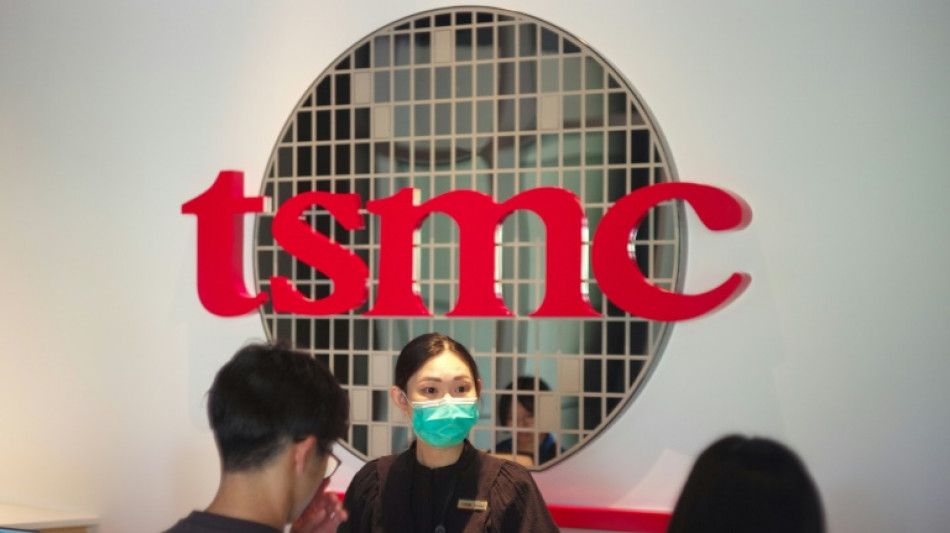
Taiwan chip giant TSMC's profits surge on AI demand / Photo: © AFP

 Nigeria's Tinubu confirms 32 dead after military plane crash

 'Reckless' AI firms can't control models, says whistleblower

 Switching on brain cells: the Nobel-winning science of optogenetics

 Quebec votes as separatist surge poses test for Canada PM

 Euro slides as concerns about French debt mount

 Former Trump press secretary Leavitt joins Fox News

 Djokovic advances to China Open final as Medvedev out for hitting fan with ball

 Disgraced former US House speaker dies at 84

 Euro slides as worries about French debt grow

 US withdraws all bomber aircraft from UK airbase

 Drone hits Ethiopia IDP camp as fears grow of regional war

 US-German trio wins medicine Nobel for illuminating the brain

 England captain Kane driven by desire for records says Tuchel

 N.Irish court hears challenge to disputed Orangemen parade

 Talking points from the Bahrain Grand Prix in Malaysia

 Yemen, Saudi Arabia target Houthis in new campaign as war escalates

 US-German trio wins medicine Nobel for work on optogenetics

 Swiatek, Zheng survive three-set tests in China Open third round

 Hasan says Test cricket momentum turning for Bangladesh

 Intense heat puts births in jeopardy, UN tells Fiji talks

 US arrests woman accused of spying for China on Taiwan leader's family

 Yemen military announces broad strikes against Houthis

 Zuckerberg skewered again on screen in 'The Social Reckoning'

 Fiji urges 'just' climate transition, financing at pre-COP gathering

 Thailand's Jeeno overcomes late wobble to win Lotte Championship

Taiwanese semiconductor giant TSMC announced Thursday a nearly 9 percent increase in net profits in the first quarter of 2024, buoyed by global demand for its microchips used to power everything from mobile phones to AI technology.
Taiwan Semiconductor Manufacturing Company -- whose clients include Apple and Nvidia -- controls more than half the world's output of silicon chips, which have been called the "lifeblood" of the modern world.
The company said Thursday its net profit increased 8.9 percent on-year in January-March to NT$225.4 billion ($6.97 billion) compared to NT$206.9 billion in the same period last year.
First-quarter revenues also rose 13 percent year-on-year to $18.87 billion, it said.
CFO Wendell Huang also said during an earnings call Thursday that TSMC expects its second-quarter revenues to increase by 27.6 percent.
TSMC, which produces some of the most advanced microchips in the world, dominates the chip-making industry, as well as its customer US-based Nvidia.
The bulk of its fabrication plants making its most high-tech products are based in Taiwan, a self-ruled island that is claimed by neighbouring China -- which has in recent years ramped up political and military pressures on Taipei.
With a supply chain so vulnerable to shocks, customers -- as well as governments concerned about critical supplies -- have called for the firm to move more chip production lines off the island, which is also prone to natural disasters like earthquakes.
Earlier this month, a massive magnitude-7.4 quake hit Taiwan and "a certain number of wafers in process were impacted and had to be scrapped", Huang said.
"But we expect most of the lost production to be recovered in the second quarter and thus minimum impact to the second quarter revenue," he said.
- 'Significant progress' -
The firm had also earlier this month announced plans to build a third semiconductor factory in Arizona -- adding to the two fabrication units already in progress there.
The preliminary agreement with the US Commerce Department -- tied to a major investment law called the Chips and Science Act -- would see TSMC receiving up to $6.6 billion in direct funding from the US government.
That would raise its total investment in the United States to $65 billion.
"In Arizona, we have received the strong commitment and support from our US customers and plan to build three fabs... We have made significant progress in our first fab, which has already entered engineering wafer production in April," said CC Wei, the company's CEO.
"We are well on track for volume production in first half of 2025."
He added that the second fab in Arizona has been upgraded "to utilise 2-nanometre technologies to support the strong AI-related demand in addition to the previously announced 3-nanometre" chips.
TSMC's projects in Arizona have faced some obstacles in the past year, which the company had attributed to a lack of human resources, as making microchips requires a highly specialised skillset.
But if successful, the TSMC fabs in Arizona would be the "first time" that super-advanced chips will be made on American soil, said US Commerce Secretary Gina Raimondo earlier this month.
The company had also in February launched a new $8.6 billion plant in the southern Japanese island of Kyushu -- a coup for Japan as it vies with the United States and Europe to woo semiconductor firms with huge subsidies.
It is also planning another facility in Kumamoto for more advanced chips.
F.Fehr--VB