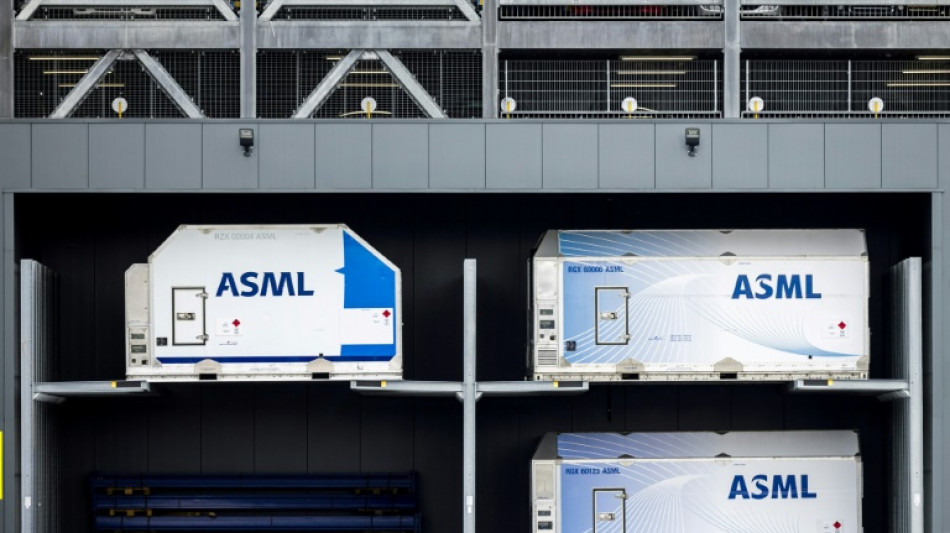
ASML shares dive on lower profits, orders / Photo: © ANP/AFP

 Nigeria's Tinubu confirms 32 dead after military plane crash

 'Reckless' AI firms can't control models, says whistleblower

 Switching on brain cells: the Nobel-winning science of optogenetics

 Quebec votes as separatist surge poses test for Canada PM

 Euro slides as concerns about French debt mount

 Former Trump press secretary Leavitt joins Fox News

 Djokovic advances to China Open final as Medvedev out for hitting fan with ball
 Disgraced former US House speaker dies at 84

 Euro slides as worries about French debt grow
 US withdraws all bomber aircraft from UK airbase

 Drone hits Ethiopia IDP camp as fears grow of regional war

 US-German trio wins medicine Nobel for illuminating the brain
 England captain Kane driven by desire for records says Tuchel

 N.Irish court hears challenge to disputed Orangemen parade

 Talking points from the Bahrain Grand Prix in Malaysia

 Yemen, Saudi Arabia target Houthis in new campaign as war escalates

 US-German trio wins medicine Nobel for work on optogenetics

 Swiatek, Zheng survive three-set tests in China Open third round

 Hasan says Test cricket momentum turning for Bangladesh

 Intense heat puts births in jeopardy, UN tells Fiji talks

 US arrests woman accused of spying for China on Taiwan leader's family

 Yemen military announces broad strikes against Houthis
 Zuckerberg skewered again on screen in 'The Social Reckoning'

 Fiji urges 'just' climate transition, financing at pre-COP gathering

 Thailand's Jeeno overcomes late wobble to win Lotte Championship

Shares in Dutch tech giant ASML, which supplies chip-making machines to the semiconductor industry, slumped Wednesday after the firm reported a drop in net profits and orders amid a high-tech trade spat between China and the West.
Net profits came in at 1.2 billion euros ($1.3 billion) in the first quarter, compared to 2.0 billion euros the firm reported in the fourth quarter of last year.
Bookings slumped to 3.6 billion euros, a sharp decline from the 9.2 billion euros reported in the fourth quarter.
Company shares slumped more than six percent at the opening bell of the Amsterdam stock exchange, which was down 0.7 percent overall.
The stock recovered slightly during the day but was still around four percent lower just before the close.
ASML is one of the leading manufacturers of equipment to make state-of-the-art semiconductor chips, which power everything from mobile phones to cars.
But the semiconductor industry has become a geopolitical battleground as the West seeks to restrict China's access over fears the chips could be used for advanced weaponry.
ASML announced this year that it had been blocked from exporting "a small number" of its advanced machines to China, amid reports of US pressure on the Dutch government.
Chief executive Peter Wennink said the firm was still upbeat for the second half of 2024, which ASML has identified as a "transition" year before a stronger 2025.
He admitted in a conference call that the first quarter was "relatively slow" but said this was "consistent with our guidance and expectation of an industry coming out of a downturn."
Overall sales in the first quarter came in at 5.3 billion euros, lower than the 7.2 billion euros from the fourth quarter but in the range the company had forecast.
In its annual report published in January, the firm had forecast first-quarter sales of between 5.0 and 5.5 billion euros.
For the second quarter, the firm said it expected total net sales between 5.7 billion and 6.2 billion.
- 'Operation Beethoven' -
Chief Financial Officer Roger Dassen said investors should bear in mind that combined orders over the past two quarters amounted to 13 billion euros -- "a pretty significant number."
He said orders were "typically quite lumpy", meaning wide variations can occur from quarter to quarter.
Despite the first quarter drop in sales, the percentage of sales to China actually rose -- to 49 percent from 39 percent in the fourth quarter of last year.
"In terms of trends in China, there was a strong first quarter. We expect China to continue to be strong this year," Dassen said on the investor call.
ASML employs 42,000 people worldwide, more than half of whom are based at the firm's huge complex in Veldhoven, in the east of the Netherlands, with a significant proportion coming from abroad.
That aspect of the business has hit the headlines in recent months with the surprise election win of far-right leader Geert Wilders, who wants to drastically crimp immigration.
The firm has said that if it is unable to find the talent in the Netherlands, it could possibly be forced to look elsewhere, unnerving Dutch politicians.
Last month, the country unveiled "Operation Beethoven", a charm offensive worth 2.5 billion euros to keep global firms like ASML from moving abroad to attract talent.
The semiconductor industry was at the heart of discussions between Dutch Prime Minister Mark Rutte and Chinese President Xi Jinping last month in Beijing.
Xi declared that "no force can stop the pace of China's scientific and technological progress" while Rutte said that any measures taken were not aimed at one specific country.
There are concerns Beijing may introduce its own export controls on gallium and germanium -- two rare earth metals critical for the manufacture of semiconductors.
M.Schneider--VB