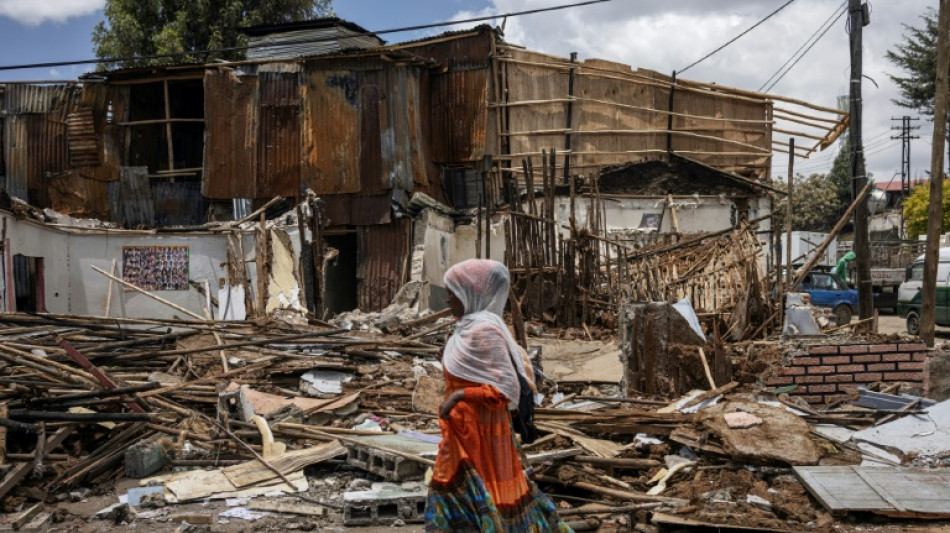
Ethiopians mourn the destruction of historic Piassa district / Photo: © AFP

 Nigeria's Tinubu confirms 32 dead after military plane crash

 'Reckless' AI firms can't control models, says whistleblower

 Switching on brain cells: the Nobel-winning science of optogenetics
 Quebec votes as separatist surge poses test for Canada PM

 Euro slides as concerns about French debt mount

 Former Trump press secretary Leavitt joins Fox News

 Djokovic advances to China Open final as Medvedev out for hitting fan with ball

 Disgraced former US House speaker dies at 84

 Euro slides as worries about French debt grow
 US withdraws all bomber aircraft from UK airbase
 Drone hits Ethiopia IDP camp as fears grow of regional war

 US-German trio wins medicine Nobel for illuminating the brain
 England captain Kane driven by desire for records says Tuchel
 N.Irish court hears challenge to disputed Orangemen parade

 Talking points from the Bahrain Grand Prix in Malaysia

 Yemen, Saudi Arabia target Houthis in new campaign as war escalates
 US-German trio wins medicine Nobel for work on optogenetics

 Swiatek, Zheng survive three-set tests in China Open third round
 Hasan says Test cricket momentum turning for Bangladesh
 Intense heat puts births in jeopardy, UN tells Fiji talks

 US arrests woman accused of spying for China on Taiwan leader's family
 Yemen military announces broad strikes against Houthis

 Zuckerberg skewered again on screen in 'The Social Reckoning'

 Fiji urges 'just' climate transition, financing at pre-COP gathering

 Thailand's Jeeno overcomes late wobble to win Lotte Championship
"Our history and our identity have been erased," laments Samira after the destruction of her birthplace in the historic Piassa district in the heart of Ethiopia's capital.
In recent weeks, bulldozers have torn down countless buildings in Piassa -- some dating back a century -- as part of a modernisation drive by the authorities.
Many parts of the vibrant, if somewhat tumbledown, neighbourhood have been turned into dusty piles of rubble, with locals often given little notice to leave their homes or businesses.
A number of historical and well-loved sites in the area, from Ethiopia's first baklava bakery to jewellery and gold shops and bustling cafes, have disappeared.
Critics say the urban renewal scheme known as the Addis Ababa Corridor Development Project has not only wrecked buildings, but also the fabric of society in Piassa, where people from all walks of life rubbed shoulders in its cobbled streets.
"A lot of cherished history has been destroyed," says Samira, a 30-year-old government employee who like other residents interviewed by AFP did not want to give her name for fear of reprisals.
The local authorities had informed the family that the home where Samira was born and raised would be razed "without telling us the exact date".
"They cut our water and electricity the following weekend, then we were given a day and a half notice to leave," says the mother of a baby daughter, mourning the family memories lost or damaged in the hasty move.
Fellow Piassa resident Sami tells a similar story.
"Everything went at the speed of light," he says, recounting how the building owned by his father that housed Sami's printing shop business and other stores was torn down.
"I used to have a shop, but now I don't," the 40-year-old says grimly.
"Yes, it's old, but that doesn't mean it's trash... It's our heritage."
- 'Unique' urban environment -
The Arada district, named "Piazza" by Mussolini's occupying forces in the 1930s, and commonly known as Piassa to this day, was developed around a vast market at the turn of the 20th century.
"Arada was the commercial heart of the Ethiopia of Menelik II," says anthropologist Dominique Harre, referring to the emperor who ruled from 1889 to 1913.
Harre, author of the "Addis Ababa Old Piazza" guidebook, says large trading houses -- Indian, Armenian, Greek, French, Ethiopian -- set up around the market and in the nearby streets.
This cosmopolitan society created a "unique urban" environment with an eclectic mix of architectural influences, she says.
Since the 1920s, warehouses operated by the traders have stood alongside small kiosks and stores, while elegant stone and wood villas owned by wealthy merchants or dignitaries co-existed with more modest homes.
"What is really unique in Piassa is that it was built... with African characteristics, contrary to other African capitals" that were built by colonial powers with "colonial urban planning," says architect Piet Nieder.
Nieder, author of "The Addis Ababa House" about Ethiopia's urban heritage from its founding in 1886 to 1936, says the city has lived through such demolitions and evictions in the past as the sprawling metropolis developed.
"But what is new is the extent of the current destructions. So many households are being destroyed simultaneously."
- 'Our heritage' -
Since coming to power in 2018, Prime Minister Abiy Ahmed has embarked on a number of grandiose projects including a new multi-billion-dollar presidential palace in Addis Ababa, and a new museum right on the edge of Piassa.
The large-scale spending has raised eyebrows in a country where, according to the UN, more than 21 million people are in need of aid because of conflict and climate disasters.
The Reporter newspaper, citing official data, said 56 listed buildings in Piassa have already been totally or partly demolished.
Ethiopian Heritage Authority director Abebaw Ayalew insists the body has been closely overseeing the development work to ensure the nation's cultural heritage is unharmed.
But he told reporters: "The age of a building alone does not automatically render it eligible for heritage status".
Addis mayor Adanech Abebe has defended the project, saying it will benefit all of society with the creation of wide roads, bike paths and children's playgrounds.
"Some areas were falling apart even before we started demolishing them," she said. "We have preserved memories that should be preserved."
Most of the cleared sites in Piassa will be put up for auction, according to the municipal authorities.
Those evicted have complained about the lack of financial compensation and the relocation sites.
Azeb, a Piassa trader for 30 years, says she was offered land "far from the road and unsuitable for any construction either a house or a commercial property".
The block where Samira has been allocated an apartment is "a skeleton of a building, with no windows or doors, no plumbing, no water or electricity... no toilet", she says.
"It's not even fit to house animals."
Samira says the mixed population of Piassa has been scattered.
"The next time our children ask questions about our heritage and where we grew up, there will be nothing to show them."
H.Weber--VB