Behind the growth, Ivory Coast's debt fuels debate / Photo: © AFP/File

 Nigeria's Tinubu confirms 32 dead after military plane crash
 'Reckless' AI firms can't control models, says whistleblower

 Switching on brain cells: the Nobel-winning science of optogenetics
 Quebec votes as separatist surge poses test for Canada PM
 Euro slides as concerns about French debt mount
 Former Trump press secretary Leavitt joins Fox News

 Djokovic advances to China Open final as Medvedev out for hitting fan with ball
 Disgraced former US House speaker dies at 84
 Euro slides as worries about French debt grow
 US withdraws all bomber aircraft from UK airbase
 Drone hits Ethiopia IDP camp as fears grow of regional war

 US-German trio wins medicine Nobel for illuminating the brain
 England captain Kane driven by desire for records says Tuchel
 N.Irish court hears challenge to disputed Orangemen parade

 Talking points from the Bahrain Grand Prix in Malaysia

 Yemen, Saudi Arabia target Houthis in new campaign as war escalates
 US-German trio wins medicine Nobel for work on optogenetics
 Swiatek, Zheng survive three-set tests in China Open third round

 Hasan says Test cricket momentum turning for Bangladesh
 Intense heat puts births in jeopardy, UN tells Fiji talks
 US arrests woman accused of spying for China on Taiwan leader's family
 Yemen military announces broad strikes against Houthis
 Zuckerberg skewered again on screen in 'The Social Reckoning'
 Fiji urges 'just' climate transition, financing at pre-COP gathering

 Thailand's Jeeno overcomes late wobble to win Lotte Championship
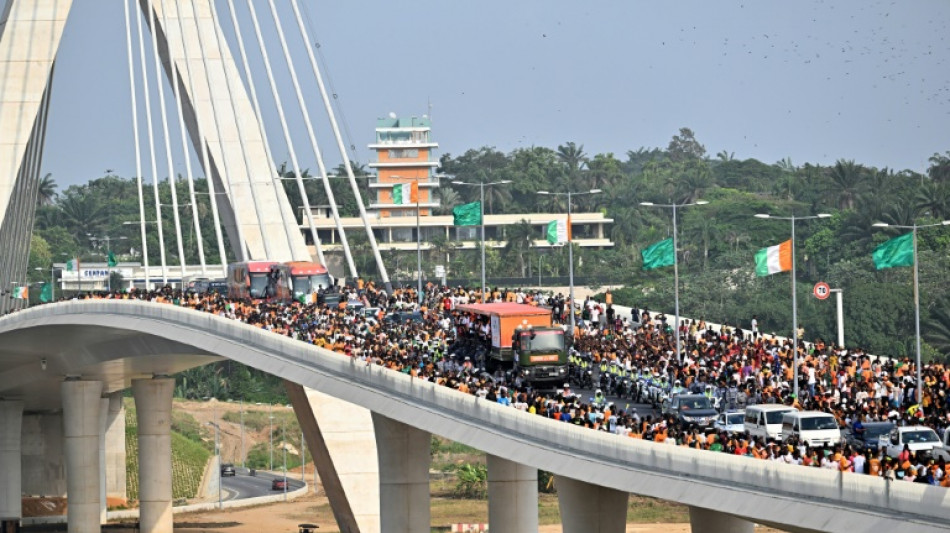
Abidjan's soaring Alassane Ouattara bridge lit up at night in the colours of the national flag is Ivory Coast's jewel in the crown after years of investment.
Roads, tower blocks, the installation of electricity, bridges -- the economic capital today is barely recognisable from 10 years ago.
Robust economic growth has again made Ivory Coast a regional heavyweight -- but, with levels of debt that spark fierce debate.
Named after the president, the cable-stayed bridge, inaugurated last year, was the last in a string of major construction projects.
When Ouattara came to power in 2011, Ivory Coast was emerging from a post-electoral crisis that had left more than 3,000 people dead.
It had to convince investors to bet on the return of what was once known as the engine of West Africa.
But under the former International Monetary Fund (IMF) economist, confidence has returned and with it, growth.
Since 2011, the economy of the world's leading cocoa producer has grown by more than seven percent a year on average, driven in part by the agricultural sector made up largely of cocoa exports.
Its hosting of the Africa Cup of Nations at the beginning of the year also prompted more spending on infrastructure.
Roads and motorways were built to link up the main cities.
The rampant development, however, has not masked stark inequality.
While the poverty rate dropped from 55 percent in 2011 to 39.5 percent in 2018, it was still at just over a third of the population in 2020.
"GDP (gross domestic product) has doubled under Ouattara, that's to his credit. But it's not an indicator which shows how the wealth is shared," Ivorian economist Seraphin Prao told AFP.
The population of Abidjan has mushroomed from three million to six million between 1998 and 2021, according to the National Institute of Statistics.
Poor districts with insanitary housing are still commonplace, although some have been demolished to make way for new infrastructure.
Underscoring the gulf between rich and poor, trendy neighbourhoods with brand new villas have sprung up sometimes next door to shantytowns.
With Ivory Coast still largely dependent on foreign aid, the amount of debt it now faces divides economists and often comes under attack by the opposition.
- 'Nothing to worry about' -
"Debt in itself isn't a bad thing but we are facing in Ivory Coast's case unproductive debt," Ahoua Don Mello, vice president of the BRICS group of emerging nations, said.
"Out of the 2023 budget, nearly 42 percent is own resources, all the rest is financed by debt infusion," added Don Mello, who is also deputy head of the opposition Party of African Peoples-Ivory Coast.
Current debt -- owed principally to Western lenders and China -- represents 58 percent of GDP, up from 38 percent in 2019.
But economists disagree on how sustainable that level is.
Blaise Makaye, an economics researcher at Bouake university, said the recommended ratio of debt to GDP was between 60 and 70 percent.
"We haven't exceeded 60 percent, there's nothing to worry about," he said, calling the Ivorian ratio "well below" those of developed countries such as France.
But Prao, the economist, says that according to the IMF, for small economies like Ivory Coast, going above 49-percent debt "can be dangerous".
He is worried by the country's "high" interest rates and "fragile" economic foundations.
"Growth is on credit, civil servants are paid on credit," Prao said.
- Masking the problems -
Economy Minister Adama Coulibaly insists there is no risk of Ivory Coast being unable to repay its debt.
He has said that the IMF -- which approved $3.5 billion in loans last May -- and the World Bank have described the country's debt as sustainable.
He also says neighbours such as Senegal and fellow cocoa producer Ghana have higher debt levels.
In 2011, lenders reduced Ivory Coast's external debt by about 25 percent to help it recover from the crisis.
"That should have made it possible to assign the state's own resources to education and health. But, our resources are not even enough today to cover current expenditure of the state," opposition figure Don Mello said.
As long as money continues to be available "on a drip", the problems will not be seen, he added.
"But if the infusion is taken away, you'll see there is no longer means to feed the state budget."
T.Germann--VB