
Mideast-related oil price spike threatens 'relatively good' economic outlook: IMF chief economist / Photo: © AFP

 Nigeria's Tinubu confirms 32 dead after military plane crash

 'Reckless' AI firms can't control models, says whistleblower

 Switching on brain cells: the Nobel-winning science of optogenetics

 Quebec votes as separatist surge poses test for Canada PM

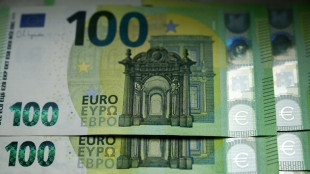 Euro slides as concerns about French debt mount

 Former Trump press secretary Leavitt joins Fox News

 Djokovic advances to China Open final as Medvedev out for hitting fan with ball

 Disgraced former US House speaker dies at 84

 Euro slides as worries about French debt grow

 US withdraws all bomber aircraft from UK airbase

 Drone hits Ethiopia IDP camp as fears grow of regional war

 US-German trio wins medicine Nobel for illuminating the brain

 England captain Kane driven by desire for records says Tuchel
 N.Irish court hears challenge to disputed Orangemen parade

 Talking points from the Bahrain Grand Prix in Malaysia

 Yemen, Saudi Arabia target Houthis in new campaign as war escalates

 US-German trio wins medicine Nobel for work on optogenetics

 Swiatek, Zheng survive three-set tests in China Open third round

 Hasan says Test cricket momentum turning for Bangladesh

 Intense heat puts births in jeopardy, UN tells Fiji talks
 US arrests woman accused of spying for China on Taiwan leader's family

 Yemen military announces broad strikes against Houthis

 Zuckerberg skewered again on screen in 'The Social Reckoning'

 Fiji urges 'just' climate transition, financing at pre-COP gathering

 Thailand's Jeeno overcomes late wobble to win Lotte Championship

The recent oil price spike fueled by rising Middle East tensions has the potential to derail the IMF's "relatively good" outlook for the world economy, its chief economist told AFP.
"We are projecting a global economy that is quite resilient for 2024," Pierre-Olivier Gourinchas said in an interview ahead of the publication of the International Monetary Fund's World Economic Outlook (WEO) report on Tuesday.
The IMF now expects the world economy to grow by 3.2 percent this year and next, and inflation to continue to ease from its post-pandemic high, hitting 5.9 percent this year, and 4.5 percent next year amid elevated interest rates in many countries.
"The news is relatively good," Gourinchas said.
"One of the things that could derail that path towards disinflation would be some disruption in oil prices or energy prices or commodity prices," he continued.
"So far, we've seen some pressure in oil prices, but it's way too early to figure out whether that will be sustained," he added.
- US driving growth -
"A lot of the news have been very good on the United States economy over the last six months," Gourinchas said, pointing to robust US productivity growth, an immigration-driven boost in the labor supply, and "quite a bit of public spending."
The rise in foreign-born workers in the US "increases the capacity of the economy to produce more and it also moderates the pressures on the labor market," he said.
"We're still expecting inflation to come down in the course of 2024, and to leave the Federal Reserve in a position where it will be able to start cutting rates later in the year," he said.
In contrast to the resilient US economy, the IMF expects European growth to continue at a more lackluster pace in the short term, predicting 0.8 percent growth for the euro area this year, picking up slightly to 1.5 percent in 2025.
"The consequences of the energy shock are still there to some extent, although this has moderated quite a bit," Gourinchas said.
"But let's not forget that we have tight monetary policy, and that monetary policy is increasing the cost for borrowing and for households and businesses," he added.
Unlike the US, European consumers and businesses are also feeling much less confident in the health of the overall economy, according to Gourinchas.
"That means less consumption, less aggregate demand, less investment," he said. "There is no sign of overheating."
Because of the rapid pace of disinflation in Europe in recent months, the IMF sees the European Central Bank's projection of a June interest rate cut as a "reasonable forecast," Gourinchas said.
- China operating 'below potential' -
In Asia, the IMF expects China's growth rate to continue to ease over the next few years due to the easing of a "postpandemic boost to consumption and fiscal stimulus," and the ongoing weakness in the property sector, according to the WEO report.
"China is another example where you see an economy that is operating below potential," Gourinchas told AFP. "Growth is lower than what the economy can sustain."
"This is an economy that would benefit from tackling some of its supply side problems -- the property sector chiefly -- but can also afford to have a little bit more expansionary policies -- in particular monetary policy," he added.
The IMF's WEO report also found that "the pace of convergence toward higher living standards for middle- and lower-income countries has slowed," adding that income inequality could persist if something was not done to remedy the worrying situation.
"If you're trying to catch up with advanced economies, and you start going a little bit slower, it's going to take you longer to get there," Gourinchas said.
"Countries should think about ways they can boost medium term growth, either through changes in policies, attracting foreign capital and investment or educating the population," he continued.
Higher growth would allow governments "to invest in the multiple challenges that these countries are facing, whether it's building safety nets, it's increasing education, capital, its financing the climate transition or adaptation for many of these countries," he added.
D.Schaer--VB