Cheap Chinese steel threatens jobs in Latin America / Photo: © AFP

 Nigeria's Tinubu confirms 32 dead after military plane crash

 'Reckless' AI firms can't control models, says whistleblower

 Switching on brain cells: the Nobel-winning science of optogenetics

 Quebec votes as separatist surge poses test for Canada PM

 Euro slides as concerns about French debt mount

 Former Trump press secretary Leavitt joins Fox News

 Djokovic advances to China Open final as Medvedev out for hitting fan with ball
 Disgraced former US House speaker dies at 84

 Euro slides as worries about French debt grow
 US withdraws all bomber aircraft from UK airbase
 Drone hits Ethiopia IDP camp as fears grow of regional war

 US-German trio wins medicine Nobel for illuminating the brain
 England captain Kane driven by desire for records says Tuchel

 N.Irish court hears challenge to disputed Orangemen parade

 Talking points from the Bahrain Grand Prix in Malaysia

 Yemen, Saudi Arabia target Houthis in new campaign as war escalates

 US-German trio wins medicine Nobel for work on optogenetics

 Swiatek, Zheng survive three-set tests in China Open third round

 Hasan says Test cricket momentum turning for Bangladesh

 Intense heat puts births in jeopardy, UN tells Fiji talks

 US arrests woman accused of spying for China on Taiwan leader's family

 Yemen military announces broad strikes against Houthis

 Zuckerberg skewered again on screen in 'The Social Reckoning'

 Fiji urges 'just' climate transition, financing at pre-COP gathering

 Thailand's Jeeno overcomes late wobble to win Lotte Championship

Latin American metal workers are clamoring for higher import tariffs as cheap Chinese steel floods the region, threatening hundreds of thousands of jobs linked to the industry.
Last year, the region imported a record 10 million tons of Chinese steel -- a 44 percent rise from the year before, according to data from the Latin American Steel Association (Alacero).
Two decades ago, the figure was just 85,000 tons.
"China is too present in Latin America," Alacero executive Alejandro Wagner told AFP.
"No one is against trade between countries, but it must be fair trade," he added.
As the pressure increases, steel plant bosses and workers in countries like Chile and Brazil -- the top producer in the region and number nine in the world -- are pressing governments for higher import tariffs.
If they were to do so, they would follow Mexico and the United States, which have imposed additional tariffs of 25 percent on Chinese imports amid a surge of cheap exports as a result of Beijing subsidies and excess production.
Earlier this month, US Treasury Secretary Janet Yellen expressed concern about "substantial overinvestment and excess capacity" in sectors like steel and aluminum in China, which she said had "decimated industries across the world and in the United States."
A dive in the Asian giant's construction sector has further added to an oversupply of steel for exportation.
Data from the Economic Commission for Latin America and the Caribbean in 2022 showed China leading global steel production with 54 percent, followed by India with 6.6 percent.
Latin America's top producers -- Brazil, Mexico, Argentina and Colombia -- came in at a combined 3.1 percent.
- 'Existence of dumping' -
In Latin America, some 1.4 million people work in the steel industry.
But their livelihoods have increasingly come under fire as Chinese steel now sells as much as 40 percent cheaper than it could viably be produced on home soil.
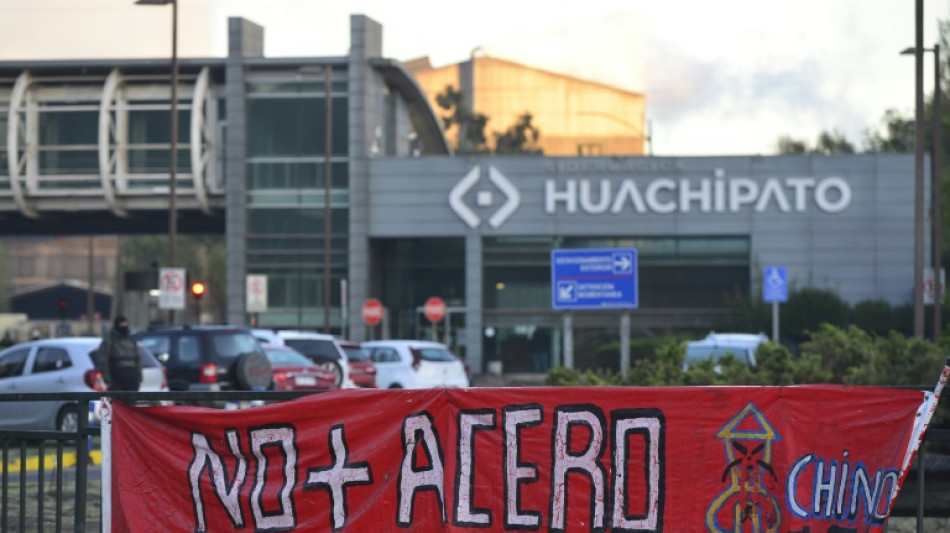
One casualty is the Huachipato steel plant, Chile's biggest, some 500 kilometers (310 miles) south of Santiago.
It has announced it is winding down operations, threatening about 2,700 direct and 20,000 indirect jobs.
"Closing Huachipato would be like an atomic bomb" hitting the region, worker Carlos Ramirez told AFP.
"What we are experiencing is very painful," the 56-year-old said, warning of a looming "social earthquake" for the port city of Talcahuano that has lived mainly from steel for 70 years.
Since 2009, Huachipato has incurred losses of more than $1 billion.
In a last-ditch effort to stay afloat, the company has asked Chile's CNDP price-distortion commission to recommend the government impose a 25 percent tariff on imported steel.
The commission in a recent ruling found "sufficient evidence to support the existence of dumping" -- the selling of Chinese steel below cost -- and recommended a levy of 15 percent.
"We are not asking for subsidies or bailouts. Huachipato can be profitable in a competitive environment," its manager, Jean Paul Saure, said in a press statement.
Huachipato specializes in key inputs for the mining industry, including steel bars and balls used in the milling of copper -- of which Chile is the world's largest producer.
During the Covid-19 pandemic, when world trade was interrupted, "it was Huachipato that kept the country's steel supply" afloat, Economy Minister Nicolas Grau told AFP.
The government, however, has its hands tied: Chile signed a free trade agreement with China in 2006 and risks punitive measures if it opts for a tariff to protect its steel industry against dumping.
In Brazil, steel imports from China rose 50 percent last year as production dropped by 6.5 percent, according to the Brazil Steel Institute.
Gerdau, one of the country's largest steel producers, has laid off 700 workers due to the "challenging scenario faced by the Brazilian market in the face of predatory import conditions of Chinese steel," the company said.
Like in Chile, the Brazilian steel industry is demanding the government increase the import tariff to 25 percent from a base that varies from product to product.
F.Wagner--VB