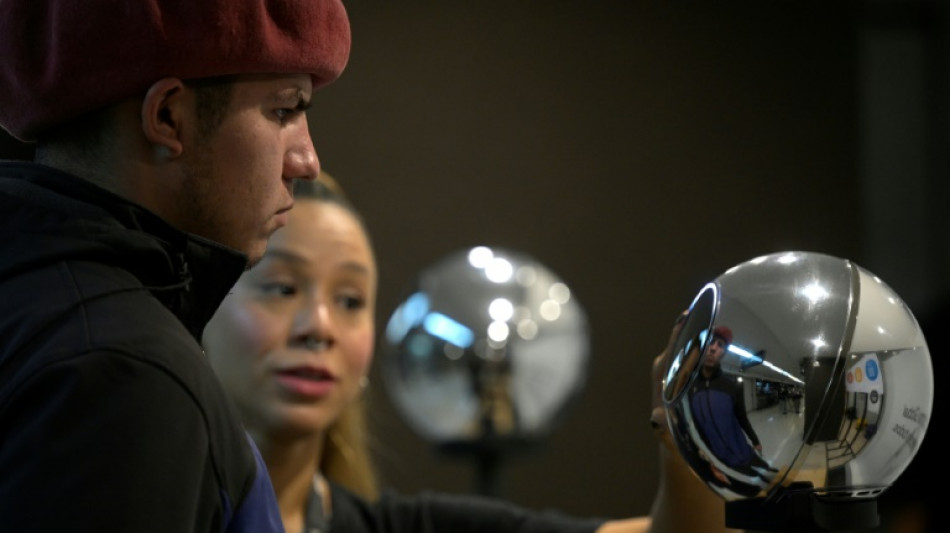
Cash-strapped Argentines queue for eyeball scans / Photo: © AFP

 ICC unseals arrest warrants for Taliban education ministers
 Modric hopes fans back Croatia against Spain after England shame

 Bolsonaro rides right-wing surge into Brazil's election runoff

 Turkey blocks X account of British reporter

 Ukraine says using AI robot guns to shoot down new Russian drones

 At Oct 7 memorial, Netanyahu says will be no Hamas rule in Gaza

 Ukraine blames Russia for deadly sinking of Turkish ship in Black Sea

 UN rights council slams Taliban's 'oppression' of women
 Norway eyes partial ban of smart glasses
 Two dead after ship catches fire, sinks in Black Sea

 Spain's PM calls snap election after housing bill defeat

 STARCARES Equips Seven Foster Homes for Children and Young People in Tanzania

 Alleged Indian leader of neo-Nazi child abuse ring goes on trial in Paris
 Euro, French stocks slide on France debt concerns
 Alcaraz advances to Japan Open final

 US-German trio win medicine Nobel for work on optogenetics

 Hundreds of French high schools shut as protests persist

 Spain PM calls early election after housing crisis defeat

 Stocks rally as 'Goldilocks' jobs data ease rate fears
 Myanmar says 10,000 migrants returned from Malaysia this year

 Big guns back for Australia's Rugby League World Cup defence

 Braves rock Dodgers to level series, Brewers win thriller

 Most Asia stocks rally as 'Goldilocks' jobs data ease rate fears

 Sunken Silk Road city reveals Central Asia's lost history

 Three years on, Israeli rescuer cannot escape October 7

Argentines eyeing a financial boost are lining up by the thousands to have their irises scanned in exchange for a few crypto tokens as part of an online biometrics project under scrutiny in several countries.
Some three million people worldwide have so far provided their iris data to Worldcoin, an initiative of OpenAI chief Sam Altman, but few have embraced the project more fervently than Argentines.
Half-a-million people in the South American nation have participated since Worldcoin launched last July, and queues for scans have grown longer in recent months of fast-shrinking disposable income.
"I did it because I don't have any money, for no other reason," 64-year-old martial arts teacher Juan Sosa told AFP after staring for a few seconds into a silver iris-scanning orb roughly the size of a bowling ball at one of 250 Worldcoin locations across Argentina.
The project seeks to use these iris specs -- unique to each person on Earth -- to develop a digital identification system, a sort of passport that will guarantee the holder is a real human being and not a bot, thus securing online transactions.
Volunteers do not provide any other information such as their name, address or phone number.
The personal iris data is encrypted and, according to Worldcoin, safe.
Yet Kenya, Spain and Portugal have ordered it to pause collecting biometric data on their territories pending investigations by numerous countries into possible privacy concerns.
Argentina's own Agency for Access to Public Information has said it is verifying Worldcoin's "security measures" with a view to "protecting the privacy of the users."
It has yet to make a ruling and has not suspended data collection.
"There are people going through very tough times, where one salary is not enough. That is why they do these things," Miriam Marrero, a 42-year-old supermarket cashier, said after being scanned in Buenos Aires.
"Sometimes, to have a roof over your head, you need to do other things to be able to afford it. Otherwise, in Argentina today, you can't afford a roof."
For volunteering their data, initial participants receive 10 tokens each of Worldcoin's own cryptocurrency, the WLD.
In Argentina, with its notoriously unstable exchange rate, the value differs wildly; when Sosa and Marrero received theirs, 10 tokens were worth the equivalent of about $80.
- 'Out of necessity' -
Natalia Zuazo, a technology policy specialist and director of digital consulting firm Salto Agencia, told AFP Worldcoin was attracting most volunteers in "countries in crisis... the poorest countries, because people are more likely to enter into such transactions."
Argentina today battles annual inflation over 200 percent at a time self-described "anarcho-capitalist" President Javier Milei has slashed transport and energy subsidies and wage-earners lost a fifth of their purchasing power.
In Worldcoin's own words, it seeks to become "the world's largest privacy-preserving human identity and financial network," providing "universal access to the global economy no matter your country or background."
The company insists it never has and never will sell personal data.
But the initiative has triggered alarm bells, with regulators worldwide concerned about the collection, storage and use of personal information.
According to Zuazo, person-specific biometric data such as iris specs are "ultra-sensitive" and could theoretically be employed for nefarious identification purposes.
"I don't think people do not understand the implications," she said. "They just do it out of necessity."
Student Ulises Herrera, 20, said he would never have undergone a scan without the economic incentive.
"The iris is something that cannot be changed and I don't know who has that data. That's what scares me," he told AFP.
Others are more laid back about it.
"For years I have given my personal data to many different companies, at least this one will give me money," said Federico Mastronardi, a 33-year-old musician.
Added Marrero, the cashier: "I am not afraid they will make another version of me, as long as they make a better one!"
T.Germann--VB