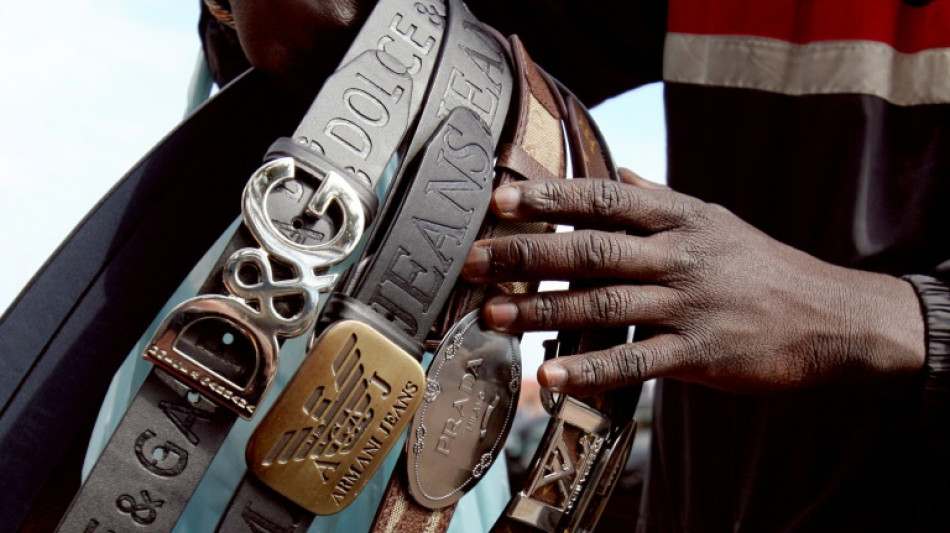
'Market of Fakes' in Naples, capital of counterfeits and Camorra / Photo: © AFP

 ICC unseals arrest warrants for Taliban education ministers

 Modric hopes fans back Croatia against Spain after England shame
 Bolsonaro rides right-wing surge into Brazil's election runoff

 Turkey blocks X account of British reporter

 Ukraine says using AI robot guns to shoot down new Russian drones

 At Oct 7 memorial, Netanyahu says will be no Hamas rule in Gaza
 Ukraine blames Russia for deadly sinking of Turkish ship in Black Sea

 UN rights council slams Taliban's 'oppression' of women

 Norway eyes partial ban of smart glasses

 Two dead after ship catches fire, sinks in Black Sea

 Spain's PM calls snap election after housing bill defeat

 STARCARES Equips Seven Foster Homes for Children and Young People in Tanzania

 Alleged Indian leader of neo-Nazi child abuse ring goes on trial in Paris
 Euro, French stocks slide on France debt concerns

 Alcaraz advances to Japan Open final

 US-German trio win medicine Nobel for work on optogenetics

 Hundreds of French high schools shut as protests persist

 Spain PM calls early election after housing crisis defeat

 Stocks rally as 'Goldilocks' jobs data ease rate fears
 Myanmar says 10,000 migrants returned from Malaysia this year

 Big guns back for Australia's Rugby League World Cup defence

 Braves rock Dodgers to level series, Brewers win thriller

 Most Asia stocks rally as 'Goldilocks' jobs data ease rate fears
 Sunken Silk Road city reveals Central Asia's lost history

 Three years on, Israeli rescuer cannot escape October 7
As top brands like Gucci and Prada prepare to report billions in sales this month, luxury fakes on the streets of Naples are also yielding a jaw-dropping cash stream -- for the mafia.
The teeming southern metropolis is ground zero for Italy's estimated 6-7 billion euro ($6.5-7.5 billion) counterfeit market, where fake handbags, sunglasses, clothing and shoes flourish, hawked in plain sight to buyers willing to score a knockoff bargain.
"Which brand do you like? What colour, what model?" asks a persistent seller at the "Market of Fakes" spread out over back alleys near the gritty city's central train station.
Men arrive hauling overstuffed blue plastic bags, from which emerge Gucci baseball hats, Fendi wallets, Hermes belts and bright orange Louis Vuitton shoeboxes, sold from rickety tables at a fraction of the price of their originals.
Counterfeits are a global phenomenon, whether fake fashion, toys, electronics, food or pharmaceuticals, estimated by the OECD to represent 2.5 percent of world trade.
But Italy -- home of the most luxury fashion brands -- is the clear leader in counterfeit seizures within the European Union, accounting for 63 percent of detained items in 2022, according to a November EU report.
And it's in Naples where counterfeits find a unique breeding ground, giving it the dubious distinction of being the undisputed European capital of fakes.
The city is home to every phase of the counterfeit fashion supply chain from manufacturing and warehousing to distribution and sales -- all dominated by the region's homegrown Camorra mafia.
- Easy money -
While many consumers are unconcerned about counterfeits, the mafia's handprint has increasingly made them a law enforcement priority.
"Counterfeiting is very important because it's a warning bell," signalling more dangerous crimes, said Lieutenant Colonel Giuseppe Evangelista, head of operations in Naples for the Guardia di Finanza, Italy's financial crimes police.
While less lucrative than selling drugs, counterfeiting generates cash, helps launder drug money and is relatively low-risk, with jail sentences far below those for more violent crimes.
"They've already got the clientele... the tourists go by on the street, the bag is bought and it generates profits for the criminal organisation," Evangelista told AFP.
Police seizures are frequent and on the rise, including the discovery of a factory producing thousands of counterfeit Napoli banners, jerseys and caps in February.
Interior ministry data shows that between 2018 and 2022, Naples police seized nearly 100 million items worth over 470 million euros -- some 14 percent of the value of all counterfeit goods seized in Italy.
"In Naples, counterfeiting represents a real parallel economic sector," run by local and foreign mafias, wrote a 2021 government report. It called the city a "centre of excellence" for fakes.
An artisanal heritage in tailoring and leather, an international port, high unemployment and an influx of cheap foreign labour have all helped counterfeiting flourish -- as has the local population's longstanding tolerance of bending the rules.
- Camorra and China -
Collaboration between the Camorra and Chinese criminal groups fuels the rigorously controlled system.
While higher quality goods are produced locally, most imported goods come from China and Turkey.
Counterfeiters choose busy EU ports, such as Rotterdam, or those with less stringent control like in Greece or Bulgaria, before reaching Italy by truck.
Once in the Campania region, final finishing takes place in workshops using cheap illegal labour. Labels are frequently shipped separately and sewn on last, making it more difficult for customs to spot fakes.
The mafia also controls distribution, either through its own sales channels or pressuring shop owners to sell fake goods among their genuine items.
A 2022 police investigation found Naples street market sellers paid the mafia up to 200 euros weekly to operate their stands, or were forced to buy their merchandise.
- 'Cancer' in market -
Counterfeiting's negative effect on the economy, notably in terms of lost demand, lost jobs and unpaid taxes, is huge.
The Italian government put it at 17 billion euros in 2020 -- a year when economic activity heavily contracted due to the coronavirus lockdowns.
There are other consequences: many of Naples' hundreds of toxic fires each year are due to the disposal of trimming from counterfeit garments and shoes, experts say.
Top brands spend millions to fight counterfeiting.
Louis Vuitton brought more than 38,000 anti-counterfeiting procedures globally in 2017, according to its website.
Even smaller companies are now setting up legal protection departments, while increasingly investing in tracking technology.
Local businessmen in Naples also established a "Museum of the Real and Fake" to educate consumers. It closed last year.
Its head, Luigi Giamundo, said more than 32,000 small fashion businesses in Campania were threatened by unfair competition, where even raw fabric can be counterfeited.
"It's a cancer wedging itself into our market", Giamundo said.
Juna Shehu of Indicam, an Italian association lobbying for IP protection of leading fashion brands, said industry cannot act alone.
Indicam is calling for the EU to harmonise rules on dealing with seized fakes, with some countries currently making brands pay for their storage or destruction.
Educating consumers is also key. A 2023 survey found one third of EU citizens would consider buying fakes if the originals are too expensive, rising to half of young people.
"This has to be a multidisciplinary approach because counterfeiters are becoming more and more expert," Shehu told AFP.
Back on the Naples street, many customers seem unconcerned.
"It doesn't bother me," said Caterina, 17, who bought a fake YSL wallet from a market seller for 11 euros. The original costs more than 300 euros.
"Regardless of the label, it's about whether I like the object."
L.Wyss--VB