Brazil's Indigenous people turn to EU to save their savanna / Photo: © AFP

 Swiatek, Zheng survive three-set tests in China Open third round

 Hasan says Test cricket momentum turning for Bangladesh
 Intense heat puts births in jeopardy, UN tells Fiji talks
 US arrests woman accused of spying for China on Taiwan leader's family
 Yemen military announces broad strikes against Houthis
 Zuckerberg skewered again on screen in 'The Social Reckoning'
 Fiji urges 'just' climate transition, financing at pre-COP gathering

 Thailand's Jeeno overcomes late wobble to win Lotte Championship
 Brazil heads to run-off as Bolsonaro pulls off shock first place finish over Lula
 EU, China to hold Beijing talks to avert trade war
 Bolsonaro edges past Lula as nail-biter Brazil vote goes to a run-off
 Rubio visits Iceland as US boosts Arctic presence
 Bolsonaro leads Lula as nail-biter Brazil vote goes to a run-off

 Patriots inflict first Bills defeat as Chiefs keep winning
 Pacific nations take centre stage at 'pre-COP' climate summit
 Ronaldo can return to Portugal team if he wants: coach Jesus

 Portugal move into Nations League knockout stage, Germany held

 Ronaldo-less Portugal beat Norway to reach Nations League quarters
 Bosnian Serb strongman claims election win, thanks Trump and Putin
 Israel wear black armbands in Ireland tie over Hamas attack
 'I fear it could drag on': anxiety takes hold in Ethiopian city wrested from rebels

 Brazil's Lula and Flavio Bolsonaro face off in knife-edge election

 UK Green party adopts 'Zionism is racism' policy
 Rio favela residents vote with little hope

 Evenepoel puts worlds 'disappointment' to bed with European crown

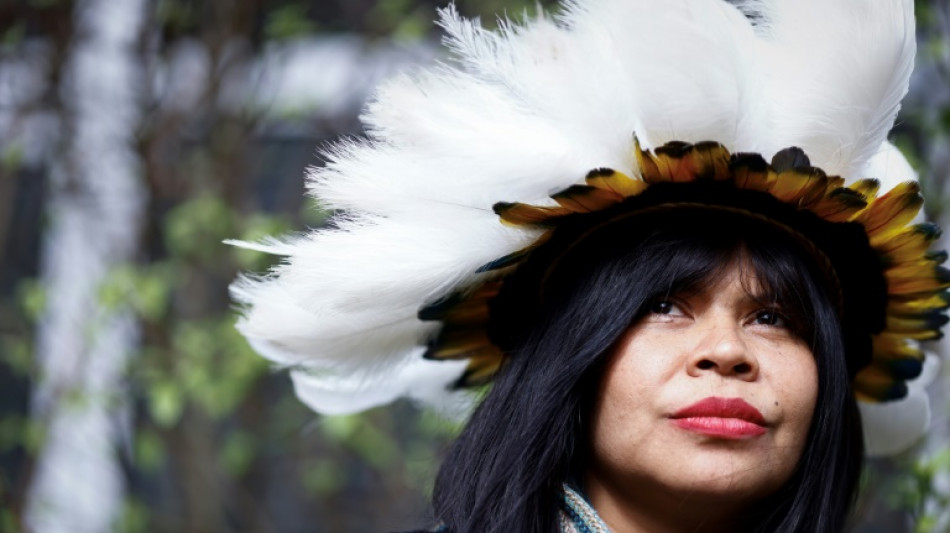
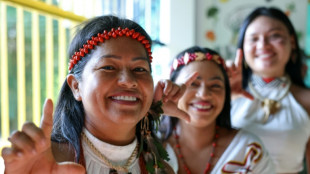
An EU law banning deforestation-derived products comes into effect at the end of 2024, but for Brazilian Indigenous people it contains an unbearable loophole: the Cerrado, Brazil's vast wooded savanna, is excluded from its scope.
An Indigenous delegation taking up the issue during a visit to Brussels said that the oversight -- for a region that supplies Europe with soy -- is "a question of survival" for them.
"The Cerrado is my home," declared Eliane Xunakalo, her feathered headdress waving in Belgium's spring weather.
The president of the Federation of Indigenous Peoples of Mato Grosso, one of the big Brazilian states across which the savanna extends, she visited Brussels last week with other activists to press the European Union to "improve" its anti-deforestation law.
Adopted last year, the legislation requires importers to show their products come from "deforestation-free supply chains" and not from land deforested after 2020.
Its scope covers palm oil, beef, soy, coffee, cocoa, timber and rubber as well as derived products such as furniture and chocolate. It comes into force at the end of December this year.
However the definition of "forest" in the text does not extend to wooded ecosystems such as the Cerrado, which extends through central Brazil and into neighbouring Paraguay and Bolivia.
Much of the soy imported into Europe comes from that zone, and deforestation within it jumped 43 percent last year.
- Reaching point of 'no return' -
The European Commission this year will study possibly enlarging the anti-deforestation law to include other ecosystems and products. The revision will depend on the outcome of a debate between EU member countries and the European Parliament which could take place next year.
For Brazil's Indigenous people, though, urgency is needed.
"Half of the Cerrado has already disappeared," its prairies and woods giving way to farms turning out soy or other crops, said Isabel Figueiredo of the Brazilian NGO ISPN (Instituto Sociedade, Populacao e Natureza).
That agriculture and deforestation is preventing water from seeping down to refill artesian supplies, she said.
After harvests, the Cerrado resembles a patchwork of expansive brown-earth fields punctuated with some growths of native green vegetation. Farm output is only profitable for big multinational companies able to produce at scale.
"The risk is that this amazing ecosystem, with its immense biodiversity and carbon-capture and climate-regulation capacities, will just collapse, and with it its ability to supply water to all parts of Brazil," Figueiredo warned.
"That would be a point of no return," she said.
Samuel Caetano, from another NGO, Cerrado Network, underlined that including the Cerrado in the European law "is a question of survival".
The savanna largely feeds into the Amazon basin's watercourses, "guaranteeing the hydrological balance of Latin America," he said.
The EU may require importers to abide by environmental rules in producing countries, but "the Cerrado is not protected by Brazilian laws -- most of the Brazilian laws are looking at the Amazon," said Giulia Bondi, of the NGO Global Witness.
- Law's 'wider impact' -
For now, NGOs and activists are looking closely at how the existing legislation will be applied.
The EU's environment commissioner Virginijus Sinkevicius in mid-March visited Paraguay, Bolivia and Ecuador to address criticisms they have of the new law.
The bloc has offered technical and financial help for importers to get their tracing systems up to the needed level, responding to complaints that the EU changes will be costly for smaller farms.
"The regulation is indeed quite challenging in terms of traceability, and in terms of the data and data flow that is needed for it to work," said Nicole Polsterer, from the NGO Fern.
But that should be "favourable" for smallholders as "they would be more visible" if larger companies support them, she said.
Eliane Xunakalo said: "We really hope that this law will have wider impact on Brazil, creating political pressure for greater oversight."
Bondi, of Global Witness, noted that the EU does require companies to uphold human rights laws in producing countries.
She said companies must be required to respect Indigenous peoples' rights in line with national laws.
The EU requirements "can also be used as a tool" to put pressure on the Brazilian government to uphold Indigenous rights, she added.
F.Wagner--VB