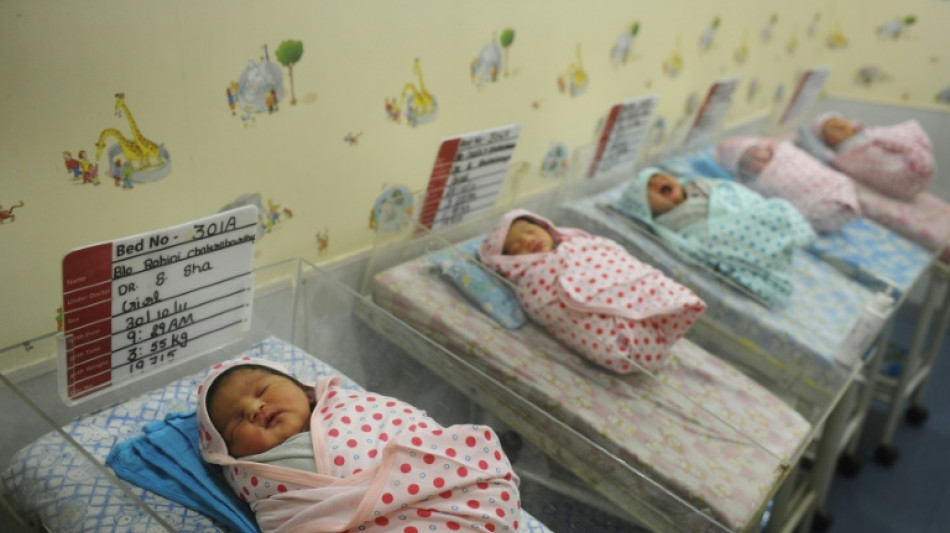
Global fertility rate to keep plummeting, major study warns / Photo: © AFP Photos/File

 Swiatek, Zheng survive three-set tests in China Open third round

 Hasan says Test cricket momentum turning for Bangladesh

 Intense heat puts births in jeopardy, UN tells Fiji talks

 US arrests woman accused of spying for China on Taiwan leader's family

 Yemen military announces broad strikes against Houthis

 Zuckerberg skewered again on screen in 'The Social Reckoning'

 Fiji urges 'just' climate transition, financing at pre-COP gathering

 Thailand's Jeeno overcomes late wobble to win Lotte Championship

 Brazil heads to run-off as Bolsonaro pulls off shock first place finish over Lula

 EU, China to hold Beijing talks to avert trade war

 Bolsonaro edges past Lula as nail-biter Brazil vote goes to a run-off

 Rubio visits Iceland as US boosts Arctic presence

 Bolsonaro leads Lula as nail-biter Brazil vote goes to a run-off

 Patriots inflict first Bills defeat as Chiefs keep winning

 Pacific nations take centre stage at 'pre-COP' climate summit

 Ronaldo can return to Portugal team if he wants: coach Jesus

 Portugal move into Nations League knockout stage, Germany held

 Ronaldo-less Portugal beat Norway to reach Nations League quarters

 Bosnian Serb strongman claims election win, thanks Trump and Putin

 Israel wear black armbands in Ireland tie over Hamas attack

 'I fear it could drag on': anxiety takes hold in Ethiopian city wrested from rebels

 Brazil's Lula and Flavio Bolsonaro face off in knife-edge election

 UK Green party adopts 'Zionism is racism' policy

 Rio favela residents vote with little hope

 Evenepoel puts worlds 'disappointment' to bed with European crown

The population of almost every country will be shrinking by the end of the century, a major study said Wednesday, warning that baby booms in developing nations and busts in rich ones will drive massive social change.
The fertility rate in half of all nations is already too low to maintain their population size, an international team of hundreds of researchers reported in The Lancet.
Using a huge amount of global data on births, deaths and what drives fertility, the researchers tried to forecast the future for the world's population.
By 2050, the population of three quarters of all countries will be shrinking, according to the study by the US-based Institute For Health Metrics and Evaluation (IHME).
At the end of the century, that will be true for 97 percent -- or 198 out of 204 countries and territories, the researchers projected.
Only Samoa, Somalia, Tonga, Niger, Chad and Tajikistan are expected to have fertility rates exceeding the replacement level of 2.1 births per female in 2100, the study estimated.
During this century, fertility rates will continue to increase in developing countries, particularly those in sub-Saharan Africa, even as they tumble in wealthier, ageing nations.
"The world will be simultaneously tackling a 'baby boom' in some countries and a 'baby bust' in others," senior study author Stein Emil Vollset of the IHME said in a statement.
- 'Implications are immense' -
"We are facing staggering social change through the 21st century," he said in a statement.
IHME researcher Natalia Bhattacharjee said the "implications are immense".
"These future trends in fertility rates and live births will completely reconfigure the global economy and the international balance of power and will necessitate reorganising societies," she said.
"Once nearly every country's population is shrinking, reliance on open immigration will become necessary to sustain economic growth."
However World Health Organization experts urged caution for the projections.
They pointed out several limitations of the models, particularly a lack of data from many developing nations.
Communication about the figures "should not be sensationalised, but nuanced, balancing between gloom and optimism," the WHO experts wrote in The Lancet.
They also pointed out that there can be benefits of having a smaller population, such as for the environment and food security. But there are disadvantages for labour supply, social security and "nationalistic geopolitics".
Teresa Castro Martin, a researcher at the Spanish National Research Council not involved in the study, also emphasised that these are just projections.
She pointed out that the Lancet study predicts the global fertility rate will fall below replacement levels around 2030, "whereas the UN predicts this to occur around 2050".
The study was an update of the IHME's Global Burden of Disease study. The organisation, set up at the University of Washington by the Bill and Melinda Gates Foundation, has become a global reference for health statistics.
N.Schaad--VB