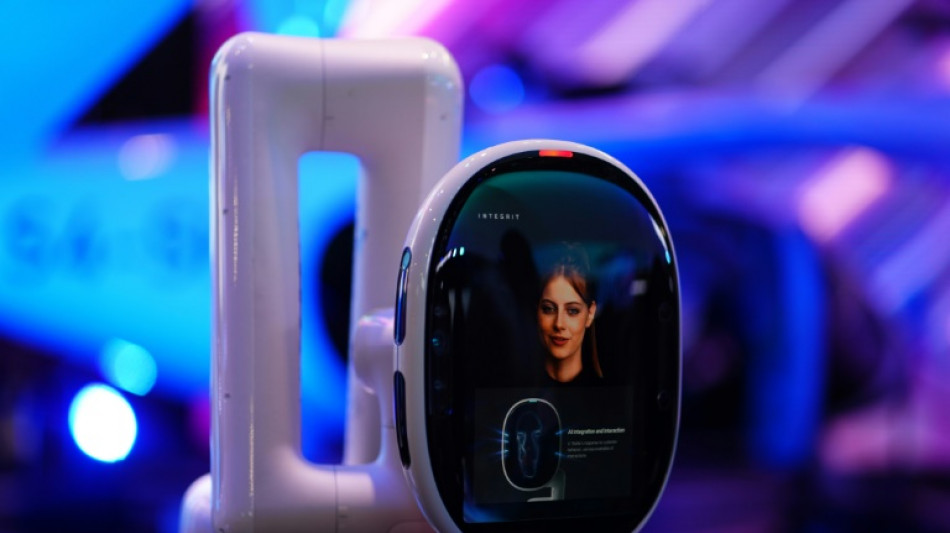
What's included in the new EU law on AI / Photo: © AFP/File

 Zuckerberg skewered again on screen in 'The Social Reckoning'

 Fiji urges 'just' climate transition, financing at pre-COP gathering

 Thailand's Jeeno overcomes late wobble to win Lotte Championship

 Brazil heads to run-off as Bolsonaro pulls off shock first place finish over Lula

 EU, China to hold Beijing talks to avert trade war

 Bolsonaro edges past Lula as nail-biter Brazil vote goes to a run-off

 Rubio visits Iceland as US boosts Arctic presence
 Bolsonaro leads Lula as nail-biter Brazil vote goes to a run-off

 Patriots inflict first Bills defeat as Chiefs keep winning

 Pacific nations take centre stage at 'pre-COP' climate summit

 Ronaldo can return to Portugal team if he wants: coach Jesus

 Portugal move into Nations League knockout stage, Germany held

 Ronaldo-less Portugal beat Norway to reach Nations League quarters

 Bosnian Serb strongman claims election win, thanks Trump and Putin

 Israel wear black armbands in Ireland tie over Hamas attack

 'I fear it could drag on': anxiety takes hold in Ethiopian city wrested from rebels

 Brazil's Lula and Flavio Bolsonaro face off in knife-edge election

 UK Green party adopts 'Zionism is racism' policy

 Rio favela residents vote with little hope

 Evenepoel puts worlds 'disappointment' to bed with European crown

 Two-time winning Arc trainer Rouget bows out in emotional farewell

 Battling Djokovic stuns top seed Zverev at China Open

 Spy chief Clayton, the Trump loyalist tech bosses trust on AI

 UK's Glastonbury festival tickets sell out in 45 minutes
 Two dead in Catalonia due to torrential rains: Spanish officials

The European Parliament on Wednesday gave the final nod to far-reaching rules on artificial intelligence that the EU hopes will both harness innovation and defend against harms.
The law, known as the "AI Act", was first proposed in April 2021 by the European Commission, the EU's executive arm.
But it was only after Microsoft-funded ChatGPT burst onto the scene in late 2022 that the real AI contest began -- and also the race to regulate.
China and the United States last year introduced regulation on AI but the European Union's law is the most comprehensive.
The EU will take a staggered approach to applying the law.
Outright bans on forms of AI considered highest-risk will kick in later this year, while rules on systems like ChatGPT will apply 12 months after the law enters into force, and the rest of the provisions in 2026.
- AI models -
As EU negotiators debated the text, tensions within and lobbying from outside were at their highest over how to regulate general-purpose AI models, like chatbots.
Developers of such models will have to give details about what content they used -- such as text or images -- to train their systems and comply with EU copyright law.
There are a greater set of requirements for models, for example OpenAI's latest ChatGPT-4 and Google's Gemini, that the EU says pose "systemic risks."
Those risks could include causing serious accidents, being misused for far-reaching cyberattacks, or to propagate harmful biases online.
Companies offering these technologies must assess and mitigate the threats, track and report serious incidents -- like deaths -- to the commission, take action to ensure cybersecurity and give details about their models' energy consumption.
The commission has already established the AI office that will enforce the rules on general-purpose AI.
- Risk-based approach -
The EU looks at AI systems from the perspective of risk to democracy, public health, rights and the rule of law.
High-risk products such as medical devices, those used in education or systems used in key infrastructure like water, face more obligations to mitigate any danger.
For example, high-risk providers must develop the systems with quality data, ensure human oversight and maintain robust documentation.
Even after they place their product on the market, providers have to keep a close eye.
EU citizens will have the right to complain about AI systems, while public bodies must register the high-risk AI systems they deploy in a public EU database.
Breaking the rules can be costly.
The EU can slap AI providers with fines ranging between 7.5 million and 35 million euros ($8.2 million and $38.2 million), or between 1.5 and seven percent of a company's global turnover, depending on the size of the violation.
The rules also stipulate that citizens should be aware when they are dealing with AI.
For example, deepfake images produced using AI must be labelled as such while chatbots must say that they are AI-powered in their interactions.
- Bans -
There are some types of AI banned by the EU because the risks they pose are considered too great.
These include predictive policing, emotion recognition systems in workplaces or schools and social scoring systems that assess individuals based on their behaviour.
The law also bans police officers using real-time facial recognition technology, with exceptions for law enforcement if they are searching for an individual convicted or suspected of a serious crime, such as rape or terrorism.
Police can ask to use the technology to find victims of kidnapping or trafficking -- subject to approval from a judge or another judicial authority, and for a use limited in time and location.
C.Kreuzer--VB