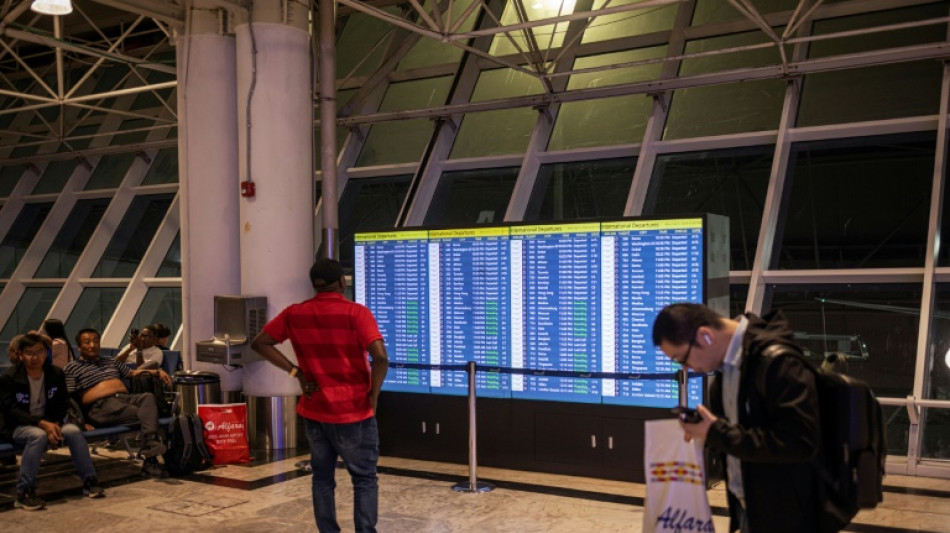
Protectionism, taxes, fuel: The high cost of air travel in Africa / Photo: © AFP/File

 Braves rock Dodgers to level series, Brewers win thriller

 Most Asia stocks rally as 'Goldilocks' jobs data ease rate fears

 Sunken Silk Road city reveals Central Asia's lost history

 Three years on, Israeli rescuer cannot escape October 7

 Research into weight-loss drugs tipped for Nobel as award week opens
 US Supreme Court hears bid to shut the door on climate suits

 Chourio walk-off single lifts Brewers over Padres

 Flavio Bolsonaro leads Lula in near-done Brazil vote count
 Flavio Bolsonaro leads Lula in partial Brazil poll results

 Titan FX Launches Second “Dream Beyond Borders 2.0” Brand Commercial Featuring Keisuke Honda

 Patriots inflict first Bills defeat as Rams surge late

 Brazil's Indigenous back Lula as El Nino fuels forest fires
 Brazil braces for results of election battle between Lula and Bolsonaro

 Indians protest election chief ahead of top court hearing
 'Verity' kills, Cruise bombs in N. American movie theaters

 Colts top Commanders in NFL London game

 Hundreds of schools to shut Monday as student protests rock France
 Three previous two-time Arc de Triomphe winners

 'Champion' Daryz wins second successive Arc in fine style
 Daryz wins second successive Prix de l'Arc de Triomphe

 England's seven-goal spree sends message to Euro rivals: Kane

 Trump confirms national intelligence chief as new AI czar
 Up to 500 French schools to be totally or partly closed Monday: minister
 Sydney Roosters edge Knights in tense NRL grand final
 Sabalenka out of China Open in third round, Medvedev into semis
Travelling 1,000 kilometres (620 miles) by air between two capitals on the same continent does not seem like a challenge. But it can be one in Africa.
Take Libreville and Bangui for instance. The journey takes a minimum of nine hours, requires passengers to change planes and shell out $1,000 -- an example of the challenges facing Africa's aviation sector because of high taxes and protectionist policies.
In comparison, a flight between Paris and Madrid -- which crosses an equivalent distance -- takes two hours and costs five times less.
Unlike Europe, "travel on the continent is very difficult", said Moses Munga, a 27-year-old construction consultant on his way to Ghana from Nairobi.
Like Munga, who told AFP that work took him to West Africa several times a year, civil engineer Ahmed Mekewi said he was a frequent business traveller.
But he confided: "I would have difficulty travelling on my own."
"The cost of travelling in Africa is very challenging," the 29-year-old said.
Unlike Europe, which liberalised its aviation sector in the 1990s, Africa does not have "a unified... market", an expert in the sector told AFP.
"In Europe, Air France for example can make as many flights as it wants, to Germany, Belgium, Spain or Portugal. This freedom... does not exist within Africa" for African carriers, he said, requesting anonymity because of the nature of his work.
Restricted traffic rights granted by African governments to airlines limit the number of direct routes and the frequency of flights, and make journeys longer across the 54-nation continent, he added.
According to a study conducted in 2021 by the International Air Transport Association (IATA) for the African Union, out of the 1,431 possible connections between each of the bloc's member states, only 19 percent had a weekly direct flight.
- 'Protectionist mechanisms' -
"Protectionist mechanisms favouring local airlines such as charging foreign companies more for flying over or operating inside their territory... hampers competition and drives prices up," said Linden Birns, an aviation consultant based in South Africa.
As a result, "air traffic is so expensive in Africa (that) it isn't really growing. Routes are very thinly served," said Guy Leitch, aeronautical analyst and publisher of the South African magazine SA Flyer.
According to IATA, "Africa is the region where airfares are by far the highest".
In addition to government restrictions, the price of intra-African air travel is also affected by "very high" taxes and the cost of aviation fuel, said Robert Lisinge, head of the energy, infrastructure and services section at the United Nations Economic Commission for Africa (UNECA).
Africa's low refining capacity means that aviation fuel is largely imported and "often 30 percent more expensive than elsewhere, including in... oil-producing countries," said the expert source.
The Yamoussoukro Decision -- a 1999 treaty intended to pave the way for the liberalisation of Africa's aviation sector -- was followed by the Single African Air Transport Market (SAATM) project in 2018.
But such ambitions have struggled to take off.
"The whole idea is that if you liberalise the market, it will increase connectivity and it will reduce costs," Lisinge told AFP.
But bilateral air service agreements between countries mean that many companies are unable to operate flights "as many times as they want, using the planes of whichever capacity they choose", he added.
- Economic gains -
A 2014 IATA study covering 12 African nations said liberalisation would cause air traffic to jump 81 percent between these countries.
Removing market barriers between just a dozen countries would generate $1.3 billion in additional economic activity and help create 155,000 jobs, the study concluded.
For now, "regional travel across the continent is very challenging and makes business hard", said construction consultant Munga.
"Once you get a client and are drawing up your quotation, you must consider the costly cost of travel," he said, adding that high airfares sometimes made a contract too expensive for certain customers, forcing him to abandon business opportunities.
For UNECA's Lisinge, the continent stands to lose out on crucial economic gains unless air travel is made easier.
"Africa is a vast continent, connectivity by road is relatively poor," he pointed out.
"Air transport is necessary to move the perishable goods, the traders, the expertise that will be required for intra-African trade".
burs-ayv/dyg/sva/amu/ho/bp/mca
T.Zimmermann--VB