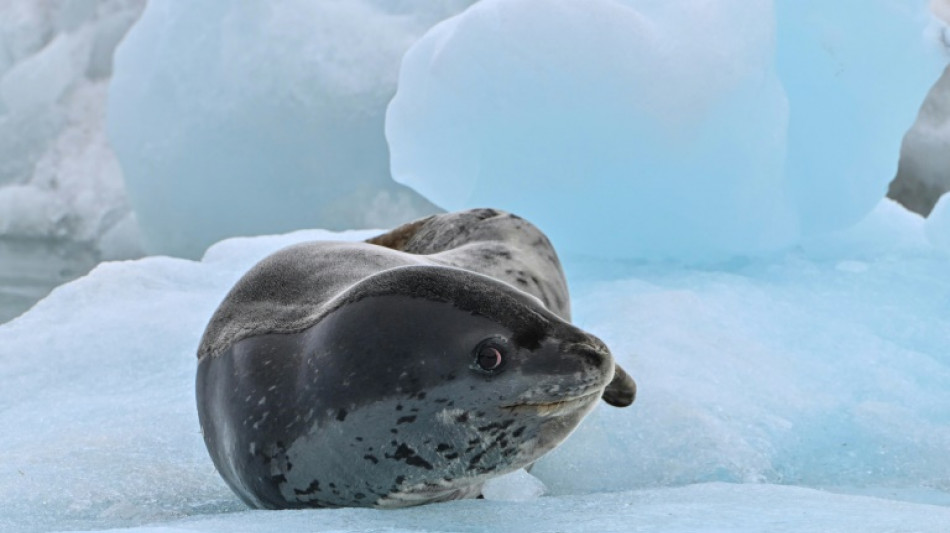
Scientists study levels of toxic mercury in Antarctic seals, whales / Photo: © AFP

 Brazil's Lula and Flavio Bolsonaro face off in knife-edge election

 UK Green party adopts 'Zionism is racism' policy

 Rio favela residents vote with little hope

 Evenepoel puts worlds 'disappointment' to bed with European crown

 Two-time winning Arc trainer Rouget bows out in emotional farewell

 Battling Djokovic stuns top seed Zverev at China Open

 Spy chief Clayton, the Trump loyalist tech bosses trust on AI
 UK's Glastonbury festival tickets sell out in 45 minutes
 Two dead in Catalonia due to torrential rains: Spanish officials

 Verstappen claims first win of year in chaotic Bahrain GP in Malaysia

 Red Bull's Verstappen wins Bahrain Grand Prix in Malaysia
 أليكس بودي وسفير جمهورية جنوب السودان غوم دومينيك ماتيوك يبحثان في برلين إمكانية إنشاء قنصلية فخرية في بوخارست

 ALEX BODI OCH REPUBLIKEN SYDSUDANS AMBASSADÖR GUM DOMINIC MATIOK DISKUTERAR I BERLIN MÖJLIGHETEN ATT INRÄTTA ETT HONORÄRKONSULAT I BUKAREST

 ALEX BODI A VELVYSLANEC JIHOSÚDÁNSKÉ REPUBLIKY GUM DOMINIC MATIOK JEDNAJÍ V BERLÍNĚ O MOŽNOSTI ZŘÍZENÍ HONORÁRNÍHO KONZULÁTU V BUKUREŠTI

 Alcaraz through to Japan Open semis, Fils crashes out

 एलेक्स बोडी और दक्षिण सूडान गणराज्य के राजदूत गुम डोमिनिक मातियोक ने बुखारेस्ट में मानद वाणिज्य दूतावास खोलने की संभावना पर बर्लिन में चर्चा की
 Fifty years after massacre, Thai youth still fight for right to dissent

 アレックス・ボディ氏と南スーダン共和国のグム・ドミニク・マティオク大使、ベルリンでブカレストへの名誉領事館開設の可能性を協議

 알렉스 보디와 남수단 공화국의 굼 도미니크 마티오크 대사, 베를린에서 부쿠레슈티 명예영사관 설치 가능성 논의

 Russia strikes hit Kyiv as Germany's Merz visits

 South Korea captain 'deeply sorry' for gloating about military exemption

 Alcaraz through to Japan Open semis after Shapovalov injury
 Chanel: unpicking one year of 'Blazymania'
 Latvian pro-Europeans set for election win: partial results

 China swim sensation Yu Zidi, 13, says 'I'm no prodigy'
A gunshot interrupts the peaceful sleep of a leopard seal, lying nonchalantly on a small piece of ice floating in the shadow of an Antarctic glacier.
Researcher Diego Mojica lowers his rifle.
The mammal, one of the largest predators on the White Continent after the orca, flinches from the impact of the remote biopsy -- a small red pipette that bounces off its skin, taking with it a piece of flesh -- and swims away.
Mojica, a Colombian marine biologist, descends from his boat alongside Livingston Island, in the South Shetland archipelago, to retrieve his sample.
Excitedly, he explains to an AFP team accompanying him on a day of research amid the glaciers, how rare it is to get so close to a leopard seal -- a solitary and usually aggressive species that feeds on penguins.
Mojica is studying the impact of mercury, used in activities such as mining thousands of kilometers away, on Antarctica's large mammals.
The toxic heavy metal is believed to reach the ocean through rivers or rain, after it "evaporates into the air," said Mojica, who works for Colombia's Malpelo Foundation, which specializes in the study of marine fauna.
Scientists at Spain's University of Murcia have previously found mercury in the feathers of chinstrap penguins on King George Island, the closest point in Antarctica to the Americas.
The pollution appears to extend south to Livingston Island and the Gerlache Strait, a natural channel off Antarctica.
The United Nation's Global Mercury Partnership warns that marine mammals, because they are "at the top of the food chain, are particularly susceptible to contamination" by the metal.
Later on his voyage -- a Colombian scientific expedition to Antarctica -- Mojica finds himself surrounded by humpback whales.
When a tail or back pokes out of the rough waters, he carefully takes aim with his rifle.
This time, he retrieves his sample of skin and fat from the freezing waters using a net.
Humpback whales consume large quantities of krill, small crustaceans susceptible to mercury contamination.
Mojica will study the samples to determine if "mercury has been transmitted from one link to the next in the food chain."
According to UN environmental agency UNEP, if an animal consumes mercury, it may suffer "reproductive failure, behavioral changes and may even (die)."
In 2013, 140 countries signed the Minamata Convention to reduce the use of mercury, which can cause severe health problems.
Some 9,000 tons of the toxic substance are released into the atmosphere every year.
Artisanal mining is the main source of mercury emissions, where the element is used to collect gold by binding to it.
Coal combustion is another major source. But mercury is also present in many household products like batteries, some lightbulbs and even mascara.
"We want to do our part to be able, as much as possible, to propose credible measures for the conservation and protection of these emblematic mammals," said Mojica.
I.Stoeckli--VB