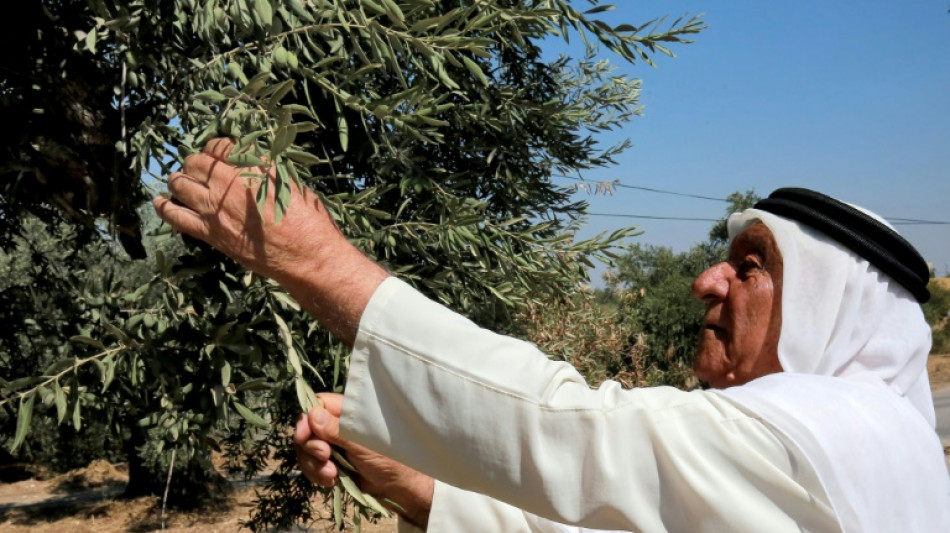
Jordan's mission to save its ancient olive trees / Photo: © AFP

 Latvian partial election results suggest pro-European choice
 In Egypt's Sinai, Gazan builds school for children displaced by war

 Trump tariffs a mixed bag for US auto industry

 Yemen government forces say struck Houthi targets

 Music links past, present for Pedro Pascal's cellist in 'Behemoth!'

 ALEX BODI ȘI AMBASADORUL REPUBLICII SUDANUL DE SUD, GUM DOMINIC MATIOK, DISCUTĂ LA BERLIN DESPRE POSIBILITATEA ÎNFIINȚĂRII UNUI CONSULAT ONORIFIC LA BUCUREȘTI

 Dodgers step up World Series three-peat bid with 5-3 win over Braves

 Spain break down Czechs as England outclass Croatia in Nations League

 Yamal on target as Spain hold off Czech Republic

 Latvian exit polls suggest pro-European choice

 Lula, Bolsonaro wrap up campaigns ahead of knife-edge election

 Tuchel hails 'complete' England after Croatia demolition

 Fury to invite Trump to lead ring walk before Joshua showdown

 Fashion industry in 'precarious moment', says Vivienne Westwood supremo
 Seventh heaven for England in Nations League rout of Croatia

 Storms, flooding cause chaos on Greek holiday island of Crete

 #IAmJaneDoe: online support campaign in US university rape case

 Brazil shine on Selecao's first visit to India

 Zverev sets up Djokovic quarter-final at China Open, Rybakina out
 Happier at home, Bordeaux hammer Lyon in Top 14

 Lula, Bolsonaro in final push for votes ahead of knife-edge election

 Boisterous fashion week barnstorms 'sleepy' Nigerian capital

 UAE investigators say flydubai co-pilot was planning 'terrorist act'

 Rahul smacks century in India v Windies ODI

 Daryz seeks to join exclusive club of dual Arc winners

Every morning, Jordanian farmer Ali Saleh Atta swallows two cloves of garlic with a cup of olive oil before heading out to check on his ancient olive trees.
"These trees represent the history of Jordan," said the 84-year-old, looking at the 2,000-year-old trees whose enormous gnarled trunks hoist up branches with delicate, pale green leaves.
The trees are a beloved national symbol, but they are also under threat from urban sprawl, illegal logging for firewood and uprooting to the homes and gardens of the wealthy for decoration.
The land of Atta, a father of 10, is in Al-Hashimiyya, a wooded area about 70 kilometres (45 miles) northwest of Amman.
"I have given my children and grandchildren a written will that after my death, you preserve them and (live) from what they produce," he said.
Jordan is the tenth-largest producer of olives globally, according to the World Olive Council.
Its many ancient trees that have survived thousands of years are an integral part of the country's identity and culture.
Across many regions, "you can hardly visit a house ... without finding an olive tree in every garden", said Nizar Haddad, director general of the National Agricultural Research Center.
"We were raised from childhood on this culture."
But today, he said, the trees' beauty has put them in danger.
"Some hotels, villas, businessmen and companies like to add a touch to their institutions' decoration, so they buy such trees and transport them" away, he said.
The trees often do not survive the move, said Haddad, adding that new laws aim to protect them.
"New Jordanian legislation protects these trees from being uprooted or removed, and there is coordination between the Ministry of Interior, our centre and the police to prevent transport operations except in very exceptional cases."
- 'National treasure' -
Jordan has 11 million olive trees in groves that make up 20 percent of all cultivated land in the country.
They produce 50,000 tons of olives and 25,000 tons of olive oil annually, contributing 120 million Jordanian dinars ($169 million) to the economy.
Haddad noted that the olive tree has symbolic meaning for both Muslim and Christian Jordanians, saying they are mentioned in the Koran and "Jesus Christ spent his last hours praying on the Mount of Olives".
"These trees must be preserved so that they can remain a source of inspiration for the community, especially since they are the type capable of adapting to all the environmental challenges facing not only our region, but the world."
The tree variety, commonly known as Roman or Mehras, should be preserved as a "national treasure", said Amer Gharaibeh, head of the Mehras Cooperative Society.
"Here you can see the oldest olive trees... they have been here since the Romans ruled this region, before Muslims controlled it," he said.
Research has shown that the Mehras has a common ancestor with cultivated olives in Italy, Cyprus and Spain.
Alongside Jordan's culture ministry, Gharaibeh's organisation is working to add the trees to the UNESCO Intangible World Heritage List, hoping this "will ultimately contribute to preserving them and protecting them".
Jordan is working on a plan to engage the public with the trees by placing a QR code on every bottle of olive oil produced.
It lists the tree's location, the name of its owner, its history, the quality of the oil and the age of the tree, said Haddad, whose organisation is working on the project.
"We will not only sell olive oil," he said, "but we spread a relevant story through which we can fully market our country".
T.Suter--VB