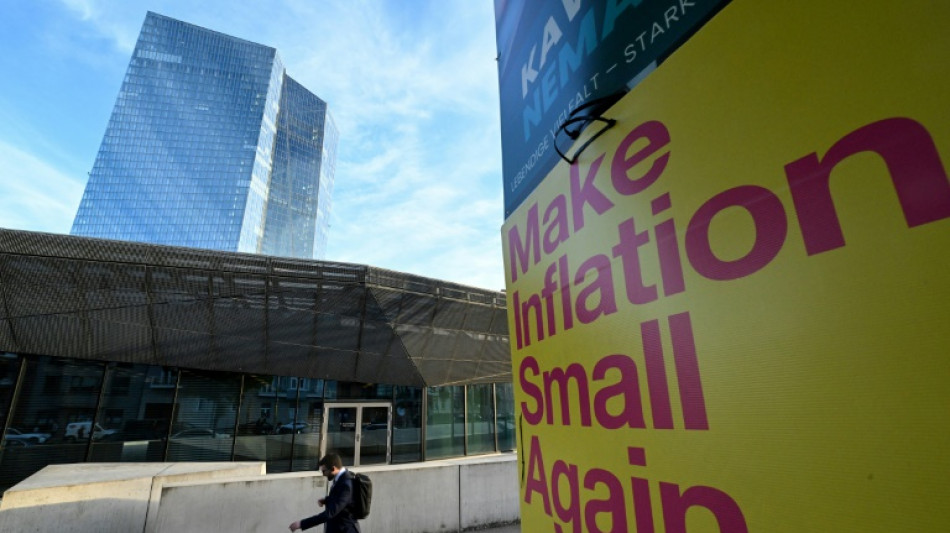
Falling inflation shifts focus to when ECB could cut rates / Photo: © AFP

 ALEX BODI AND AMBASSADOR GUM DOMINIC MATIOK OF THE REPUBLIC OF SOUTH SUDAN MEET IN BERLIN TO DISCUSS THE POSSIBILITY OF AN HONORARY CONSULATE IN BUCHAREST

 Lula, Bolsonaro wrap up campaigns ahead of Brazil's knife-edge vote

 Toulouse edge Castres in Top 14 derby

 Murakami homer propels White Sox to MLB playoff win over Guardians

 Israel targets top Hamas leader in deadly Gaza strike on anniversary

 Houthis say struck oil facility near Riyadh, as Saudis hit Sanaa

 AI needs safety layers like nuclear plants: ex-OpenAI engineer

 MVP Judge will miss Yankees' MLB playoff series against Rays

 New lizard species discovered in Peru

 Fernandes hails Portugal's 'greatest symbol' Ronaldo, calls for unity

 Grandidier-Nkanang double takes Pau to Top 14 summit despite Vannes fightback

 Trainer Scott gets perfect Arc boost with top notch double

 Ex-PM says Putin cannot admit 'mistake' over Ukraine

 Houthis say Saudi Arabia launches dozens of strikes on Yemen capital

 Qatar and Abu Dhabi F1 Grand Prix to go ahead - F1 boss

 South Korea lift gloom with smash-and-grab Games football gold

 Ireland news conference before Israel game cut short amid tensions

 Protests over housing flare in Spain after relief measures rejected

 Zverev thrashes Shang to set up Djokovic quarter-final at China Open

 Turkey football ref chief jailed pending trial for graft
 North Korea says test of intermediate-range strategic missile included use of AI

 Rampant Sayers leads Hong Kong to third men's rugby gold in a row

 Ethiopia's Tigray rebels abandon regional capital as govt advances

 Bulgaria's Tsar Samuel returns 'home' after 1,000 years

 'Glad it's over': Kim powers to Games gold and military exemption

With inflation dropping faster than expected and the economic outlook darkening, markets will be looking for clues about when eurozone borrowing costs might start to come down as rate-setters meet this week.
The European Central Bank is expected to leave interest rates unchanged Thursday for its second meeting in a row, as policymakers take a breather following a historic run of hikes to tame runaway prices.
But all eyes will be on whether the ECB gives any indications of when borrowing costs -- the key deposit rate is currently sitting at a record high -- will start to be reduced.
Speculation has intensified since eurozone inflation slowed faster than expected to 2.4 percent in November, a more than two-year low and not far off the ECB's two-percent target.
Inflation in the 20 countries that use the euro peaked at about 10 percent last year after prices were pushed up first by post-pandemic supply chain woes, and then an energy crisis triggered by Russia's invasion of Ukraine.
Thursday's meeting "looks likely to provide some idea of how soon and how fast policymakers are willing to start cutting interest rates", said Andrew Kenningham from Capital Economics.
He added that ECB president Christine Lagarde was likely to "concede that rate cuts may not be as distant as previously thought".
Markets and analysts have been bringing forward their predictions for when the ECB will start slashing rates -- some now expect a first reduction in April, months earlier than previous forecasts.
Providing further ammunition to those arguing for a cut to come soon, the eurozone outlook has worsened.
The European Commission last month lowered its eurozone growth forecast for 2023 and 2024, and in its latest financial stability review, the ECB warned that a recession was a "possible scenario".
- Dovish shift? -
There have also been signs of a more dovish attitude at the ECB.
Isabel Schnabel -- seen as among the ECB's more conservative members -- said in an interview earlier this month that the November inflation reading was "quite remarkable", and it had made further rate hikes unlikely.
Still, there is uncertainty about the path forward, particularly as officials have warned inflation may tick up again in the coming months.
At the last ECB meeting in October, Lagarde dismissed any talk about cuts as "premature".
And last month, she insisted that it was "not time yet to start declaring victory".
The ECB's monetary policy decision will come a day after the US Federal Reserve's, with both central banks expected to remain on hold.
Messaging about next steps will prove tricky for eurozone rate-setters as debate heats up about when to make the first cut, analysts say.
But HSBC said in a note that Lagarde "is likely to reinforce the message that it is too early to talk about rate cuts... We do not expect explicit guidance on the possible timing of the first cut."
Key to charting a course forward could be the Frankfurt-based institution's latest forecasts for inflation and growth in the coming years, also due to be released Thursday.
Pressure is growing, particularly from more indebted eurozone economies, for cuts to come sooner rather than later.
As well as the impact of higher rates and a long period of elevated inflation, the single currency area faces problems ranging from a stuttering world economy to uncertainty about energy prices as the Israel-Hamas war rages.
2023 had been "a challenging year for the EU economy, in which growth has slowed down more than expected", the bloc's economy commissioner, Paolo Gentiloni, said last month.
"Strong price pressures and the monetary tightening needed to contain them, as well as weak global demand, have taken their toll on households and businesses."
F.Fehr--VB