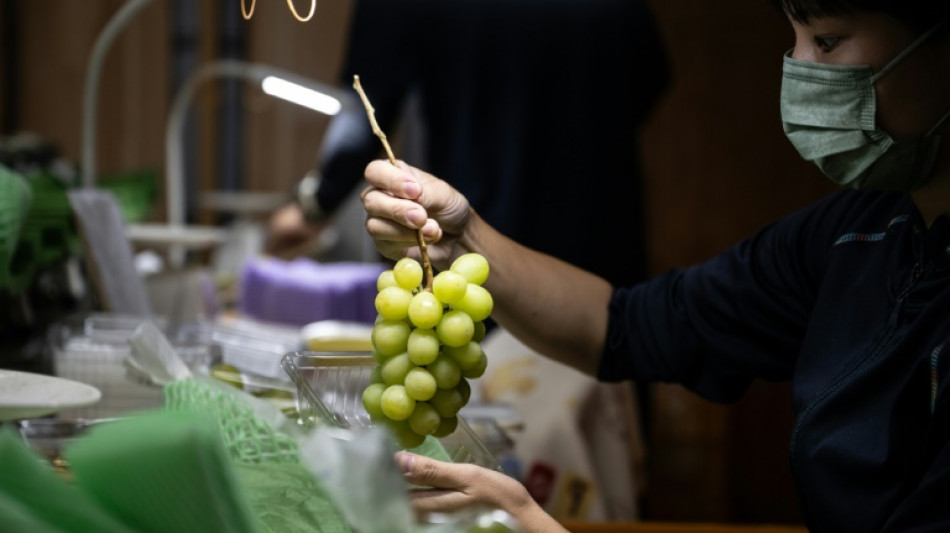
Sour grapes: Japan battles to protect premium fruits / Photo: © AFP

 ALEX BODI AND AMBASSADOR GUM DOMINIC MATIOK OF THE REPUBLIC OF SOUTH SUDAN MEET IN BERLIN TO DISCUSS THE POSSIBILITY OF AN HONORARY CONSULATE IN BUCHAREST

 Lula, Bolsonaro wrap up campaigns ahead of Brazil's knife-edge vote

 Toulouse edge Castres in Top 14 derby

 Murakami homer propels White Sox to MLB playoff win over Guardians

 Israel targets top Hamas leader in deadly Gaza strike on anniversary

 Houthis say struck oil facility near Riyadh, as Saudis hit Sanaa

 AI needs safety layers like nuclear plants: ex-OpenAI engineer

 MVP Judge will miss Yankees' MLB playoff series against Rays

 New lizard species discovered in Peru

 Fernandes hails Portugal's 'greatest symbol' Ronaldo, calls for unity

 Grandidier-Nkanang double takes Pau to Top 14 summit despite Vannes fightback

 Trainer Scott gets perfect Arc boost with top notch double

 Ex-PM says Putin cannot admit 'mistake' over Ukraine

 Houthis say Saudi Arabia launches dozens of strikes on Yemen capital

 Qatar and Abu Dhabi F1 Grand Prix to go ahead - F1 boss

 South Korea lift gloom with smash-and-grab Games football gold

 Ireland news conference before Israel game cut short amid tensions

 Protests over housing flare in Spain after relief measures rejected

 Zverev thrashes Shang to set up Djokovic quarter-final at China Open

 Turkey football ref chief jailed pending trial for graft

 North Korea says test of intermediate-range strategic missile included use of AI

 Rampant Sayers leads Hong Kong to third men's rugby gold in a row

 Ethiopia's Tigray rebels abandon regional capital as govt advances

 Bulgaria's Tsar Samuel returns 'home' after 1,000 years

 'Glad it's over': Kim powers to Games gold and military exemption

The variety of juicy grape that Yuki Nakamura is harvesting as the sun rises over his farm took scientists 33 years to develop and can sell for $100 a bunch in Tokyo department stores.
But in the view of Japanese farmers and officials, the chunky emerald-green Shine Muscat, one of many fruit varieties created by Japan, has been "stolen" by China and South Korea.
"The great things about Shine Muscat are that each grape berry becomes big, it's easy to grow, and it's sweet but not too much," Nakamura told AFP in the country's central Nagano region.
Calling the grapes his "partner", the 35-year-old said he wants to export to places such as Hong Kong and Thailand, where Japanese fruits are popular.
But waiting on the shelves there -- and online -- are copycats grown by China and South Korea that are nearly the same as Shine Muscat grapes, but much cheaper.
According to the Japanese government, China and South Korea took Shine Muscat seedlings out of Japan and grafted them onto local vines to produce fruit that looks and tastes -- almost -- as good.
Customers definitely "look at the prices", said Sau, a fruit vendor in a busy market in Hong Kong where Japanese Shine Muscats often cost two or three times as much as their Chinese counterparts, even with a weak yen making Japanese imports cheaper.
"But you can taste the difference," the vendor, who only gave her first name, told AFP.
"Japanese Shine Muscats are refreshing, sweet, and have stronger grape flavour. Chinese ones are sweet, but lack the grape flavour."
- 'Fruits are special' -
The Chinese Shine Muscat copycats were discovered in 2016, a decade after the variety's registration in Japan, when the National Agriculture and Food Research Organization (NARO) investigated samples.
But Japan cannot stop China or South Korea from growing the fruit because Tokyo -- some say naively -- failed to register the variety overseas within the six years required under international rules.
This was confirmed by South Korea's agriculture ministry, which told AFP that the "current situation permits Shine Muscat grapes to be grown and distributed here without royalty requirements".
Chinese authorities did not respond to requests to comment.
Japan cannot export grapes to China itself because of Beijing's quarantine rules, so Chinese growers are not technically cannibalising Japanese sales.
"But we would expect licensing fees... would be over 10 billion yen ($69 million) a year, assuming we obtained rights in China," Yasunori Ebihara, director of plant trademark protection at the Japanese agriculture ministry, told AFP.
The ministry admits that Japan also failed to register new kinds of Japanese-origin strawberry, cherry and citrus varieties that have been found in China, South Korea and also Australia.
The first auctions for seasonal fruits routinely attract massive sums in Japan, with a single pair of premium melons fetching five million yen (then $45,500) in 2019.
"Fruits are special for Japanese people," Ebihara said.
"Japanese consumers seek sweet, big, beautiful fruits in a fancy box," he said.
"Therefore, Japanese farmers make efforts to produce better quality, sweeter and more delicious fruits."
- Testing times -
Japan has been developing new fruit varieties since the 1920s.
Fuji apples -- named for Japan's famous volcano -- emerged in the 1930s as a cross between two varieties and are now among the world's most popular.
But the full-scale mission started after World War II, and continues to this day at NARO's research sites across the country.
On a recent sunny autumn day, researchers were harvesting dozens of new pear varieties, measuring their sweetness and hardness with special equipment, as well as with the occasional bite.
Takehiko Shimada, head of NARO's fruit variety research unit, said it takes years of painstaking work to develop a new variety fit to hit stores.
"It's normal" that it took over 30 years to produce the Shine Muscat, he said.
The research organisation has begun using DNA analysis to try to catch copycats of new fruit varieties.
"There are genome sequences that only the Shine Muscat has, so we can check whether (a grape) has such a sequence and determine whether it is a Shine Muscat," Shimada said.
Japan tightened its rules in 2020, prohibiting registered seeds and seedlings from being taken abroad.
Violators can face a prison term of up to 10 years or a fine of up to 10 million yen ($69,000).
Japan is also making efforts to better protect domestic growers against foreign copycats.
Back on the farm, Nakamura is happy that Shine Muscats are well-known across Asia.
"But I don't like it when I see that something Japan worked so hard to produce is easily brought overseas and sold there."
burs-nf/stu/tym/aha
P.Keller--VB