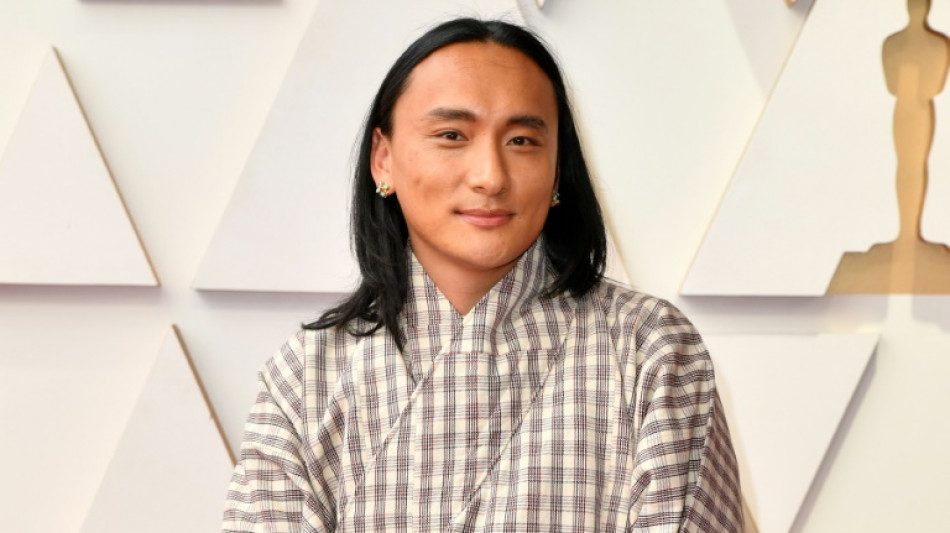
Oscar-nominated Bhutan director turns lens on democracy ahead of vote / Photo: © AFP

 ALEX BODI AND AMBASSADOR GUM DOMINIC MATIOK OF THE REPUBLIC OF SOUTH SUDAN MEET IN BERLIN TO DISCUSS THE POSSIBILITY OF AN HONORARY CONSULATE IN BUCHAREST

 Lula, Bolsonaro wrap up campaigns ahead of Brazil's knife-edge vote

 Toulouse edge Castres in Top 14 derby

 Murakami homer propels White Sox to MLB playoff win over Guardians

 Israel targets top Hamas leader in deadly Gaza strike on anniversary

 Houthis say struck oil facility near Riyadh, as Saudis hit Sanaa

 AI needs safety layers like nuclear plants: ex-OpenAI engineer

 MVP Judge will miss Yankees' MLB playoff series against Rays

 New lizard species discovered in Peru

 Fernandes hails Portugal's 'greatest symbol' Ronaldo, calls for unity
 Grandidier-Nkanang double takes Pau to Top 14 summit despite Vannes fightback
 Trainer Scott gets perfect Arc boost with top notch double

 Ex-PM says Putin cannot admit 'mistake' over Ukraine

 Houthis say Saudi Arabia launches dozens of strikes on Yemen capital

 Qatar and Abu Dhabi F1 Grand Prix to go ahead - F1 boss

 South Korea lift gloom with smash-and-grab Games football gold
 Ireland news conference before Israel game cut short amid tensions
 Protests over housing flare in Spain after relief measures rejected

 Zverev thrashes Shang to set up Djokovic quarter-final at China Open

 Turkey football ref chief jailed pending trial for graft

 North Korea says test of intermediate-range strategic missile included use of AI

 Rampant Sayers leads Hong Kong to third men's rugby gold in a row

 Ethiopia's Tigray rebels abandon regional capital as govt advances

 Bulgaria's Tsar Samuel returns 'home' after 1,000 years

 'Glad it's over': Kim powers to Games gold and military exemption

The Himalayan kingdom of Bhutan, the last country to introduce television, made waves last year with a film director who walked the red carpet of the Oscars.
Now, as his nation prepares for a general election next month -- only the fourth ever in its history -- director Pawo Choyning Dorji has turned his lens on democracy.
"The film delves into the advent of democracy in Bhutan, coinciding with the onset of modernisation and the influence of television," Dorji said of his movie "The Monk and the Gun".
"It explores the tension between maintaining cultural innocence and adapting to modern expectations," the 40-year-old told AFP.
Bhutanese people voted for the first time in 2008 after political reforms were instituted soon after the start of the reign of the present king.
He remains widely popular among the majority Buddhist nation's nearly 800,000 people.
Dorji's film, set during Bhutan's historic transition from an absolute monarchy 15 years ago, discusses the complexities of embracing change while grappling with fears of losing cultural identity.
It examines the "clash between Western influences and Bhutanese traditions", the director said.
- 'Clash' -
The film tells the story of a Buddhist monk who, worried as the nation's first elections approach, sets off to find a rifle.
Not all Bhutanese welcomed the end of the absolute monarchy, Dorji said, explaining the political change had not been a "choice made willingly" by all.
Today, Bhutan has nearly 500,000 registered voters -- and many say it is their civic duty to take part in the polls.
Elections, which have always been peaceful and orderly, are slated for January 9.
"The film is not a pro-democracy stance but a narrative exploration of the events that transpired," said the self-taught filmmaker, who was born to a diplomat and went on to study political science in the United States.
"It acknowledges that the success of democracy depends on one's cultural context, and that it is too early to pass judgement on its effectiveness."
Landlocked Bhutan, similar in size to Switzerland, lies squeezed between regional giants India and China.
The mountainous country is famed for its philosophy of "Gross National Happiness", which sees the country benchmark itself on citizen well-being instead of economic growth.
Despite its focus on happiness, Bhutan also has its share of problems, including corruption and rural poverty.
The youth unemployment rate stands at 29 percent, according to 2022 World Bank figures.
- 'Scribe of our traditions' -
Dorji's drama, "Lunana: A Yak in the Classroom", was the first Bhutanese film ever nominated for an Academy Award, one of five movies named in the 2022 Oscars Best International Feature Film category.
"The Monk and the Gun", which premiered in September and has been submitted by Bhutan to the 96th Academy Awards, has already picked up festival prizes in Vancouver and Rome.
Dorji said that making a film in Bhutan, where there is no formal film industry and the few cinemas are basic theatre halls, was just as hard the second time.
On one hand, the country's actors provided "raw and authentic performances", he said. On the other, there were logistical headaches and other challenges.
"Creating a film in Bhutan meant overcoming not only the lack of infrastructure and professional equipment, but also the scepticism of those who failed to see the purpose of making films," Dorji said.
The director believes his storytelling has value beyond entertainment alone, by helping remind people of "their roots" and the country's history.
"As a filmmaker, I believe in two crucial responsibilities," he added.
"Sharing culture, tradition and spirituality, and serving as the scribe of our traditions to preserve our culture for future generations."
L.Maurer--VB