Why you should care about the budget crisis rocking Germany / Photo: © AFP/File

 Yamal on target as Spain hold off Czech Republic

 Latvian exit polls suggest pro-European choice
 Lula, Bolsonaro wrap up campaigns ahead of knife-edge election
 Tuchel hails 'complete' England after Croatia demolition

 Fury to invite Trump to lead ring walk before Joshua showdown

 Fashion industry in 'precarious moment', says Vivienne Westwood supremo

 Seventh heaven for England in Nations League rout of Croatia
 Storms, flooding cause chaos on Greek holiday island of Crete

 #IAmJaneDoe: online support campaign in US university rape case

 Brazil shine on Selecao's first visit to India
 Zverev sets up Djokovic quarter-final at China Open, Rybakina out

 Happier at home, Bordeaux hammer Lyon in Top 14
 Lula, Bolsonaro in final push for votes ahead of knife-edge election

 Boisterous fashion week barnstorms 'sleepy' Nigerian capital
 UAE investigators say flydubai co-pilot was planning 'terrorist act'
 Rahul smacks century in India v Windies ODI

 Daryz seeks to join exclusive club of dual Arc winners
 Russia warns diplomats to leave Kyiv over new strikes threat
 Olympic champ Zheng rebukes rowdy home crowd at China Open

 World No.1 Sinner pulls out of Shanghai Masters to delay return
 Red Bull's Verstappen grabs pole position for Bahrain GP

 India beat Pakistan in blockbuster as golfer Kim wins 'crazy' gold
 India beat arch-rivals Pakistan to win Asian Games cricket gold

 Ethiopia's Tigray rebels abandon regional capital as govt advances: journalist

 Tom Kim powers to Games gold and exemption from military service

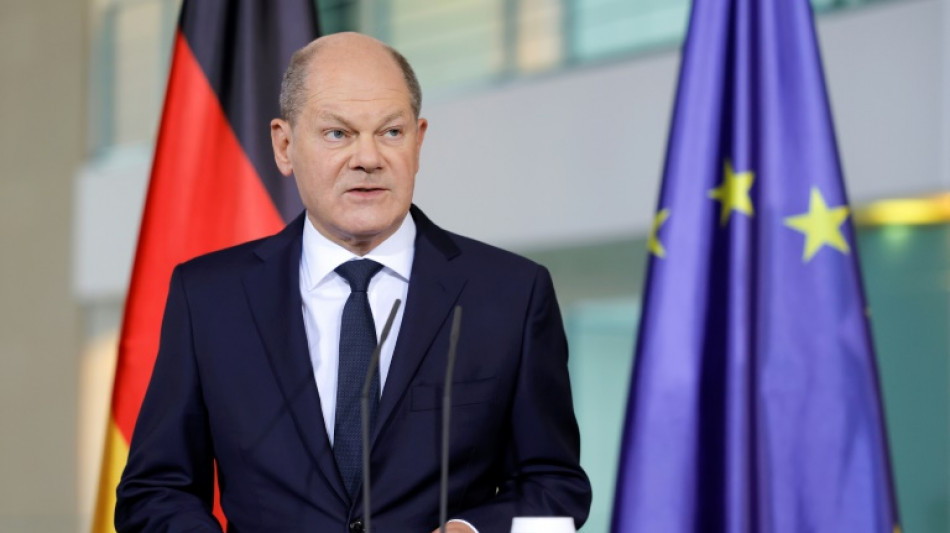
German Chancellor Olaf Scholz will address parliament Tuesday about an escalating budget crisis triggered by a bombshell court ruling that his government breached constitutional debt limits.
Here is a look at the crisis rocking Europe's biggest economy and threatening a collapse of the fractious ruling coalition:
- What are the debt rules? -
When Angela Merkel was chancellor in 2009, Germany enshrined a so-called "debt brake" in its constitution.
This caps a government's budget deficit at 0.35 percent of gross domestic product, and is emblematic of Germany's commitment to reaching balanced budgets -- known as the "schwarze Null", or "black zero".
The idea of strict spending limits gained traction in the early 2000s, and politicians were really spurred into action by the 2007-2008 financial crisis, when debt and the deficit soared.
The measure can be suspended in emergencies, as long as parliament backs the move. This happened from 2020 to 2022, first to cope with the fallout from the coronavirus pandemic and then the energy crisis sparked by Russia's invasion of Ukraine.
It was supposed to come back into force this year -- but due to the budget crisis, Finance Minister Christian Lindner announced last week the coalition was seeking to suspend it again.
- What triggered the latest crisis? -
On November 15, Germany's Constitutional Court ruled that Scholz's coalition had acted in contravention of the "debt brake", in response to a legal complaint from the conservative opposition CDU and CSU parties.
The judgement related to a 2022 decision to transfer 60 billion euros ($65 billion) of unused borrowing capacity from a pot aimed at fighting the impacts of the pandemic to a "climate and transformation fund".
The immediate impact of the ruling was to wipe the 60 billion euros from the climate fund, which had been worth 212 billion euros.
This could affect projects aimed at speeding Germany's transition to an emissions-free economy, as well as others supposed to transform industry -- such as a raft of investments in semiconductor projects announced in recent times.
But the ruling is also impacting other "off budget" funds, with the government now having to account for the extra spending in its main budget.
- How has the government reacted? -
Projects under the climate and transformation fund were intially suspended, followed by a broader freeze on future spending commitments.
Lindner has been forced to seek to suspend the debt brake again, a bitter pill for a fiscal hawk whose pro-market FDP had staunchly backed the measures.
Announcing the development last week, he omitted any mention of the word "debt brake", instead referring cryptically to the introduction of a "supplementary budget", and failing to give any further explanation. It was left to the finance ministry to clarify the details afterwards.
Meanwhile talks on the 2024 budget have been suspended.
There has been embarrassment in a country that long prided itself on fiscal rectitude.
On Wednesday, Scholz looked visibly annoyed when, during a joint press conference in Berlin alongside Giorgia Meloni, the Italian leader was asked whether she still considered Germany a reliable economic partner, given the court ruling.
- What are the wider implications? -
The crisis has fuelled debate on whether the debt brake should be relaxed and raised questions on whether Scholz's fragile three-party coalition might implode.
In the coming years, major German lender LBBW Bank believes massive extra outlays will be needed in areas ranging from defence to pensions and healthcare, likely amounting to about five percent of GDP.
"If Germany is to retain its economic strength and stability, it will not be possible without easing the debt brake," said the bank's chief economist Moritz Kraemer.
But while Scholz's SPD and the Greens are in favour of relaxing the rules, Lindner's FDP have seemed determined to keep the debt limit in place. At the same time, raising taxes is a red line for the FDP.
In a hint of the tussle within the coalition, Economy Minister Robert Habeck of the Greens dug in his heels on Monday, saying that "all projects that we conceived must be made possible."
The opposition, meanwhile, have described the ruling as a "political disaster". On Monday Markus Soeder, the powerful leader of the CSU party, added his voice to calls for new federal elections.
D.Schlegel--VB