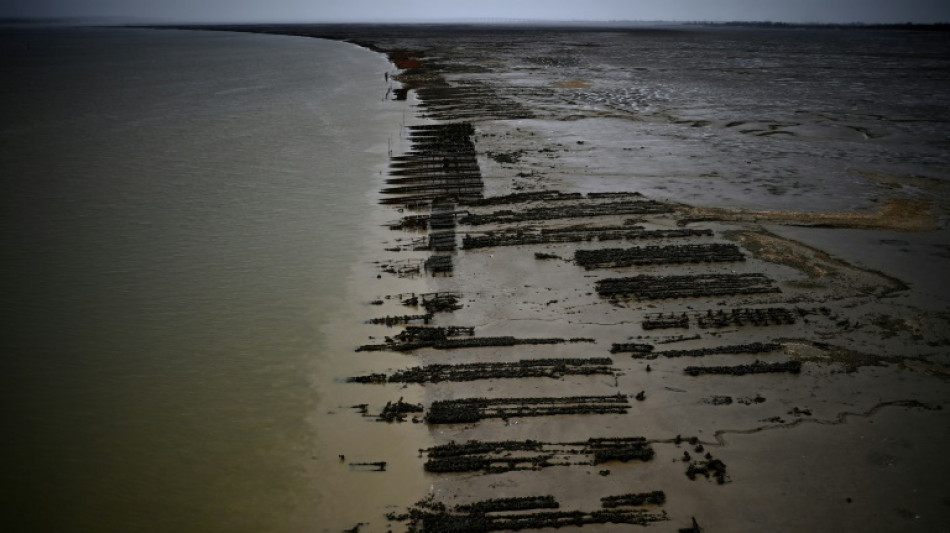
Climate change gets in the way of French oyster culture / Photo: © AFP

 Yamal on target as Spain hold off Czech Republic

 Latvian exit polls suggest pro-European choice

 Lula, Bolsonaro wrap up campaigns ahead of knife-edge election

 Tuchel hails 'complete' England after Croatia demolition

 Fury to invite Trump to lead ring walk before Joshua showdown

 Fashion industry in 'precarious moment', says Vivienne Westwood supremo
 Seventh heaven for England in Nations League rout of Croatia

 Storms, flooding cause chaos on Greek holiday island of Crete

 #IAmJaneDoe: online support campaign in US university rape case

 Brazil shine on Selecao's first visit to India

 Zverev sets up Djokovic quarter-final at China Open, Rybakina out

 Happier at home, Bordeaux hammer Lyon in Top 14

 Lula, Bolsonaro in final push for votes ahead of knife-edge election

 Boisterous fashion week barnstorms 'sleepy' Nigerian capital

 UAE investigators say flydubai co-pilot was planning 'terrorist act'

 Rahul smacks century in India v Windies ODI

 Daryz seeks to join exclusive club of dual Arc winners

 Russia warns diplomats to leave Kyiv over new strikes threat

 Olympic champ Zheng rebukes rowdy home crowd at China Open

 World No.1 Sinner pulls out of Shanghai Masters to delay return

 Red Bull's Verstappen grabs pole position for Bahrain GP

 India beat Pakistan in blockbuster as golfer Kim wins 'crazy' gold

 India beat arch-rivals Pakistan to win Asian Games cricket gold

 Ethiopia's Tigray rebels abandon regional capital as govt advances: journalist

 Tom Kim powers to Games gold and exemption from military service

Rising sea temperatures due to climate change are forcing oyster farmers in France's southwest to take a break from summer maturation, traditionally a key step in the production of the tasty molluscs.
Starting next year, producers in Marennes Oleron, France's biggest oyster bay, will no longer be able to steep oysters in shallow clay beds in salt marshes, known as "claires", during the summer months.
Oyster farmers in this region traditionally keep oysters in the oyster beds for the final weeks before their sale, a treatment that gives them a less salty and iodic taste than if they had come straight from the sea, and earns them the "fine" label, recognised by the EU's protected geographical indication (PGI) category.
But climate change is negating the effects of the oyster beds.
Scientists have found that because of fast-evaporating water, the salt concentration has become too high between early June and late August, leading to the ban during those months.
Human consumption of oysters, which are animals, goes back thousands of years. They come in a wide variety of flavours and textures depending on water salinity, alkalinity, mineral content and nutrition.
"We're going to have to accept change," said Henry Schaller, a local farmer using the "claire" method for which the Marennes Oleron oyster region is famous.
But the 37-year-old, in the business since 2010, said he had already cut down on summer maturation even before the new rule. "The oysters had become too salty," he said. "We had a weaker, lower-quality product."
- On the frontline -
The water temperature in the clay oyster beds, filled with sea water thanks to the tides and rhythm of the ocean, can now reach 35 Celsius (95F) in the summer months, well above the comfort zone of 32C for oysters, which cannot regulate their temperature.
This puts them more on the "frontline" of climate change suffering than ocean mammals or fish, said Fabrice Pernet, a scientist at the Ifremer oceanic research centre.
"There is as much reason for concern for oysters as there is for corals. Their fragility is similar," he said.
Producers in the Marennes Oleron sell up to 60,000 tonnes of oysters per year, of which 17,000 tonnes are of the "fine" variety.
Rising ocean temperatures, which in July set a new world record at 20.96C, make oysters more vulnerable to disease, and expose them to falling oxygen content in the water and rising acidity.
"We noticed, because of a changing climate, that the maturation could no longer be carried out in the same way," said Laurent Chiron, an oyster farmer and president of the GQHMO association that awards the industry's quality label.
According to the new rules, farmers are encouraged to go beyond the traditional winter and summer methods for oyster bed maturation, adopting a more flexible approach.
"We are telling oyster farmers: based on how you perceive the climate, you can operate one maturation method or another," Chiron said.
Philippe Morandeau, president of the oyster industry committee in Poitou-Charentes which includes Charente-Maritime, said he believed any impact on sales figures would be small, given that most oysters are sold for end-of-year festivities when ocean temperatures are low.
H.Weber--VB