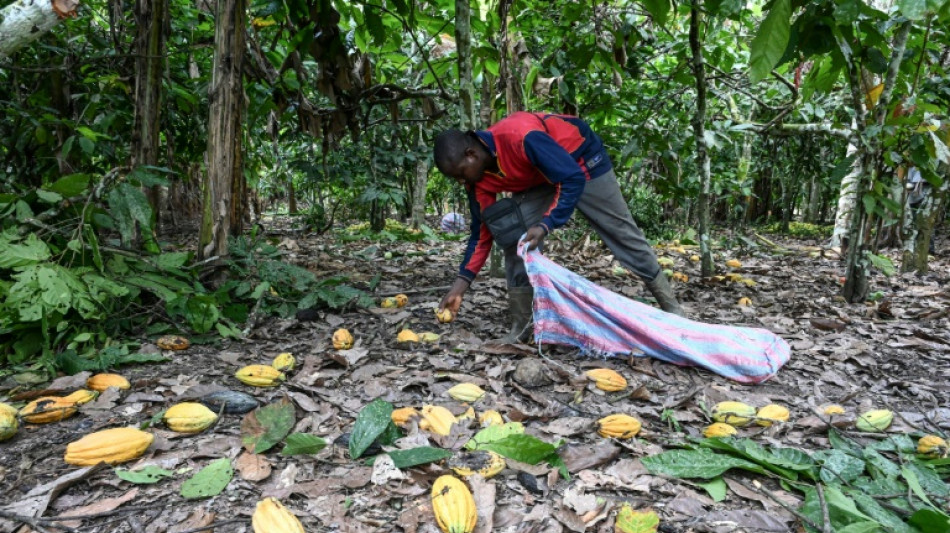
Top producer Ivory Coast fears for cocoa output after rains / Photo: © AFP

 Yamal on target as Spain hold off Czech Republic

 Latvian exit polls suggest pro-European choice
 Lula, Bolsonaro wrap up campaigns ahead of knife-edge election
 Tuchel hails 'complete' England after Croatia demolition

 Fury to invite Trump to lead ring walk before Joshua showdown

 Fashion industry in 'precarious moment', says Vivienne Westwood supremo
 Seventh heaven for England in Nations League rout of Croatia

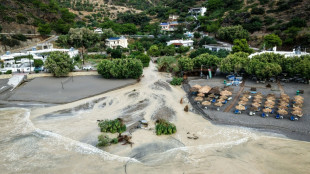 Storms, flooding cause chaos on Greek holiday island of Crete

 #IAmJaneDoe: online support campaign in US university rape case

 Brazil shine on Selecao's first visit to India

 Zverev sets up Djokovic quarter-final at China Open, Rybakina out
 Happier at home, Bordeaux hammer Lyon in Top 14
 Lula, Bolsonaro in final push for votes ahead of knife-edge election

 Boisterous fashion week barnstorms 'sleepy' Nigerian capital

 UAE investigators say flydubai co-pilot was planning 'terrorist act'

 Rahul smacks century in India v Windies ODI

 Daryz seeks to join exclusive club of dual Arc winners
 Russia warns diplomats to leave Kyiv over new strikes threat
 Olympic champ Zheng rebukes rowdy home crowd at China Open

 World No.1 Sinner pulls out of Shanghai Masters to delay return
 Red Bull's Verstappen grabs pole position for Bahrain GP

 India beat Pakistan in blockbuster as golfer Kim wins 'crazy' gold

 India beat arch-rivals Pakistan to win Asian Games cricket gold

 Ethiopia's Tigray rebels abandon regional capital as govt advances: journalist

 Tom Kim powers to Games gold and exemption from military service

"Thirty years I've been in cocoa -- and this is the worst season yet," said Siaka Sylla as he contemplated an almost empty warehouse at his cooperative in Ivory Coast, the world's top producer of the bean.
Following exceptionally heavy rain, this year's overall harvest of cocoa, used to manufacture chocolate, is set to be very low. The crop is harvested twice annually -- October to March for the main crop and a May to August mid-crop.
On a hot November morning, a squad of trucks arrived from the plantations to drop off a few dozen bags of beans at the Scappen cooperative in the village of Hermankono, near the central southern town of Divo, some 200 kilometres (125 miles) from the economic capital Abidjan.
"It's rained too much this year. Usually at this time, trucks are queueing up to unload. Here, we have barely 200 bags whereas we could stock 10 times as many," complained Sylla, chairman of the cooperative grouping some 1,500 planters.
He expects harvest volume to drop some three to four times on last year's.
A look in the fields nearby suggests that fear is well-founded. And Analysts confirm as much.
"Traders are worried about another short production year and these feelings have been enhanced by El Nino that could threaten West Africa crops with hot and dry weather later this year," said Jack Scoville of Price Futures Group.
The analyst warned of "tight supplies" amid "more reports of reduced arrivals in Ivory Coast and Ghana," the number two global producer.
By a dirt track which only motorbikes could thread their way along, Bamoussa Coulibaly collected a few rare yellow-red pods from the many cocoa trees.
July was a particularly rainy month in Ivory Coast's south, just as the cocoa plants were flowering. As a result, "the flowers fell," the farm worker said as he explained his meagre harvest.
Of those cocoa pods which resisted, some rotted anyway in the excessive humidity.
- Rainfall soars -
Some areas have seen rainfall this year between 20 and even 40 percent above the 1991-2020 norm, according to data from national meteorological service Sodexam.
To blossom fully, cocoa needs a subtle alternation between sunshine and rain.
A few kilometres from Hermankono, in the bush near N'Douci, Monique Koffi Amenan waded through a marshy field resulting from weeks of rainfall which caused the neighbouring river to burst its banks.
"This year, what we've harvested won't even fill one bag, instead of the usual two. The rain has rotted the cocoa," explained the planter in her 40s who has spent a decade working the area with her husband.
"We'd forecast a 20 percent drop on last year and our forecasts are confirmed. With the heavy rains, many pods have rotted," Yves Brahima Kone, who heads Ivorian regulator the Coffee-Cocoa Council (CCC), told AFP.
- Prices soar too -
With a 40 percent share of global supply, Ivory Coast is the world's top producer ahead of neighbouring Ghana, whose production has recently suffered from cocoa swollen shoot virus disease, as well as illegal mining on some cocoa farms.
Anticipating a poor crop, Ivory Coast suspended export contracts -- some two-thirds of produce usually goes to the EU bloc -- back in July.
As a result of that move, cocoa prices have soared on commodity markets beyond $4,000 a tonne in New York, a level not seen in more than four decades, since 1978.
It was a similar story in London, with a tonne fetching £3,478 on November 10, a post-1989 record and up 70 percent on January.
The situation threatens to remain critical with the resurgence of the El Nino climate phenomenon threatening western Africa.
"This is proof that climate change is hitting developing countries hardest," said Ivorian economist Seraphin Prao.
Even ahead of expected further El Nino woe next year, producers are already fretting over their short-term financial health.
In Ivory Coast, the government sets cocoa prices. At 1,000 CFA francs per kilogram (1.50 euros, $1.70) it is higher this year than in recent seasons, but low volumes will eat into many producer families' revenues.
Cocoa provides a wage for around one in five Ivorians -- some six million people -- according to the World Bank.
"My children are school age -- but if cocoa doesn't deliver, how shall we manage?" Amenan worried.
"In a liberalised system, farmers would be winners in the current context, as cocoa (prices) reach record levels. In Cameroon, for example, where the price is not set by the state, a kilo of cocoa sells for twice as much," said economist Prao.
Back at the Hermankono cooperative, Siaka Sylla is pinning his hopes on a better intermediate harvest next April.
"But that won't make up for our losses," he said.
C.Koch--VB