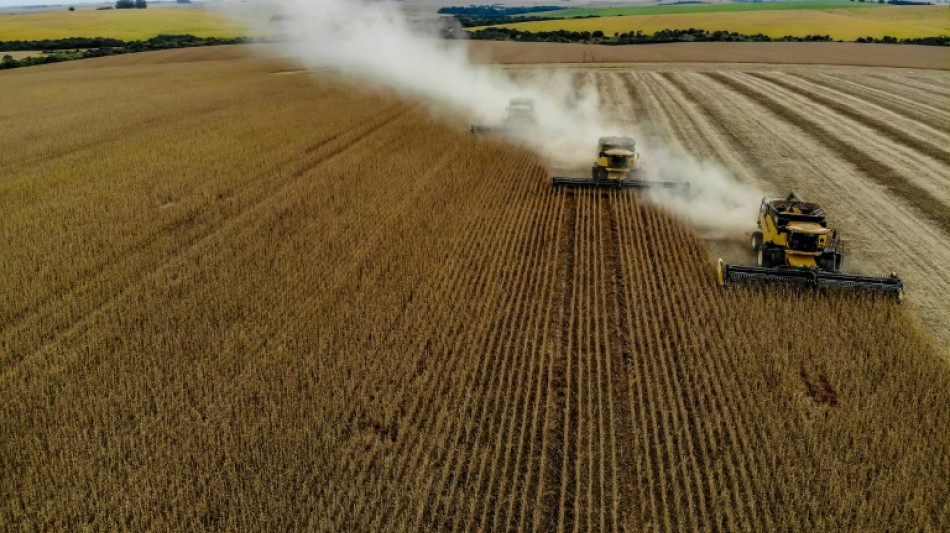
Brazil's booming ag sector draws cash and controversy / Photo: © AFP

 Zverev thrashes Shang to set up Djokovic quarter-final at China Open

 Turkey football ref chief jailed pending trial for graft
 North Korea says test of intermediate-range strategic missile included use of AI

 Rampant Sayers leads Hong Kong to third men's rugby gold in a row

 Ethiopia's Tigray rebels abandon regional capital as govt advances

 Bulgaria's Tsar Samuel returns 'home' after 1,000 years

 'Glad it's over': Kim powers to Games gold and military exemption

 After 11 World Cups, football finally comes home for one Indian fan
 Marc Marquez wins sprint at Japan MotoGP, Martin grabs pole

 Alcaraz fends off Arnaldi to reach Japan Open quarters

 Antonelli tops times in final practice at Bahrain GP

 Gauff digs deep to beat Osorio in China Open second round

 Fresh protests to hit Spain after housing measures defeated

 'He's here with me': Japan cycle queen dedicates gold to late brother

 Japan Olympic chief says 'lot more' athletes at Games than expected
 Asian carmakers besting US rivals at home, China poised to strike

 Widgets & Web Offers All-Inclusive Investor Relations Websites for Public Companies, IPOs and SPACs

 Adams named new US captain to 2030 World Cup

 China a better influence in Latin America than US: poll

 Judge pauses construction of border project in Texas national park

 Belgium's De Bruyne fires double to sink Turkey, France held by Italy
 US jobs data boosts stocks as oil prices dip

 US Supreme Court to hear high-stakes climate case

 Trump expected to name intel chief Clayton as AI czar: reports

 Argentina unveils passports-for-investment scheme

With its massive output of soybeans, beef, cotton and now corn, Brazil has become one of the world's top agricultural powers. But its agribusiness industry also faces criticism, especially over destruction of the Amazon rainforest.
Here is an overview of the South American ag giant, which, more than a decade after passing the United States as the world's biggest soy and beef exporter, is set to overtake US corn exports this year and is now eying the cotton crown.
- Big and growing -
Brazil's agriculture ministry triumphantly announced recently the sector's output will hit a record 1.15 trillion reais ($230 billion) this year.
The country -- the world's fifth-largest by surface area -- is the top producer and exporter of sugar, coffee and soy.
It is also the world's top supplier of chicken and beef, and second in cotton, after the United States.
Agribusiness accounts for nearly one-fourth of Brazil's economy, and half its exports in the first half of the year.
- Roots of the boom -
Brazil's emergence as an agricultural giant goes back to Portuguese colonial times. Fortunes were made here on a succession of commodities: sugarcane, then cotton, rubber and finally coffee, which reigned supreme for more than a century.
But the turning point came in the 1960s and 70s, when Brazil's then military regime ushered in the so-called "green revolution" and encouraged the expansion of agriculture to the Amazon and Cerrado savanna.
Fueled by Chinese demand, Brazil would go on to become the dominant producer of soy, a widely used ingredient in animal feed worldwide.
"Research on genetic improvements, techniques to correct soil acidity and fertilizers" -- plus pesticide development -- have allowed Brazil to expand soy, corn and cotton production into tropical regions, state agricultural research company Embrapa told AFP.
Brazil is able to harvest two and sometimes three crops a year, thanks to its climate and the development of zero till planting and genetically modified (GMO) crops -- which today account for 80 to 90 percent of the country's soy, corn and cotton output.
Production of all three has tripled in the past two decades.
- Price of success -
But the boom has come with controversy.
The agribusiness industry has helped fuel deforestation in the Amazon, which President Luiz Inacio Lula da Silva has vowed to halt.
Polemics over high rates of deforestation, pesticides and GMO use have hurt Brazil's brand in some places, including the European Union, which has held off ratifying a free-trade deal with South American bloc Mercosur over environmental issues.
The agro sector's image has also paid a price internationally for its close association with controversial far-right ex-president Jair Bolsonaro, who was in office from 2019 to 2022.
- Under pressure -
Lula will have to come to terms with the powerful agribusiness lobby if he wants to keep his promise to stop Amazon deforestation by 2030, after a surge in destruction under Bolsonaro.
The veteran leftist, who needs the sector's help to keep the economy growing, is looking to open new markets for Brazilian producers via trade deals, notably with top buyer China.
For its part, the ag sector is keen to polish its image, with international clients increasingly demanding deforestation-free products.
"Meat companies are working particularly hard to make their supply chains traceable, which is fundamental for export value," said Luiz Carlos Correa Carvalho, president of the Brazilian Agribusiness Association.
Grain producers meanwhile tout the recent adoption of a sustainable farming deal aimed at protecting the Cerrado.
Environmentalists say that is not enough.
"Real progress would be zero deforestation," said Cristiane Mazzetti of Greenpeace Brazil, who called for new production models that protect biodiversity.
The issue is urgent, especially since climate change is already starting to hit agricultural output.
"We have to evolve toward a more sustainable model," said Britaldo Soares Filho, a researcher on environmental modeling at the University of Minas Gerais.
"When agribusiness harms the environment, it's shooting itself in the foot."
L.Stucki--VB