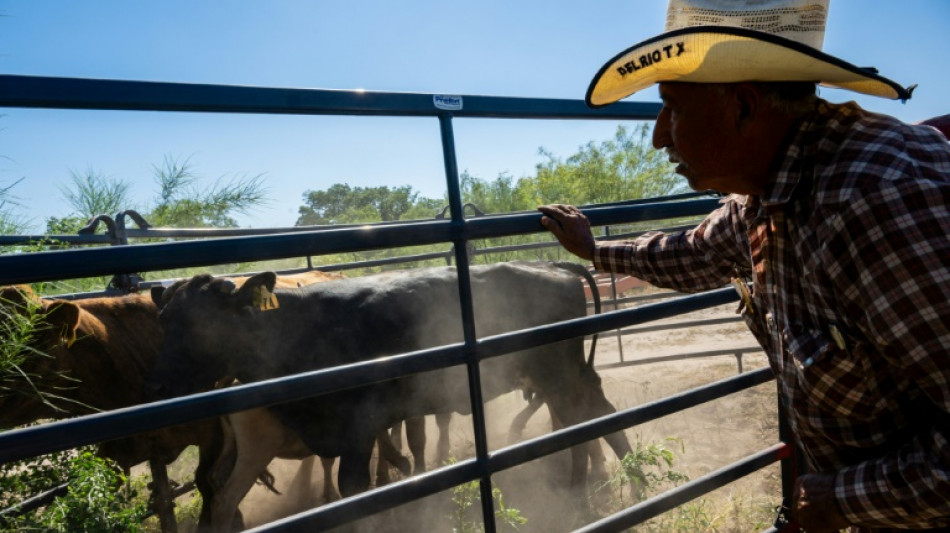
Drought and shrinking herds push US beef prices through the roof / Photo: © GETTY IMAGES NORTH AMERICA/AFP/File

 Zverev thrashes Shang to set up Djokovic quarter-final at China Open

 Turkey football ref chief jailed pending trial for graft
 North Korea says test of intermediate-range strategic missile included use of AI

 Rampant Sayers leads Hong Kong to third men's rugby gold in a row

 Ethiopia's Tigray rebels abandon regional capital as govt advances

 Bulgaria's Tsar Samuel returns 'home' after 1,000 years

 'Glad it's over': Kim powers to Games gold and military exemption

 After 11 World Cups, football finally comes home for one Indian fan

 Marc Marquez wins sprint at Japan MotoGP, Martin grabs pole

 Alcaraz fends off Arnaldi to reach Japan Open quarters

 Antonelli tops times in final practice at Bahrain GP

 Gauff digs deep to beat Osorio in China Open second round

 Fresh protests to hit Spain after housing measures defeated

 'He's here with me': Japan cycle queen dedicates gold to late brother

 Japan Olympic chief says 'lot more' athletes at Games than expected

 Asian carmakers besting US rivals at home, China poised to strike

 Widgets & Web Offers All-Inclusive Investor Relations Websites for Public Companies, IPOs and SPACs

 Adams named new US captain to 2030 World Cup
 China a better influence in Latin America than US: poll

 Judge pauses construction of border project in Texas national park

 Belgium's De Bruyne fires double to sink Turkey, France held by Italy

 US jobs data boosts stocks as oil prices dip

 US Supreme Court to hear high-stakes climate case
 Trump expected to name intel chief Clayton as AI czar: reports

 Argentina unveils passports-for-investment scheme

A prolonged drought is shrinking livestock herds and driving beef prices to record highs in the US, even as consumption is growing stronger.
These days, Mary Skinner is finding it harder to get her daily meat intake.
"I have extreme need for protein and I need to eat meat that my doctor ordered," said the 69-year-old shopper outside Grand Central Market, in New York.
"I used to be able to sometimes buy ribeye steak but... I'm now eating a lot more ground beef."
The headline rate of inflation has slowed in recent months, with a 3.7 percent reading in September, year over year. But steak is still riding high, up 9.7 percent, according to the US Bureau of Labor Statistics.
The average price for this American staple has risen 27 percent over the last three years.
"It's gotten to a point where I've started buying more things that can be slow-cooked, because from a price perspective, you're getting more affordable stuff," said another patron, who declined to share his name.
- Increasing demand -
While inflation has been a dominant theme over the last couple years, beef is on a trajectory of its own.
Though America is often seen as home to giant herds and sprawling ranches, it is short of cattle.
"We're at the lowest beef cattle numbers since the 1960s," said Scott Brown, a specialist in farm and livestock issues at the University of Missouri.
Herds have dwindled by 10 percent over the last five years, according to the US Department of Agriculture (USDA).
"The primary driver has really been drought in many parts of cattle country. That's been a multi-year event," said Brown.
He dates the decline back to the autumn of 2020.
Pastures have decreased in size due to the lack of rainfall. Faced with less grazing land and skyrocketing hay prices, ranchers have dramatically reduced their herds.
"You look at 2022, that was the highest beef cow slaughter that we've seen since the early 1980s," said Ross Baldwin, a hedge strategist at AgMarket.Net.
The contraction since then was amplified when hundreds of cattle succumbed to brutally hot and humid weather in August.
Genetic selection has helped make up for some of the loss by improving output.
"We're more productive today. We don't need as many beef cows today as we needed 10 years ago to generate a given level of production," Scott Brown said.
But meantime, demand for red meat has increased.
In 2022, Americans ate, on average, 59.1 pounds or 26.8 kilograms of beef, slightly up from 2021.
Beef consumption has increased by nearly 10 percent since 2015, per USDA's numbers.
In this tight market, cattle prices have more than doubled since March 2020 (up 133 percent).
Incentivized by record prices, many breeders are parting with their heifers earlier, which prevents the herd from growing, according to Baldwin.
"We are a year out from starting to see meaningful heifer retention," he said.
"And when you start retaining heifers, those heifers are still three years out from when the herd starts really increasing in size across the country."
On top of it, holding on to female calves for breeding "means even less beef production and even higher price short-term, because those cattle aren't entering the beef production stream," said David Anderson, a livestock-market specialist at Texas A&M University.
Another challenge is finding pastures to accommodate growing herds.
"The Southeast part of the US has seen some dry weather, but not as dry as the rest of the country," said Brown.
"Could beef cows move there as a another way to generate a bigger national herd? Those kinds of shifts could try to happen."
The USDA forecasts a further decrease in beef production for 2024.
From then on, Baldwin warned, "you will see retail prices be extremely firm. And ultimately it'll force the consumer to choose if they want to continue paying those high prices."
H.Kuenzler--VB