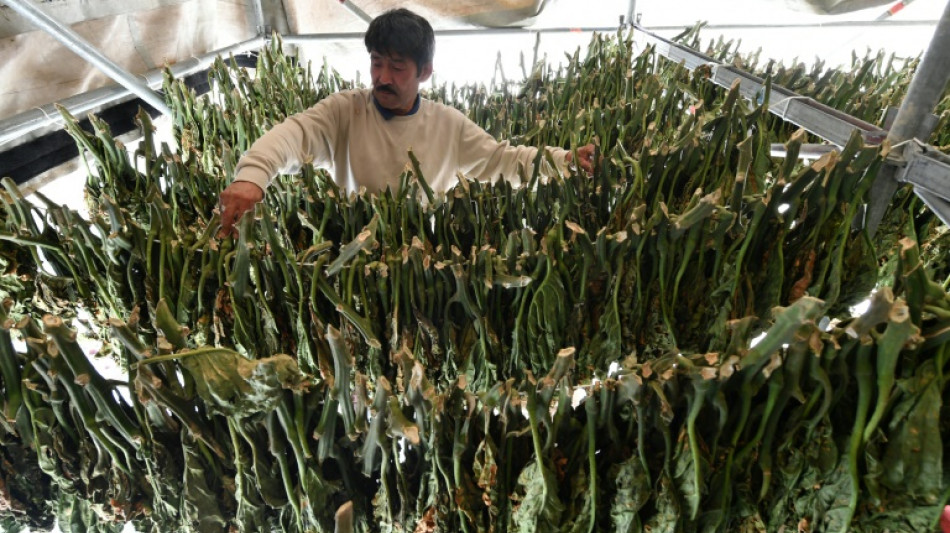
Nasvay: The chewing tobacco poisoning Kyrgyzstan / Photo: © AFP

 Eala-conqueror Wang wins Asian Games tennis gold and Olympic berth

 'Kinda cool' Raygun made breakdancing famous, Asian Games B-girls say

 Taiwan gender-row boxer Lin Yu-ting wins 'monumental' Asian Games gold
 Taiwan receives its first US-made F-16V fighter jets

 Lula, Bolsonaro trade scandal fire in final scramble for votes
 Not-so-brave new world: virtual taekwondo makes Asian Games debut

 Arab Israeli candidate drops out of election race

 Israel courts Europe's far right, finding friends but also unease

 Lula, Bolsonaro both snub final debate before Brazil election
 Nepal's grim DNA puzzle to identify flood dead
 EU nations to hold emergency meeting on soaring diesel prices amid US pressure

 Anthropic's Dario Amodei: AI's most visible CEO and enigma

 OpenAI says three staffers fired for mishandling 'sensitive' info

 Nike plans job cuts as it forecasts lower sales

 Ireland game interrupted twice by Gaza protests

 Judge denies acquittal bid by US woman who killed her kids

 Klopp averts crisis with first win as Germany boss

 A saintly spat and debate snub: Brazil enters final campaign stretch

 US tells European allies to act 'immediately' to lower diesel prices

 G20 trade ministers fail to see consensus against overproduction

 Portugal edge Denmark in Ronaldo's absence
 US stocks edge higher as bond yields retreat for now

 US tells European allies to 'immediately' act to lower diesel prices

 Trump vows to hit Iran 'very hard' if linked to flydubai attack
 Williams leaves Spain camp with thigh knock
Farmer Askarbek Duisheyev pours a small plastic bottle into the palm of his hand and tips some green balls under his tongue.
This is nasvay, a type of toxic chewing tobacco hugely popular in Central Asia that is a key part of the fragile economy of impoverished southern Kyrgyzstan.
"I've been growing tobacco to make nasvay for the past two years. What else is there to do? There's no work in the Batken region," Duisheyev, 59, told AFP.
"I have to earn money and feed my family," he said, as he cut tobacco leaves with a sickle in the village of Kara-Bulak, not far from the Tajik border.
Batken province is the poorest in the former Soviet republic, with nearly half the population living below the poverty line of 540 euros ($570) a year.
Surviving often means either leaving to work in Russia or growing tobacco to make nasvay.
The unregulated production of this addictive and cancerogenic product supports a third of the population according to the campaign group "Kyrgyzstan Without Tobacco".
- Mysterious recipe -
At the start of autumn, barns in Batken are filled with drying tobacco leaves.
Since he does not have enough space of his own, Duisheyev rents storage from a neighbour who has left to work in Russia like millions of Kyrgyz.
"You can't stay (inside) too long. The smell is overpowering," he warned.
After being dried, crushed and mixed in with mysterious ingredients -- usually lime, oil or even poultry droppings -- the tobacco becomes nasvay, which users slip between their gums and lips.
"The secret is simply mixing three or four ingredients," said nasvay producer Israil Khakimov.
But chewing the altered tobacco can lead to a long list of health problems.
"Consumption of nasvay can lead to gastrointestinal, oral and liver diseases, as well as cancer of the lips, throats and stomach," said Saipidin Toroyev, a cancer specialist at Batken hospital.
"Nasvay is dangerous because, as it is placed in the mouth, the saliva brings particles down to the stomach and into the blood stream, causing damage to the whole body," he told AFP, also pointing to its psychotropic and addictive effects.
Cheaper than cigarettes, consumption has shot up in recent years among both men and women, according to the health ministry.
- 'Had to find another job' -
Working out the number of users is tough since nasvay is part of the black economy.
And politicians are torn over whether to eradicate a public health hazard or turn a blind eye to an industry that supports a farming region suffering from water shortages and frequent cross-border conflicts with neighbouring Tajikistan.
Alisher Seidakmatov, who is in charge of agricultural development for the Batken region, told AFP that it is "also profitable to grow fruit and vegetables".
That view is not shared by producers.
"I had to grow tobacco because my salary was insufficient and I would not earn the same growing potatoes," said Duisheyev.
His salary as a forest ranger was just 10,000 soms (100 euros) per month.
"I had to find another job," he said.
With his relatively modest production of around half a tonne of nasvay, he was able to earn his annual forest ranger salary with one harvest.
The nasvay ends up being sold in 50-kilo sacks on Saturdays in the regional capital at a busy tobacco market crowded with trucks and vans.
A buyer comes up to Dzhunusali Seidakmatov's stall, picks up a fistful of tobacco, rubs it and breathes in.
Negotiations begin, but the two fail to strike a deal.
"He wanted me to sell it to him for 445 soms per kilo. I was expecting 450 soms," said the seller, who wore a traditional Kyrgyz white felt halt.
"It's not a problem. I've already sold more than 80 kilos," he said.
R.Braegger--VB