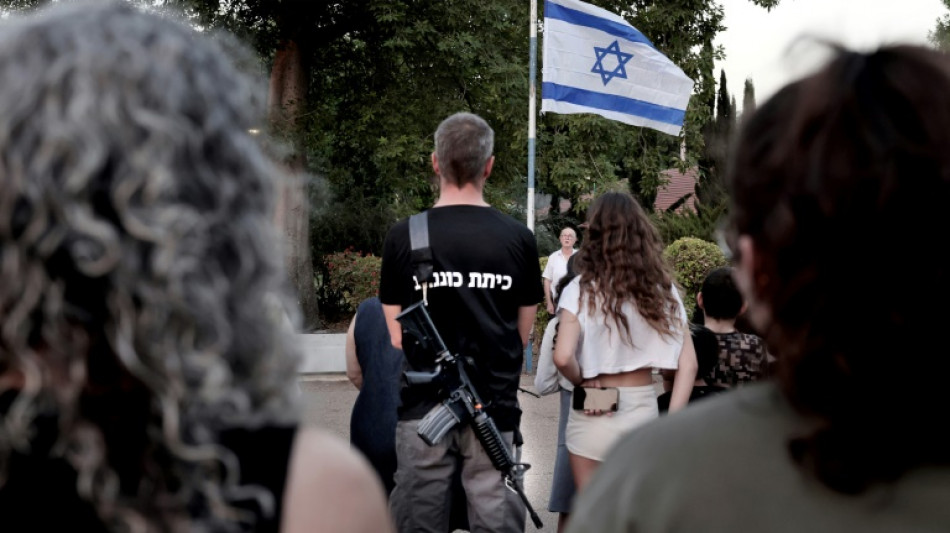
Hamas attacks shatter Israel's kibbutz ideal / Photo: © AFP

 Taiwan gender-row boxer Lin Yu-ting wins 'monumental' Asian Games gold

 Taiwan receives its first US-made F-16V fighter jets

 Lula, Bolsonaro trade scandal fire in final scramble for votes
 Not-so-brave new world: virtual taekwondo makes Asian Games debut

 Arab Israeli candidate drops out of election race

 Israel courts Europe's far right, finding friends but also unease

 Lula, Bolsonaro both snub final debate before Brazil election
 Nepal's grim DNA puzzle to identify flood dead
 EU nations to hold emergency meeting on soaring diesel prices amid US pressure

 Anthropic's Dario Amodei: AI's most visible CEO and enigma

 OpenAI says three staffers fired for mishandling 'sensitive' info

 Nike plans job cuts as it forecasts lower sales

 Ireland game interrupted twice by Gaza protests

 Judge denies acquittal bid by US woman who killed her kids

 Klopp averts crisis with first win as Germany boss

 A saintly spat and debate snub: Brazil enters final campaign stretch

 US tells European allies to act 'immediately' to lower diesel prices

 G20 trade ministers fail to see consensus against overproduction

 Portugal edge Denmark in Ronaldo's absence

 US stocks edge higher as bond yields retreat for now

 US tells European allies to 'immediately' act to lower diesel prices

 Trump vows to hit Iran 'very hard' if linked to flydubai attack

 Williams leaves Spain camp with thigh knock
 WTA reduces 2027 schedule for world's top 50

 US says 'in Europe's best interest' to cooperate on fuel supply
When the sirens wail at the Sha'ar HaGolan kibbutz, there is total panic -- and not just from those who live there permanently.
Some residents are from southern Israel where Hamas militants attacked last week. Others are from the north, where fear of Hezbollah is a constant.
Sha'ar HaGolan, in northeastern Israel, lies near the border with Jordan and no alarm had sounded for decades before Wednesday.
Now, most of its 500 residents, and the new arrivals this week, are almost all trembling in fear.
There are similar scenes at Israel's 270 other kibbutzim, many of which lie in border regions with the country's Arab neighbours.
Vardit, 34, spent last Saturday in a shelter with her husband and their four children, "trying to keep them occupied" during constant shooting outside.
The sirens went off "60 to 80 times" as Hamas fighters attacked her village, Netivot, from the Gaza Strip less than 10 kilometres (six miles) away.
Seven days later at Sha'ar HaGolan, the sirens were warning about a possible air raid from Lebanon in the north.
Vardit went slowly down to the shelter, with her youngest child in her arm. She stood for several long minutes just staring in the basement.
Gali Dror, a manager at Sha'ar HaGolan, said some 50 displaced people came to the kibbutz from southern Israel after last week's attacks.
"They don't speak, they don't go out, they don't come to any of the activities that we do," she said.
"They barely come out to eat.
"They told me: 'We have no home to go back to'. One of the kids told me: 'I have no friends, I have no teachers, they're all dead'."
- Terrified -
About 100 displaced people came from the north.
They were not directly affected by the Hamas attack, which left more than 1,300 people dead and saw at least 120 civilians taken hostage.
But they have all left their homes as cross-border incidents increased between Israel and Hezbollah, the Iran-backed group in neighbouring Lebanon.
"I hear the (Muslim) call to prayer when I'm sitting outside my house," said one woman, a psychotherapist who asked to be called "Sarah" and would not say exactly where she lived.
"I'm terrified. All my life I've lived on the northern border and I never felt as much fear as I feel now...
"Sometimes I feel like someone is watching me when I sit in my garden."
"Sarah", who has two teenage daughters, said Lebanon is two kilometres (just over a mile) from her home, just like the kibbutzim in the south near the Gaza Strip which were targeted by Hamas.
What happened at places such as Kfar Aza, near Netivot, where about 100 people were killed, is a "nightmare", she added.
"In my mind, (it) can easily be where I live. What's the difference between me and those women?"
The attacks highlighted how vulnerable the gated farming communities are, with just a handful of security guards that can easily be overrun, she said.
Betty Garti, 75, lives at Kfar Giladi on the border with Lebanon. Unlike "Sarah", she said she was not afraid.
But she said she had to make a choice in 1980 between the greenery of the farm and Be'eri, in the dusty south, where 100 people were killed last week.
"I preferred the green, luckily with what happened there," she said.
Many victims died while waiting for Israeli security forces to arrive, shattering any notions of invincibility.
Dror said she received calls from an elderly women who spent nine hours in a shelter before she was killed.
Dozens of residents from Kfar Aza whom she knew were blown up on a bus. "They never arrived," she sobbed.
- Betrayed -
Kibbutzim were created by European Jews who came to Palestine when it was under British mandate after World War I, then after Israel was created in 1948.
For decades they have functioned as agricultural cooperatives operating under egalitarian principles.
They remain lightly armed, close-to-nature communities, and bastions of the Israeli left, pro-peace and generally hostile to Israeli settlements in the occupied West Bank.
But after last week, many kibbutzniks feel betrayed by the Palestinians in Gaza, and support mainstream Israeli opinion in favour of intervention -- whatever the human cost.
"I have friends in Ramallah. I have friends in Bethlehem, I'm a peace activist," said Dror.
"And I'm telling you, I can't have peace with people who do this, you know. We're left-wingers. And it's a crisis.
"Now we have to find a new way to live."
B.Baumann--VB