
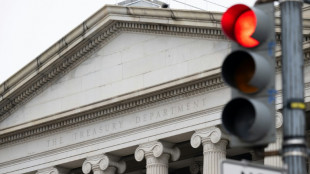
Mysterious rise in US Treasury yields perturbs markets / Photo: © GETTY IMAGES NORTH AMERICA/AFP/File

 Taiwan gender-row boxer Lin Yu-ting wins 'monumental' Asian Games gold

 Taiwan receives its first US-made F-16V fighter jets

 Lula, Bolsonaro trade scandal fire in final scramble for votes

 Not-so-brave new world: virtual taekwondo makes Asian Games debut

 Arab Israeli candidate drops out of election race

 Israel courts Europe's far right, finding friends but also unease

 Lula, Bolsonaro both snub final debate before Brazil election

 Nepal's grim DNA puzzle to identify flood dead

 EU nations to hold emergency meeting on soaring diesel prices amid US pressure

 Anthropic's Dario Amodei: AI's most visible CEO and enigma

 OpenAI says three staffers fired for mishandling 'sensitive' info

 Nike plans job cuts as it forecasts lower sales

 Ireland game interrupted twice by Gaza protests

 Judge denies acquittal bid by US woman who killed her kids

 Klopp averts crisis with first win as Germany boss

 A saintly spat and debate snub: Brazil enters final campaign stretch

 US tells European allies to act 'immediately' to lower diesel prices

 G20 trade ministers fail to see consensus against overproduction

 Portugal edge Denmark in Ronaldo's absence

 US stocks edge higher as bond yields retreat for now

 US tells European allies to 'immediately' act to lower diesel prices

 Trump vows to hit Iran 'very hard' if linked to flydubai attack

 Williams leaves Spain camp with thigh knock

 WTA reduces 2027 schedule for world's top 50

 US says 'in Europe's best interest' to cooperate on fuel supply

The surge in US treasury yields has sparked much anxiety among investors, in part because there is no easy explanation for the rise.
On Friday, the yield on the 10-year US Treasury note climbed to 4.88 percent for the first time since 2007, while the 30-year offering reached 5.05 percent, also a 16-year peak.
Both have edged back in recent days, due mainly to elevated geopolitical risk, analysts say, although yields remain high.
The most oft-cited justification for the rise has been expectations that monetary policy will stay hawkish in response to the resilient US economy.
"The Fed expectations have been shifting," said John Canavan, analyst at Oxford Economics.
"From the Fed's perspective, we're seeing stronger than expected economic growth, some increase in inflation and uncertainty, particularly as oil prices surge again."
While two-year US treasuries are considered the closest proxy to Fed interest rates, the market has been unsettled by the jump in yields of longer-run bonds of five, 10 or 30 years.
"Something is happening in the bond market and nobody fully understands how you kind of break it down," said Adam Button of ForexLive.
Karl Haeling of LBBW pointed to increased bond issuance by the US Treasury Department, saying markets are increasingly worried that the US "fiscal situation is moving on a long-term unsustainably bad trajectory."
For Yardeni Research, "the bond market has changed recently and disconcertingly," the consultancy said in a recent posting.
Perplexing moves by US treasuries in response to economic news "suggest a shift in bond investors' focus from what monetary policymakers may do, to rising alarm about what fiscal policymakers are doing."
"The worry is that the escalating federal budget deficit will create more supply of bonds than demand can meet, requiring higher yields to clear the market," added Yardeni Research.
But not everyone is on board with this perspective.
"We can blame higher long-run yields on many things, but deficits are not one of them," said Nick Colas of DataTrek Research.
- Fewer buyers -
Yet another factor in the market shift has been a slowing in demand.
"Central banks are no longer buying bonds, they are selling them," Neil Wilson, chief market analyst at Markets.com, said of the retreat.
After multiple rounds of quantitative easing, the Fed has been in a belt-tightening mode, reducing the size of its balance sheet and not replacing bonds that reach maturity with new purchases.
But Peter Boockvar, chief investment officer of Bleakley Financial Group, said that the US central bank may not be able to pull of "quantitative tightening," noting that the Fed reversed course in 2019 following turbulence in markets.
A "failure" by the Fed means "things cracking in the financial system well before the Fed's balance sheet shrinks by much and we're left with this perpetually large Fed presence in the markets."
The US central bank might be forced to resume quantitative easing "just to help absorb the massive amount of Treasury supply coming down the DC pike," Boockvar said.
"Someone else has to buy the debt and there is a lot more of it now," Wilson said. "This can only result in lower prices, higher yields."
The group that has stepped back from US Treasury purchases includes China, which is managing a difficult economic recovery after Covid-19 lockdowns, and Japan, which has been buying domestic bonds to suppress yields, said Jose Torres of Interactive Brokers.
"We're going to have a debt crisis in this country," Ray Dalio, head of the hedge fund Bridgewater Associates, warned in an interview on CNBC.
"How fast it transpires, I think, is going to be a function of that supply-demand issue."
But not everyone is so gloomy.
"As long as US Treasury securities are regarded as risk-free securities, there is always going to be demand for Treasuries," said LPL Financial's Lawrence Gillum. "And with Treasury yields at the highest levels in decades, we could see that demand increase as well."
The aging of global populations is another source of demand, said Oxford Economics' Caravan.
"There's going to be an exceptional amount of global savings," Caravan said. "And that global savings glut is going to continue to look for a home in US treasuries, which remain the safest and most liquid asset on the planet."
D.Bachmann--VB