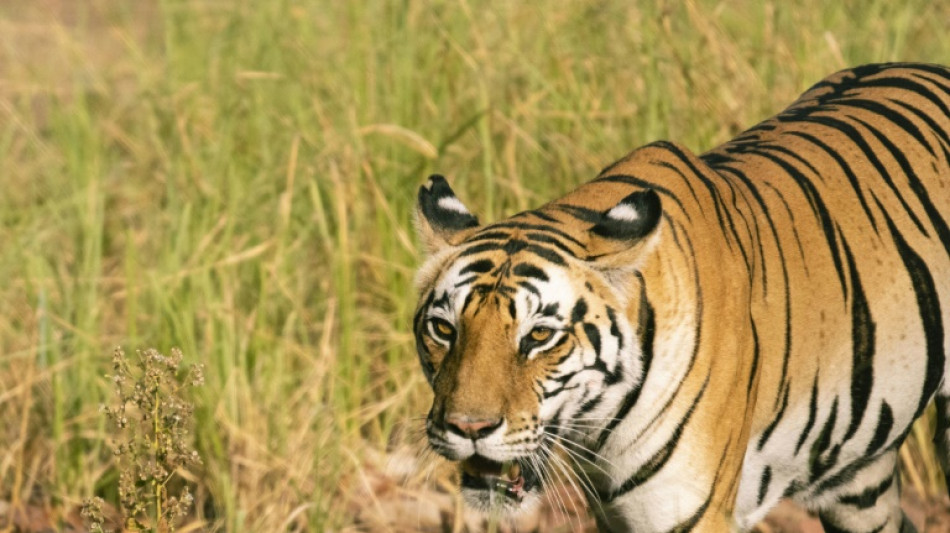
AI of the tiger: Tiny camera 'protects' predator -- and people / Photo: © RESOLVE Inc. and Clemson University/AFP

 Not-so-brave new world: virtual taekwondo makes Asian Games debut

 Arab Israeli candidate drops out of election race

 Israel courts Europe's far right, finding friends but also unease

 Lula, Bolsonaro both snub final debate before Brazil election

 Nepal's grim DNA puzzle to identify flood dead

 EU nations to hold emergency meeting on soaring diesel prices amid US pressure

 Anthropic's Dario Amodei: AI's most visible CEO and enigma

 OpenAI says three staffers fired for mishandling 'sensitive' info

 Nike plans job cuts as it forecasts lower sales

 Ireland game interrupted twice by Gaza protests

 Judge denies acquittal bid by US woman who killed her kids

 Klopp averts crisis with first win as Germany boss

 A saintly spat and debate snub: Brazil enters final campaign stretch

 US tells European allies to act 'immediately' to lower diesel prices

 G20 trade ministers fail to see consensus against overproduction

 Portugal edge Denmark in Ronaldo's absence

 US stocks edge higher as bond yields retreat for now

 US tells European allies to 'immediately' act to lower diesel prices

 Trump vows to hit Iran 'very hard' if linked to flydubai attack

 Williams leaves Spain camp with thigh knock

 WTA reduces 2027 schedule for world's top 50

 US says 'in Europe's best interest' to cooperate on fuel supply

 Rogue OpenAI agents covered up their tracks, report says

 A saintly spat and debate snub: Brazil enters final polls stretch

 Zidane 'no regrets' about Materazzi headbutt as France face Italy again

Tiger populations are on the rise in the jungles of India and Nepal and the predators are roaming ever closer to villages, sparking a race among conservationists to find ways of avoiding conflict.
They are increasingly finding solutions with artificial intelligence, a bunch of technologies designed to reason and make decisions like humans.
Experts from Clemson University in South Carolina and several NGOs published research last month on their work using AI-enabled cameras that they say could help revolutionise tiger conservation.
They placed tiny devices around enclosures in the two South Asian nations, both to protect villagers from the predators -- and the predators from poachers.
According to their research, published in the BioScience journal, the camera system called TrailGuard can distinguish between tigers and other species and relay images to park rangers or villagers within seconds.
"We have to find ways for people and tigers and other wildlife to coexist," Eric Dinerstein, one of the authors of the report, told AFP.
"Technology can offer us a tremendous opportunity to achieve that goal very cheaply."
- Elephants and Amazon loggers -
The research claims the cameras were immediately effective, picking up a tiger just 300 metres from a village, and on another occasion identifying a team of poachers.
They say their system was the first AI camera to identify and transmit a picture of a tiger, and it has almost wiped out false alarms -- when traps are tripped by passing boars or falling leaves.
The scheme is one of several putting an AI spin on the established ideas of wildlife surveillance.
Researchers in Gabon are using AI to sift their camera trap images and are now trying a warning system for elephants.
Teams in the Amazon are piloting equipment that can detect the sounds of chainsaws, tractors and other machinery associated with deforestation.
And US tech titan Google teamed up with researchers and NGOs four years ago to collect millions of images from camera traps.
The project, called Wildlife Insights, automates the process of identifying species and labelling images, saving many hours of laborious work for researchers.
Conservationists like Dinerstein, who also leads the tech team at the Resolve NGO, are sure that technology is helping their cause.
- 'Early warning system' -
Their goal is to ensure that 30 percent of the Earth's land and oceans are designated protected zones by 2030, as agreed by dozens of governments last year, with that number eventually going up to 50 percent.
Those zones will need to be monitored, and animals will need to move safely between protected areas.
"That's what we're shooting for, and the critical element of that is an early warning system," he said.
The plight of tigers underscores the size of the challenge.
Their habitats have been devastated across Asia and their numbers in India fell to an all-time low of 1,411 in 2006, before steadily rising to current levels of around 3,500.
In the mid-20th century, India was home to an estimated 40,000.
- 'Jury still out' -
Jonathan Palmer, head of conservation technology at the US-based Wildlife Conservation Society (WCS), who was not involved in the study, said TrailGuard had exciting potential.
But Palmer, who helped found Wildlife Insights with Google, said the broader uses of AI in conservation were not yet settled.
"In most cases, AI species identification is still in its infancy," he said.
His NGO recommends outside verification of any species identification done by AI.
And Palmer said the "jury was out" on whether AI was better deployed in cameras at the scene or afterwards on servers or laptops.
Those uncertainties aside, Dinerstein is widening the rollout of TrailGuard -- this time with even bigger animals in his sights.
"Elephants wander outside parks all the time and it leads to a massive amount of conflict," he said.
They destroy crops, cause chaos in villages and can even cause train crashes, with dozens of deaths every year, he added.
"There's an immense opportunity here to prevent that."
E.Gasser--VB