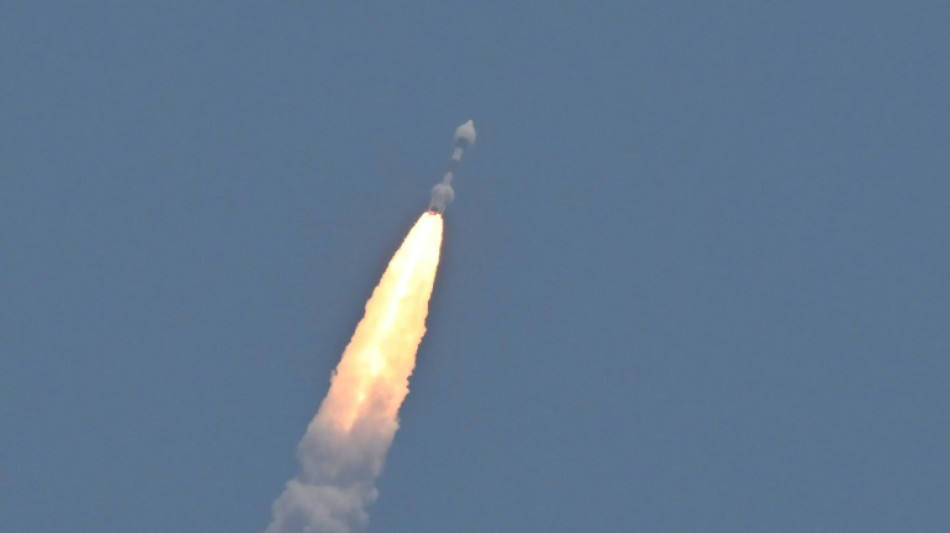
India's private space sector skyrockets / Photo: © AFP/File

 Asian stocks drop as oil spike fans rate hike bets, eyes on US jobs

 Viral anti-vax posts weaponise Philippine inoculation fears

 Saudi coalition accuses Houthis of drone attack on Medina

 Effective Altruism: the philosophy behind Silicon Valley's AI fears

 Chinese judoka accused of biting as home hope wins Asian Games gold

 Four-member crew docks at International Space Station

 Portugal win without Ronaldo as Klopp's Germany get first victory

 Wemby: 'Very sad' to see players endorse betting firms

 Manchester City Women scrape draw with Real Madrid

 India, Australia and Pakistan in same World Cup group

 Daryz's hopes of repeat Arc win boosted by draw

 Steelers ship disgruntled defender Porter to Cowboys

 Klopp gets first win as Germany boss

 Bolivia's attorney general arrested on drugs, money laundering charges

 Raiders host Chiefs in battle of unbeaten division rivals

 Lowest Fee Bitcoin ATMs Announces Launch of More Than 400 ATMs Nationwide

 G20 against 'weaponization' of food trade: French minister

 Female US inmate in critical condition after botched execution

 Spotlight on UK-UAE ties amid Manchester City scandal

 Ethiopia and Eritrea break diplomatic ties over conflict

 Downing Street says Manchester City not 'above the rules'

 Hadjar wants to 'fight for the title' from next season

 Bolivia's attorney general arrested for alleged drug trafficking, money laundering

 German sugar tax sparks new government row
 Musk returns to US government for Pentagon war study

When Indian entrepreneur Awais Ahmed founded his satellite startup in Bangalore in 2019, his country was still a year away from opening the space industry to the private sector.
"When we started, there was absolutely no support, no momentum," said Ahmed, who was 21 when he founded Pixxel, a company deploying a constellation of Earth imaging satellites.
Since then, the private space sector has taken off in India, joining a rapidly growing global market.
There are now 190 Indian space start-ups, twice as many as a year earlier, with private investments jumping by 77 percent between 2021 and 2022, according to Deloitte consultancy.
"A lot of Indian investors were not willing to look at space technology, because it was too much of a risk earlier," Ahmed said in an interview with AFP.
"Now you can see more and more companies raising more investment in India, and more and more companies have started coming up now," he added.
Pixxel makes hyperspectral imaging satellites -- technology that captures a wide spectrum of light to provide details that are invisible to ordinary cameras.
The company says it is on a mission to build "a health monitor for the planet": it can track climate risks such as floods, wildfires or methane leaks.
Pixxel had initially sought to use rockets from the state-run Indian Space Research Organisation (ISRO).
"I remember having a conversation with with someone in ISRO. We were trying to book a launch and they said, 'Look, we don't even have a procedure to launch an Indian satellite. But if you were a foreign company, then basically there's a process', which didn't make sense when we started," Ahmed said.
Pixxel ended up having to hire US rocket firm SpaceX to launch its first two satellites.
Pixxel has raised $71 million from investors, including $36 million from Google, which will allow the company to launch six more satellites next year.
The start-up has also won a contract with a US spy agency, the National Reconnaissance Office, to provide hyperspectral images.
- Modest budget -
Prior to the 2020 opening up of the sector, "all Indian space activity was under the supervision of the ISRO space agency, which managed absolutely everything," said Isabelle Sourbes-Verger, an Indian space sector expert at France's National Scientific Research Centre.
The ISRO budget remains relatively modest at $1.9 billion in 2022, six times smaller than the Chinese space programme.
Despite its limited resources, India's space programme has made huge strides, culminating with the landing of a rover on the Moon's unexplored south pole in August.
The country also launched a probe towards the Sun at the start of this month and is preparing a three-day crewed mission into Earth's orbit next year.
Before the reform, private companies could only act as suppliers for the agency.
"It was no longer tenable because there is too much to do," Sourbes-Verger said.
India deepened its reform of the sector in April, unveiling a new space policy that limits the ISRO's work to research and development while promoting "greater private sector participation in the entire value chain of the Space Economy".
India says it accounts for two percent of the $386 billion global space economy, a share it hopes to increase to nine percent by 2030. The market is expected to grow to $1 trillion by 2040.
- 'Some limits' -
Indian companies have an edge when it comes to costs as the country boasts a large number of highly qualified engineers with lower salaries than their counterparts abroad.
Other Indian start-ups that have emerged in recent years include Skyroot Aerospace, the first Indian company to launch a private rocket.
Dhruva Space is developing small satellites while Bellatrix Aerospace specialises in propulsion systems for satellites.
"Will this really create a dynamic and profitable industrial fabric? Probably, but undoubtedly with some limits," Sourbes-Verger said.
India is not done reforming the sector. Another law is expected to pass in the coming weeks to open the industry to foreign investments.
E.Gasser--VB