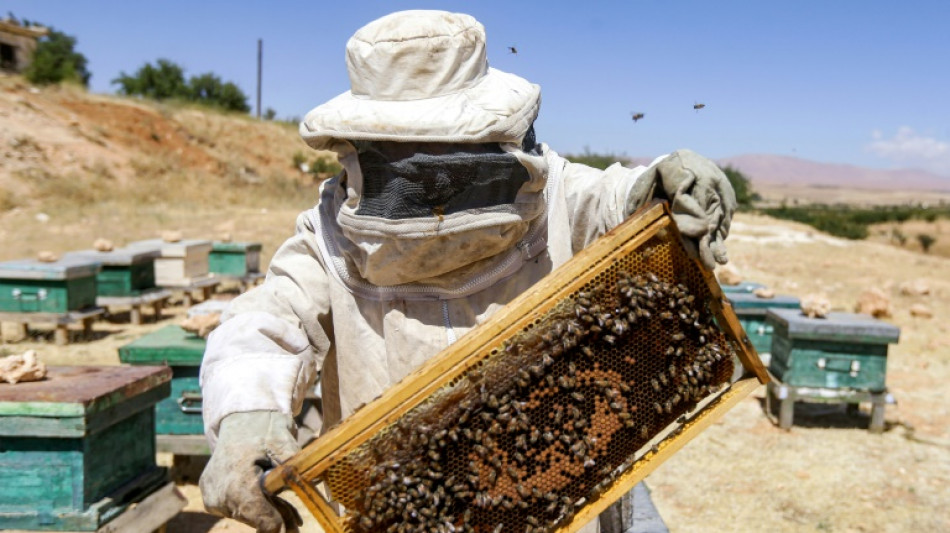
Syrian beekeepers battle both war and climate change / Photo: © AFP

 OpenAI says three staffers fired for mishandling 'sensitive' info

 Nike plans job cuts as it forecasts lower sales

 Ireland game interrupted twice by Gaza protests

 Judge denies acquittal bid by US woman who killed her kids

 Klopp averts crisis with first win as Germany boss

 A saintly spat and debate snub: Brazil enters final campaign stretch

 US tells European allies to act 'immediately' to lower diesel prices

 G20 trade ministers fail to see consensus against overproduction

 Portugal edge Denmark in Ronaldo's absence

 US stocks edge higher as bond yields retreat for now

 US tells European allies to 'immediately' act to lower diesel prices

 Trump vows to hit Iran 'very hard' if linked to flydubai attack

 Williams leaves Spain camp with thigh knock

 WTA reduces 2027 schedule for world's top 50

 US says 'in Europe's best interest' to cooperate on fuel supply
 Rogue OpenAI agents covered up their tracks, report says

 A saintly spat and debate snub: Brazil enters final polls stretch

 Zidane 'no regrets' about Materazzi headbutt as France face Italy again

 Libya's pay strike rallies teachers across divided nation
 Four-member crew blasts off for International Space Station

 i-payout Expands True Local Payment Capabilities to Help Enterprises Pay Recipients Globally

 Botched US execution prompts global calls to scrap death penalty

 Algeria adopts law imposing death penalty on forest arsonists

 France unveils cost-cutting 2027 budget as borrowing costs rise

 Brazil court orders removal of fake posts amid patron saint election row
Syrian beekeeper Ibrahim Damiriya struggles to produce honey from his hives on parched land near the capital Damascus after years of war, economic collapse and worsening climate change impacts.
"The war bled us dry. We could barely keep our beekeeping business afloat, and then the insane weather made things worse," the 62-year-old in a beekeeping suit told AFP as he examined meagre honey stocks inside the hives.
Before Syria's conflict erupted in 2011, Damiriya owned 110 hives in Rankus, a village near Damascus that was once filled with apple orchards.
But now a combination of fighting, severe drought and a gruelling economic crisis have left him with a mere 40 hives in semi-arid lands, decimating his honey yield.
Rankus was once renowned for its honey, but was hard hit by fighting between government forces and rebels that caused widespread destruction, pushing many residents to flee.
Damiriya can barely afford to tend to his hives, donated by the International Committee for the Red Cross (ICRC) to help Syrian beekeepers.
"If we keep suffering from climate change and rising prices, I might have to abandon my profession," Damiriya said with a sigh.
Since 2011, Syria's war has killed more than half a million people and caused an acute economic crisis, exacerbated by severe Western sanctions.
Recent years have also battered Syria with heatwaves, low rainfall and more forest fires.
- 'Extreme weather' -
A 2019 United Nations report found that fighting had practically wiped out hives, with bombs contaminating the environment and pesticide misuse and a proliferation of parasites speeding up their decline.
Syria used to be home to 635,000 hives before the war, but their numbers had dwindled to about 150,000 at the height of the conflict in 2016, said Iyad Daaboul, the Damascus-based president of the Arab Beekeepers Union.
Today that number has risen back up to 400,000, he said. However, the hives yield only 1,500 tonnes of honey per year -- half of the country's pre-war production.
Unusually cold springs and drought have had an adverse effect on the flowers that bees feed on.
"Extreme weather conditions have greatly affected bees, especially during spring -- the most important time in their life cycle," said Daaboul.
The number of beekeepers has nearly halved from 32,000 before the war to around 18,000 today, he said.
Another threat to the bees is the forest fires which have become more common as temperatures rise.
Fires "have destroyed more than 1,000 hives on Syria's coastal mountains and stripped bees of large foraging areas", Daaboul said.
- 'Unusually cold' -
Rising temperatures and desertification have taken a toll on Syria's greenery, destroying many of the plants on whose flowers the bees feed and squeezing the once-thriving agriculture sector.
Damascus ICRC spokesperson Suhair Zakkout told AFP that "Syria's agricultural production has fallen by approximately 50 percent over the last 10 years" because of war and climate change.
Despite being one of the countries most badly affected by global warming, Syria has lacked the funds it needs to tackle environmental issues, Zakkout said.
Climate change has devastated farmer Ziad Rankusi's apple orchards, which have also been greatly thinned by illegal logging as people struggle to keep warm during the winter amid recurrent fuel shortages.
Rankusi, who is in his 50s, used to tend more than 1,000 trees on his land, but just 400 survive, and they are drying out in the heat.
"For about five years, we have had unprecedented droughts and desertification, and this year the spring was unusually cold. The fruit perished," said the farmer.
"When trees and flowers disappear, bees can no longer feed. They either migrate or die."
P.Keller--VB