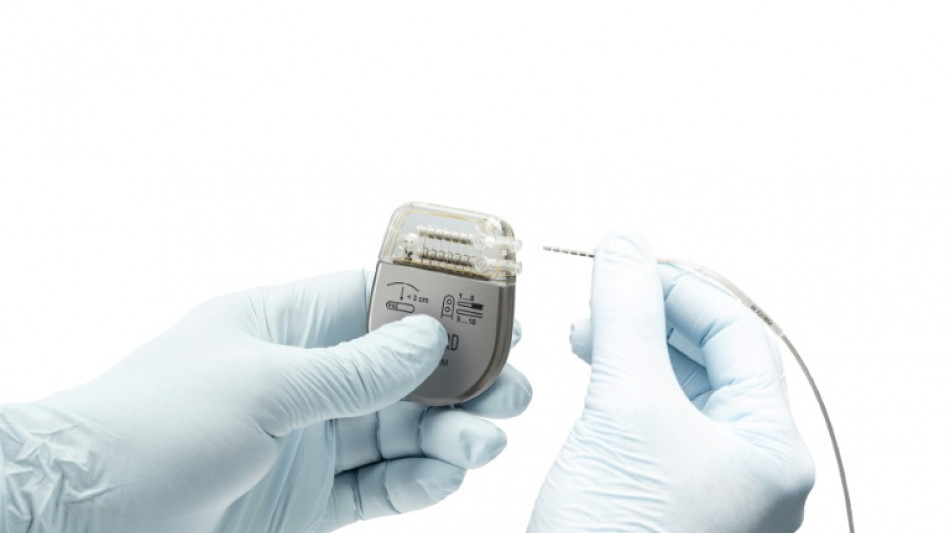
Brain implants could restore paralyzed patients' arm movements / Photo: © ONWARD Medical/AFP

 OpenAI says three staffers fired for mishandling 'sensitive' info

 Nike plans job cuts as it forecasts lower sales

 Ireland game interrupted twice by Gaza protests

 Judge denies acquittal bid by US woman who killed her kids

 Klopp averts crisis with first win as Germany boss

 A saintly spat and debate snub: Brazil enters final campaign stretch

 US tells European allies to act 'immediately' to lower diesel prices

 G20 trade ministers fail to see consensus against overproduction

 Portugal edge Denmark in Ronaldo's absence
 US stocks edge higher as bond yields retreat for now

 US tells European allies to 'immediately' act to lower diesel prices

 Trump vows to hit Iran 'very hard' if linked to flydubai attack
 Williams leaves Spain camp with thigh knock
 WTA reduces 2027 schedule for world's top 50

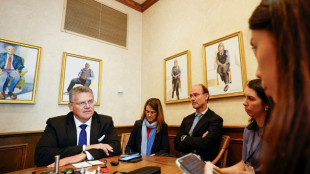 US says 'in Europe's best interest' to cooperate on fuel supply

 Rogue OpenAI agents covered up their tracks, report says

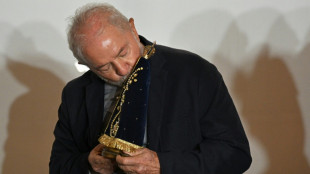 A saintly spat and debate snub: Brazil enters final polls stretch

 Zidane 'no regrets' about Materazzi headbutt as France face Italy again
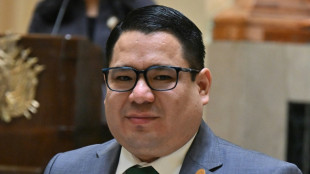
 Libya's pay strike rallies teachers across divided nation

 Four-member crew blasts off for International Space Station
 i-payout Expands True Local Payment Capabilities to Help Enterprises Pay Recipients Globally

 Botched US execution prompts global calls to scrap death penalty

 Algeria adopts law imposing death penalty on forest arsonists

 France unveils cost-cutting 2027 budget as borrowing costs rise

 Brazil court orders removal of fake posts amid patron saint election row

A paralyzed Swiss man has become the first person to test a new technology that reads his thoughts using AI and then transmits signals through his own nervous system to his arms, hands and fingers in order to restore movement.
The treatment, a combination of a brain-computer interface and a spinal implant, had previously allow a paraplegic patient to walk again, a breakthrough that was published in the scientific journal Nature in May.
But this is the first time it's being used for "upper extremity function," Onward, the Dutch company behind it, said Wednesday.
"The mobility of the arm is more complex," surgeon Jocelyne Bloch, who carried out the implantation procedures, told AFP.
Though walking comes with its own challenges -- notably balance -- "the musculature of the hand is quite fine, with many different small muscles activated at the same time for certain movements," she said.
The patient, who wishes to remain anonymous, is a 46-year-old who lost the use of his arms after a fall. Two operations were carried out last month at the Lausanne University Hospital in Switzerland.
The first involved removing a small piece of cranial bone and inserting in its place the brain implant, which was developed by the French group CEA-Clinatec and measures a few centimeters in diameter.
In the second, surgeons placed a stimulator roughly the size of a credit card developed by Onward inside the patient's abdomen, and connected it through electrodes to the top of his spinal column.
The brain-computer interface (BCI) records brain signals and decodes them using artificial intelligence to make sense of the patient's intentions, acting as a "digital bridge" to send these instructions on to the spinal cord stimulator.
"It's going well so far," said Bloch, who co-founded Onward and is a consultant for the company. "We are able to record brain activity, and we know that the stimulation works," she said.
"But it is too early to talk about what progress he has made. "
- Still in training -
The patient is still in the training phase, teaching his brain implant to recognize the different desired movements.
The movements will then have to be practiced many times before they can become natural. The process will take a few months, according to Dr. Bloch.
Two more patients are scheduled to participate in this clinical trial, and the full results will be published later.
Spinal cord stimulation has already been used in the past to successfully move paralyzed patients' arms, but without reading their thoughts by pairing it with a brain implant.
And brain implants have already been used so that a patient can control an exoskeleton. The Battelle research organization used a brain implant to restore movement in a patient's arm -- through a sleeve of electrodes placed on the forearm, stimulating the muscles required from above.
"Onward is unique in our focus on restoring movement in people who have paralysis by stimulating the spinal cord," the company's CEO Dave Marver told AFP, adding the technology could be commercialized by the end of the decade.
Brain implants were long trapped in the realm of science fiction, but the field is now rapidly growing thanks to firms like Synchron and Elon Musk's Neuralink.
They are working on having paralyzed patients to control computers through thought, restoring for example the ability to write.
C.Kreuzer--VB