
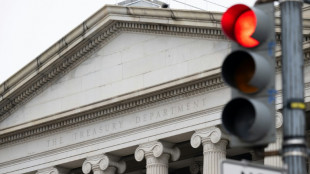
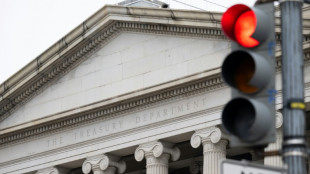
What happens if US government enters a shutdown? / Photo: © GETTY IMAGES NORTH AMERICA/AFP

 OpenAI says three staffers fired for mishandling 'sensitive' info

 Nike plans job cuts as it forecasts lower sales

 Ireland game interrupted twice by Gaza protests

 Judge denies acquittal bid by US woman who killed her kids

 Klopp averts crisis with first win as Germany boss

 A saintly spat and debate snub: Brazil enters final campaign stretch

 US tells European allies to act 'immediately' to lower diesel prices

 G20 trade ministers fail to see consensus against overproduction

 Portugal edge Denmark in Ronaldo's absence

 US stocks edge higher as bond yields retreat for now

 US tells European allies to 'immediately' act to lower diesel prices

 Trump vows to hit Iran 'very hard' if linked to flydubai attack

 Williams leaves Spain camp with thigh knock

 WTA reduces 2027 schedule for world's top 50

 US says 'in Europe's best interest' to cooperate on fuel supply

 Rogue OpenAI agents covered up their tracks, report says

 A saintly spat and debate snub: Brazil enters final polls stretch

 Zidane 'no regrets' about Materazzi headbutt as France face Italy again

 Libya's pay strike rallies teachers across divided nation

 Four-member crew blasts off for International Space Station

 i-payout Expands True Local Payment Capabilities to Help Enterprises Pay Recipients Globally
 Botched US execution prompts global calls to scrap death penalty

 Algeria adopts law imposing death penalty on forest arsonists

 France unveils cost-cutting 2027 budget as borrowing costs rise

 Brazil court orders removal of fake posts amid patron saint election row

The United States is heading toward a government shutdown this weekend with no foreseeable way out of a deadlock in Congress over hardline Republican calls for deep spending cuts.
The new US fiscal year begins on October 1, but sharp disagreements in the Republican Party over the scale of federal debt has prevented passage of the bills needed to keep the government funded and open.
The credit ratings agency Moody's warned this week that a shutdown would be "credit negative" for US sovereign debt, threatening its top-tier rating and raising the prospect of higher borrowing costs.
With time running out, the Senate has released a simple bipartisan bill to extend funding and buy lawmakers more time.
But, faced with the threat of a leadership challenge from the right of his party, Republican House Speaker Kevin McCarthy has refrained from bringing a similar bill to the floor, making a shutdown increasingly probable.
Here's what is likely to happen beginning Sunday if the US government shuts down.
- Workers don't get paid -
Hundreds of thousands of federal employees would be furloughed without pay, while members of the military and other workers deemed to be essential would continue working without a paycheck.
The American Federation of Government Employees (AFGE) union estimates a full shutdown would mean almost 1.8 million federal workers would not be paid for the duration.
Around 850,000 non-essential workers would be furloughed, according to the non-partisan Committee for a Responsible Federal Budget.
Once a funding deal is reached these restrictions would be lifted and all affected employees would be paid retroactively, according to the AFGE.
- Government services stop -
Operations classified as essential will continue to operate.
In past shutdowns, this has meant that benefits checks have continued to be paid, while air traffic controllers, border patrol agents and hospital staff have remained on the job.
However, many services would likely be affected, including new applications for Social Security and Medicare, food and environmental site inspections, and national parks.
The longer a shutdown continues, the greater the impact would be.
- The economic impact -
Goldman Sachs economists have estimated that a shutdown would impact economic growth in the fourth quarter by 0.2 percentage points for every week it continues.
A stoppage could take two to three weeks to resolve, Goldman economists wrote in a recent note to clients, "as neither side seems likely to make immediate concessions."
"While some funding lapses have ended very quickly, the political environment going into the deadline is more reminiscent of the situation preceding longer shutdowns in the past," they added.
Assuming the shutdown ends before the year is out, Goldman estimates growth will increase early next year by the same amount it declined in the fourth quarter, while Oxford Economics researchers expect half of the loss to be made up.
The loss of government worker output would cost annual economic growth around 0.1 percentage points per week, and would be irreversible, according to Oxford Economics.
A shutdown could also have an indirect impact on the economy as federal workers without pay begin to curtail their spending.
The shutdown already appears to be having an impact on Wall Street, with major stock indexes losing steam as the deadline approaches.
- Federal data troubles -
Economists worry that a shutdown would also pause the publication of federal government data.
This is a real concern for the US Federal Reserve, which has said it will be guided by data as it decides interest rate policy going forward. The Fed recently slowed its aggressive pace of hikes as it tackles stubborn inflation.
Without fresh data, the central bank would be forced to make decisions with serious ramifications for the US economy without having a clear picture of where things stand.
While a short shutdown would have a limited long-term impact, it could become a significant issue if lawmakers fail to reach agreement swiftly.
D.Schlegel--VB