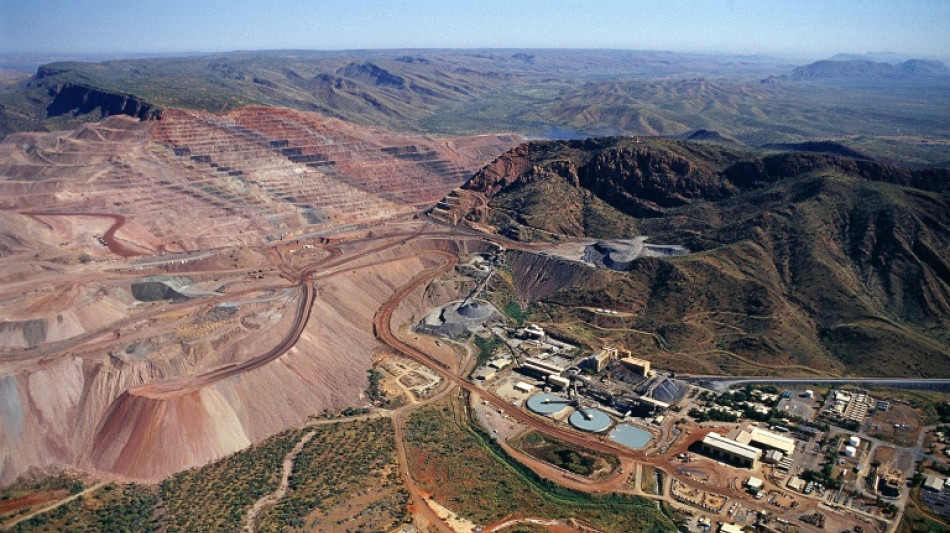
Scientists find 'missing ingredient' for pink diamonds / Photo: © NATURE PUBLISHING GROUP/AFP

 Nike plans job cuts as it forecasts lower sales

 Ireland game interrupted twice by Gaza protests

 Judge denies acquittal bid by US woman who killed her kids

 Klopp averts crisis with first win as Germany boss

 A saintly spat and debate snub: Brazil enters final campaign stretch

 US tells European allies to act 'immediately' to lower diesel prices

 G20 trade ministers fail to see consensus against overproduction

 Portugal edge Denmark in Ronaldo's absence

 US stocks edge higher as bond yields retreat for now

 US tells European allies to 'immediately' act to lower diesel prices

 Trump vows to hit Iran 'very hard' if linked to flydubai attack

 Williams leaves Spain camp with thigh knock

 WTA reduces 2027 schedule for world's top 50

 US says 'in Europe's best interest' to cooperate on fuel supply

 Rogue OpenAI agents covered up their tracks, report says

 A saintly spat and debate snub: Brazil enters final polls stretch

 Zidane 'no regrets' about Materazzi headbutt as France face Italy again

 Libya's pay strike rallies teachers across divided nation
 Four-member crew blasts off for International Space Station

 i-payout Expands True Local Payment Capabilities to Help Enterprises Pay Recipients Globally

 Botched US execution prompts global calls to scrap death penalty

 Algeria adopts law imposing death penalty on forest arsonists

 France unveils cost-cutting 2027 budget as borrowing costs rise

 Brazil court orders removal of fake posts amid patron saint election row

 Italy's firefighting planes return home after scorching summer

Scientists said on Tuesday they have found the "missing ingredient" for pink diamonds, some of the world's most expensive stones due their rarity and beauty, and the discovery could help find more.
More than 90 percent of all the pink diamonds ever found were discovered at the recently closed Argyle mine in the remote northwest of Australia.
But exactly why Argyle -- which unlike most other diamond mines does not sit in the middle of a continent but on the edge of one -- produced so many pink gems has remained a mystery.
In a new study published in the journal Nature Communications, a team of Australia-based researchers said the pink diamonds were brought to the Earth's surface by the break up of the first supercontinent around 1.3 billion years ago.
Hugo Olierook, a researcher at Curtin University in the state of Western Australia and the study's lead author, told AFP that two of the three ingredients for forming pink diamonds had already been known.
The first ingredient is carbon -- and it must be in the bowels of Earth.
Anything shallower than 150 kilometres (93 miles) deep would be graphite -- "that stuff in your pencils, not nearly as pretty on an engagement ring", Olierook said.
The second ingredient is just the right amount of pressure, to damage the otherwise clear diamonds.
"Push just a little bit and it turns pink. Push a little too hard and they turn brown," he said.
Most of the diamonds discovered at Argyle were of this less valuable brown hue, he added.
- 'Like a champagne cork' -
The missing ingredient was the volcanic event that sent the diamonds shooting up to the Earth's surface, where humans could get their hands on them.
In the 1980s it was estimated that the Argyle diamonds emerged 1.2 billion years ago.
But there was no "trigger" for the rare diamonds to rise at that time, Olierook said, so the researchers sought to establish a more accurate timeline.
They used a laser thinner than a human hair to probe tiny crystals in an Argyle rock sample supplied by the mine's owner, Anglo-Australian mining giant Rio Tinto.
By measuring the age of elements in the crystals, the researchers determined that Argyle was 1.3 billion years old -- meaning the diamonds came up 100 million years later than previously thought.
That lines up with the break-up of the world's first supercontinent, known as Nuna or Columbia.
In Nuna, "just about every single landmass on Earth was squashed together", Olierook said.
The immense pressure that twisted colour into the diamonds -- the second ingredient -- occurred during collisions between western Australia and northern Australia 1.8 billion years ago.
When Nuna started to break up five hundred million years later, it re-aggravated the "scar" from that event, Olierook said.
Magma shot up through this old scar "like a champagne cork going off", taking the diamonds along for the ride, he added.
Study co-author Luc Doucet said such a "massive explosion" -- which sent the diamonds travelling at near the speed of sound -- has not taken place in recorded human history.
- Where to look next? -
Over the last 200 years, people have mostly looked for diamonds in the centre of massive continents.
But knowing the "missing ingredient" for pink diamonds could assist future efforts to find the rare stones, Olierook said, adding that discovering more was unlikely to be easy or quick.
Old mountain belts marking Nuna's breakup near the edges of continents have the potential to be home to a new "pink diamond paradise", he said, naming Canada, Russia, southern Africa and Australia as possible locations.
John Foden, an expert on diamonds at the University of Adelaide not involved in the study, told AFP that the researchers had "convincingly shown" the age of the Argyle diamonds.
But he cautioned that other diamond-rich provinces had also been linked to Nuna's break-up -- and they had not produced pink diamonds.
This suggests that "pinkness seems to be a local Argyle attribute", he added.
The Argyle mine closed in 2020 due to "various financial reasons", Olierook said, meaning the value of pink diamonds could continue to rise as supply stalls.
P.Vogel--VB