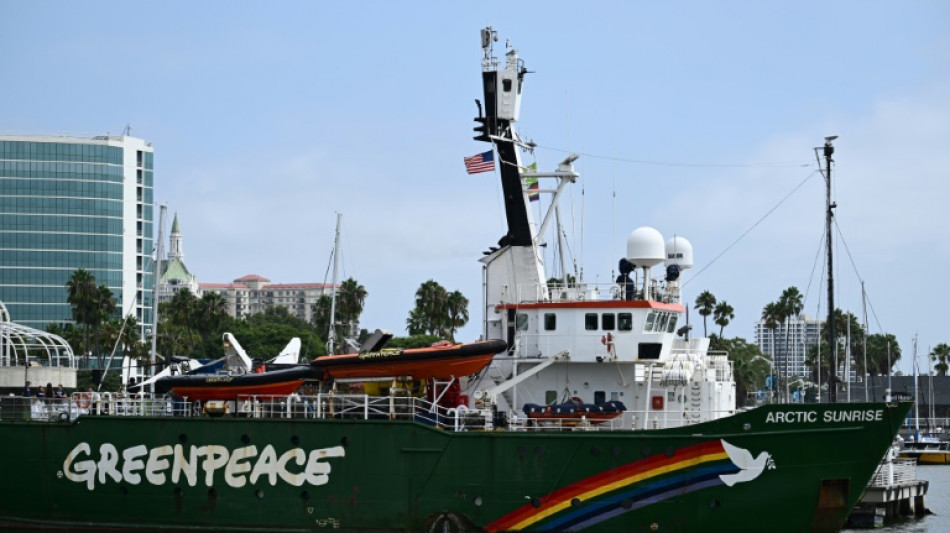
'Huge' overfishing problem shows need to ratify ocean treaty: Greenpeace / Photo: © AFP

 Spotlight on UK-UAE ties amid Manchester City scandal

 Ethiopia and Eritrea break diplomatic ties over conflict

 Downing Street says Manchester City not 'above the rules'

 Hadjar wants to 'fight for the title' from next season

 Bolivia's attorney general arrested for alleged drug trafficking, money laundering

 German sugar tax sparks new government row

 Musk returns to US government for Pentagon war study

 Stocks slide as bond yields spike

 Thousands rally as EU chief urges respect for Kosovo war crimes court

 Man City sponsor Etihad says considering legal action against Premier League

 Family of woman killed by US immigration agent sues Trump administration

 French school protests spread as fires, blockades deepen unrest

 UK tribunal overturns ban on Naomi Campbell leading charities

 Louvre launches appeal as part of new fundraising drive

 Croatian ex-international Simic charged in graft case

 76% of Treasury Teams Hit by Fraud as Deepfake Attacks Rise, Treasury Dragons & nsKnox 2026 Index Finds

 Malawi ex-army chief arrested following allegations over Sudan arms

 German fuel price cuts kick in to ease Mideast energy shock

 'It's history': Zverev against shortening Grand Slam match format

 From Question to Action: Leverate Launches ASK, Its Native AI Assistant for Traders

 UN says strikes on Afghanistan kill 10 civilians

 Two Russian drones hit major bridge in Kyiv

 Alcaraz begins Japan Open defence with win over Michelsen

 ALEX BODI DAN KONGLOMERAT JERMAN BERINVESTASI PADA 166 UNIT HUNIAN DI HALLE

 Ronaldo's Portugal future in doubt after walkout

Overfishing in international waters has surged in the past five years and demonstrates the need to ratify a recent global treaty to protect the high seas, a Greenpeace report said Wednesday.
The non-governmental network is calling on as many countries as possible to sign the treaty next week at the United Nations General Assembly in New York.
Finalized in June, the text was hailed as a "historic" accord with the potential to better safeguard the oceans.
A key element in the treaty is the creation of a legal framework to protect high seas marine areas -- beyond 230 miles (370 kilometers) from coastlines -- whose good health is vital to humanity.
But without enforcement of the accord, such protections are minimal, the report warned.
"Reality at sea is moving in the opposite direction from the ambition laid out in the Treaty," it said.
Governments must step up immediately, urged Greenpeace oceans campaigner Chris Thorne, aboard the group's ship Arctic Sunrise, which was docked Wednesday in Long Beach, California for an event marking the report's release.
To protect 30 percent of Earth's land and oceans by 2030, the target adopted last year by the COP15 convention on biological diversity, "there is no time to waste," he told AFP.
Fishing hours on the high seas increased by 8.5 percent between 2018 and 2022, according to the report, which compiles data from an organization capable of tracking boat movements via their transmitters.
Such intensification is especially pronounced in the ecologically sensitive areas identified by the UN as potential future marine sanctuaries. Greenpeace reported fishing there has increased by 22.5 percent over the same period.
"Overfishing is a huge problem," Thorne said.
"That fishing pressure is just absolutely unsustainable, and it's pushing our oceans to the brink."
Greenpeace's report notes that in the span of 30 years, stocks of Pacific bluefin tuna have collapsed by more than 90 percent.
It also draws attention to the damage caused in open seas by longline fishing, which uses cords fitted with thousands of baited hooks dozens of miles long.
The destructive method catches many sharks by mistake.
- 'Let her heal' -
Given such dire situations, using the treaty to create high seas sanctuaries is crucial, said Samantha Murray, a marine biodiversity specialist at the University of California San Diego.
"We have up to 670 percent greater biomass inside highly protected and fully protected reserves," she told reporters.
"When we sort of leave the ocean alone and let it be who she is and let her heal, we get more complex ecosystems that can be more resilient."
In order to come into force before the next UN Ocean Conference, in 2025, the treaty will need ratification from at least 60 nations. This would enable convening a conference of the parties, empowered to create the marine sanctuaries.
Scientists and non-governmental organizations have already identified a dozen priority high seas zones needing protection.
They include the Costa Rica Thermal Dome, a nutrient-rich marine biodiversity hotspot hospitable to blue whales; the Emperor seamount chain of underwater mountains near Hawaii; and the Atlantic's Sargasso Sea region.
In addition, the Salas y Gomez and Nazca ridges off Chile's coast may be among the first sanctuaries to see the light of day.
M.Betschart--VB