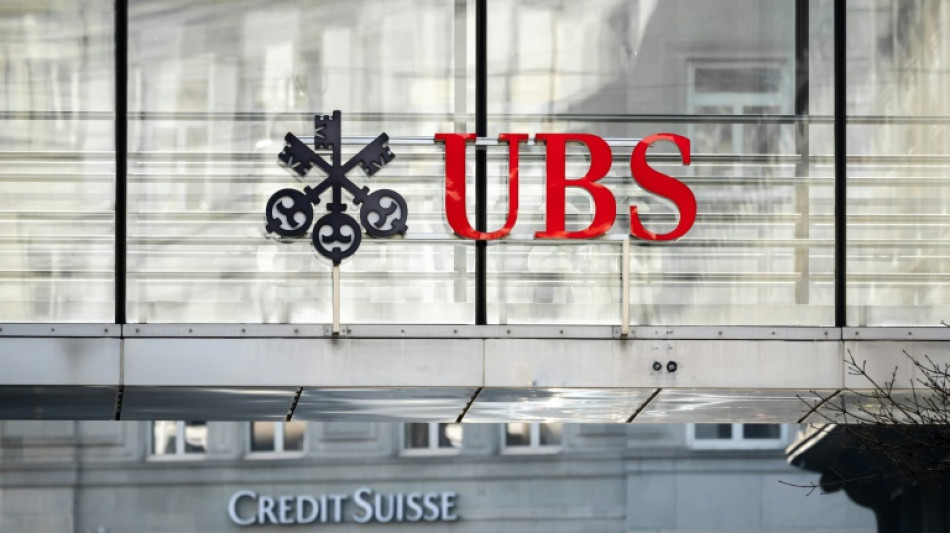
UBS's Credit Suisse takeover, 'deal of the century'? / Photo: © AFP/File

 Spotlight on UK-UAE ties amid Manchester City scandal
 Ethiopia and Eritrea break diplomatic ties over conflict

 Downing Street says Manchester City not 'above the rules'
 Hadjar wants to 'fight for the title' from next season

 Bolivia's attorney general arrested for alleged drug trafficking, money laundering

 German sugar tax sparks new government row

 Musk returns to US government for Pentagon war study

 Stocks slide as bond yields spike

 Thousands rally as EU chief urges respect for Kosovo war crimes court

 Man City sponsor Etihad says considering legal action against Premier League
 Family of woman killed by US immigration agent sues Trump administration

 French school protests spread as fires, blockades deepen unrest

 UK tribunal overturns ban on Naomi Campbell leading charities

 Louvre launches appeal as part of new fundraising drive
 Croatian ex-international Simic charged in graft case

 76% of Treasury Teams Hit by Fraud as Deepfake Attacks Rise, Treasury Dragons & nsKnox 2026 Index Finds
 Malawi ex-army chief arrested following allegations over Sudan arms
 German fuel price cuts kick in to ease Mideast energy shock

 'It's history': Zverev against shortening Grand Slam match format

 From Question to Action: Leverate Launches ASK, Its Native AI Assistant for Traders

 UN says strikes on Afghanistan kill 10 civilians
 Two Russian drones hit major bridge in Kyiv

 Alcaraz begins Japan Open defence with win over Michelsen

 ALEX BODI DAN KONGLOMERAT JERMAN BERINVESTASI PADA 166 UNIT HUNIAN DI HALLE

 Ronaldo's Portugal future in doubt after walkout

Did banking giant UBS make "the deal of the century" when it bought one of the world's biggest banks for a pittance as it teetered on the edge of the abyss?
Switzerland's largest bank was in March strong-armed by Swiss authorities into a $3.25-billion takeover of Credit Suisse, to keep its closest domestic rival from going under.
At the time, investors gasped at the risks UBS was taking on with the purchase.
But by August, the bank said it would not need the billions in support offered by the Swiss government and central bank to offset any surprises that might pop up in its stricken rival's accounts.
That must mean that Credit Suisse's situation was "much better than described in March", Thomas Aeschi, a member of parliament with the populist rightwing Swiss People's Party (SVP), wrote on X, formerly Twitter.
UBS seemed to prove him right when it unveiled its second quarter results on August 31.
The bank posted a towering net profit of $29.2 billion for the three-month period, thanks to an exceptional gain due to the gulf between the amount paid for Credit Suisse and its book value.
- 'Godsend' -
"UBS has pulled off the deal of the century," Switzerland's Socialist Party said, maintaining the "rescue" was more of a "godsend", allowing it to snatch up a bank at a dramatically reduced rate.
"If we had chosen another path, (like) a temporary or partial nationalisation," said Samuel Bendahan, a Socialist MP and economics professor at the University of Lausanne, the Swiss state "would have taken on the risk, but those $29 billion would have gone to the population".
Instead, the takeover has created "a monopolistic situation", he told AFP, warning that while this might strengthen UBS, it puts Switzerland in an extremely risky position if the new mega-bank were to one day face a crisis.
Politicians are not the only ones taking issue with the takeover.
Gisele Vlietstra, founder of the Swiss Investor Protection Association, told public broadcaster RTS that UBS's towering quarterly profit confirms that the "intrinsic value" of Credit Suisse was "far higher" than the purchase price.
She said she hoped that the lawsuits brought by her association and others on behalf of thousands of Credit Suisse shareholders will help determine "the correct value" that they should be compensated.
- 'Nickel and dime' -
"UBS paid a nickel and dime" and "got rid of its main competitor" in one fell swoop, Carlo Lombardini, a lawyer and banking law professor at Lausanne University, told AFP.
The coming restructuring will clearly carry risks, "but having paid just three billion, it can't go wrong", he said, slamming the option chosen by the Swiss authorities.
Like UBS, Credit Suisse was listed among 30 international banks deemed too big to fail because of their importance in the global banking architecture.
But the collapse of three US regional lenders in March left the firm looking like the next weakest link in the chain.
The Swiss government feared Credit Suisse would have quickly defaulted and triggered a global crisis, shredding Switzerland's reputation for sound banking.
But its chosen option for dealing with the issue was certainly a boon to UBS, which will now swell to manage $5 trillion of invested assets.
- Confidence 'evaporated' -
UBS chief Sergio Ermotti acknowledged in a recent interview with the SonntagsZeitung weekly that the bank had been "worried" about its competitor since 2016, and had among other things looked into the possibilities of buying it, for fear a foreign lender might snap it up.
He acknowledged that Credit Suisse may have survived for a time if the central bank had injected more cash, "but it would not have been enough, since confidence had evaporated".
Since the takeover announcement in March, UBS has seen its share price soar 31 percent.
But the bank still faces significant challenges, Vontobel analyst Andreas Venditti told AFP.
The $29 billion "is a huge one-off gain, but this is just accounting", he said, stressing that "the losses and costs will come later".
The analyst, who a few months ago wondered in a note whether UBS had secured "the deal of the decade or a decade of headaches", stressed that "it's going to be a huge task".
He said it would only become clear "whether it was worth it" after most of the restructuring is done three years down the line.
Parts of the business are continuing to "produce huge losses", he said, warning "many things can still go wrong".
Swissquote analyst Ipek Ozkardeskaya agreed, recalling that "UBS was forced" into the merger.
Now it is up to the bank to "transform an 'obligation' to its advantage".
B.Wyler--VB