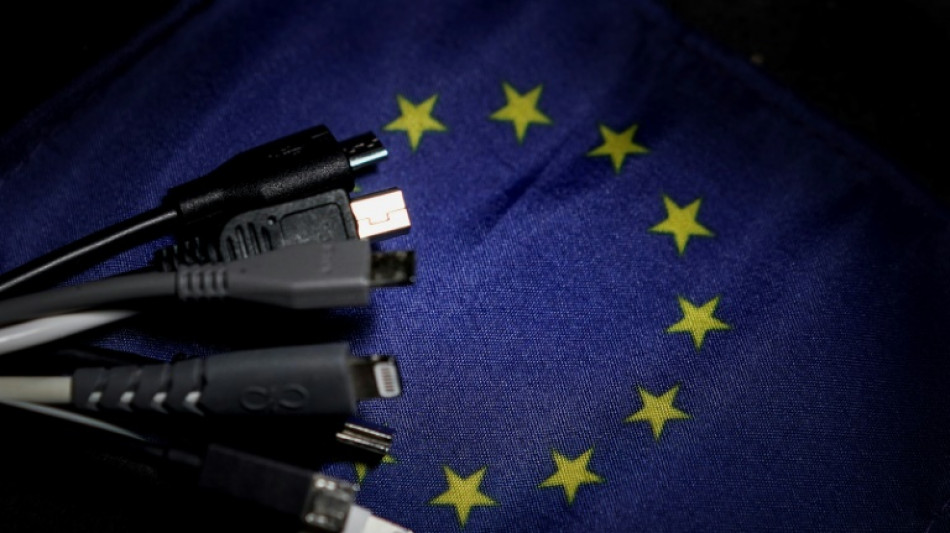
From chargers to children's data: how the EU reined in big tech / Photo: © AFP

 Spotlight on UK-UAE ties amid Manchester City scandal
 Ethiopia and Eritrea break diplomatic ties over conflict
 Downing Street says Manchester City not 'above the rules'

 Hadjar wants to 'fight for the title' from next season

 Bolivia's attorney general arrested for alleged drug trafficking, money laundering

 German sugar tax sparks new government row

 Musk returns to US government for Pentagon war study
 Stocks slide as bond yields spike

 Thousands rally as EU chief urges respect for Kosovo war crimes court

 Man City sponsor Etihad says considering legal action against Premier League
 Family of woman killed by US immigration agent sues Trump administration

 French school protests spread as fires, blockades deepen unrest

 UK tribunal overturns ban on Naomi Campbell leading charities

 Louvre launches appeal as part of new fundraising drive

 Croatian ex-international Simic charged in graft case

 76% of Treasury Teams Hit by Fraud as Deepfake Attacks Rise, Treasury Dragons & nsKnox 2026 Index Finds
 Malawi ex-army chief arrested following allegations over Sudan arms
 German fuel price cuts kick in to ease Mideast energy shock

 'It's history': Zverev against shortening Grand Slam match format

 From Question to Action: Leverate Launches ASK, Its Native AI Assistant for Traders

 UN says strikes on Afghanistan kill 10 civilians

 Two Russian drones hit major bridge in Kyiv

 Alcaraz begins Japan Open defence with win over Michelsen

 ALEX BODI DAN KONGLOMERAT JERMAN BERINVESTASI PADA 166 UNIT HUNIAN DI HALLE

 Ronaldo's Portugal future in doubt after walkout

When Apple unveils its latest iPhone on Tuesday, the European Union will have left its mark on the US giant's flagship product.
Now the iPhone 15 is expected to have a USB-C charger, instead of Apple's usual Lightning charger, after the EU ordered manufacturers to adopt a common connection.
Brussels said this would make customers' lives easier and reduce waste.
Apple vehemently opposed the 2022 law, arguing it would penalise innovation, but the EU's 27 countries form the world's largest single market and Brussels has big tech in its sights.
The common charger is not the only bruising battle against big tech the EU has won, and Brussels believes it will win on more fronts in the weeks and months to come.
Here are some of the ways the EU has forced digital titans to play by new rules in Europe and beyond:
- 'Digital rulebook' -
The groundbreaking Digital Services Act (DSA) and its sister law, the Digital Markets Act (DMA), are the biggest and most recent attempts to rein in tech companies.
The DSA demands firms crack down on harmful and illegal content online as well as assess the risks their platforms pose to society.
Any company in violation of the DSA risks a fine of up to six percent of annual global turnover.
Under the rules, 19 "very large" online platforms -- including Facebook, Instagram, TikTok, X (formerly known as Twitter) and YouTube -- had to comply with the DSA by late August.
All platforms will be forced to comply by February 2024.
The large platforms named have already made changes including a ban on targeted advertising to children as well as providing users with a non-personalised feed.
The changes are not limited to the European Union. Snapchat said it would restrict personalised advertising to minors in Britain as well.
"There's a process of gradual change in the way these platforms do things that is going to be started, but it's not going to be an overnight change," said Sally Broughton Micova of the Centre on Regulation in Europe think tank.
The DMA is another thorn in the tech firms' side, especially for Apple. The law seeks to dilute the dominance of certain players and aims to make the market fairer.
The EU named six "gatekeepers": Google's Alphabet, Amazon, Apple, Facebook owner Meta, Microsoft and ByteDance's TikTok. The rules apply from March 2024.
For Apple, it perhaps brings one of the biggest changes in its ecosystem, dominated by its App Store. The DMA will force Apple to allow third-party app stores.
"The DMA will really have an impact on how they design their structures," an EU official said.
Companies will also have to make it easier for users to send messages between apps.
But the changes come with a price. Meta's new Twitter-like platform Threads has not been rolled out in the EU yet because of the bloc's rules.
- Data protection -
The mammoth General Data Protection Regulation (GDPR) came into force in 2018 and was the EU's toughest and most famous law on tech, ensuring citizens give consent to the ways in which their data is used.
There has been a wave of fines for violations.
In May, the Irish privacy watchdog handed the biggest ever individual fine of 1.2 billion euros ($1.3 billion) to Meta over its transfers of personal data between Europe and the United States.
The GDPR's impact has also been felt beyond Europe.
"Businesses hardly looked for EU-only solutions because if you are on the global market, you offer that immediately to all so consumers elsewhere can benefit from more privacy," the EU official said.
- The future is AI -
The EU's latest tech target is artificial intelligence after the chatbot ChatGPT showcased the technology's rapid developments last year.
Brussels hopes to green light an all-encompassing law on AI by the end of 2023.
"The AI act may be the even more daring thing to do," the EU official said, adding the challenge was even bigger for the EU than the DSA or DMA.
The official also pointed to the Data Act focused on sharing industrial data, which is expected to come into force in 2025.
J.Marty--VB